

On this page
When you first learn limits, you are taught to plug the number in. If you get a normal number, great. If you get 0/0, you factor. But what if you substitute a value and get 3/0, or any other non-zero number divided by zero?
What happens to the limit when the denominator tends to zero?
According to OpenStax Calculus Volume 1, when direct substitution of x = a into a rational function yields a non-zero constant divided by zero, the values of the function increase or decrease without bound.
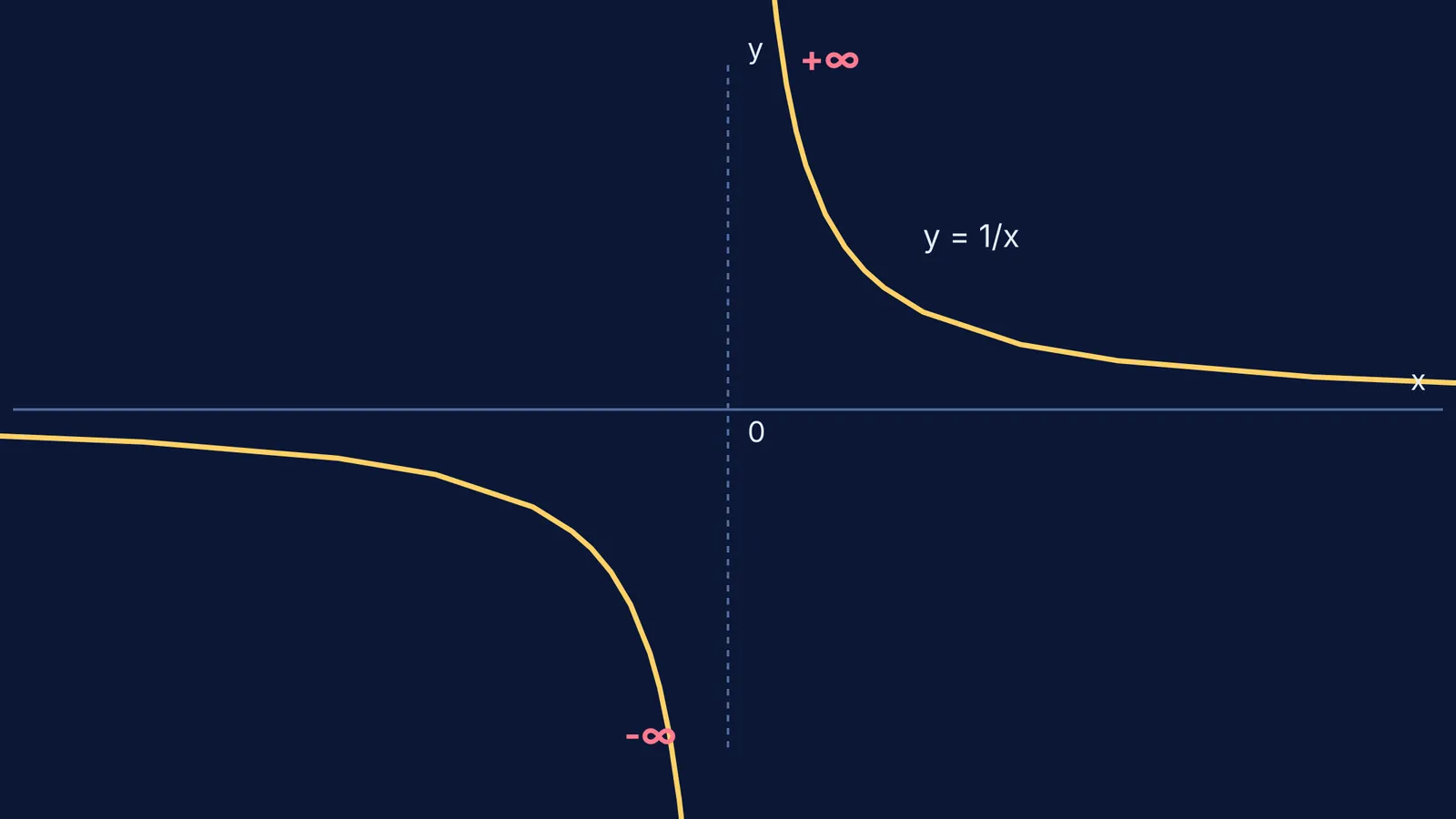
This means the limit does not exist as a finite number; instead, it is an infinite limit. On a graph, this behavior forms a vertical asymptote at x = a. As the x-values get closer and closer to a, the function will plunge downwards to -∞ or shoot upwards to +∞.
How do you find the sign of an infinite limit?
Because the function could go up or down, writing "does not exist" is often not enough. You need to check the one-sided limits by analyzing the signs on each side of the asymptote.
A practical framework for checking signs:
Factor completely: Simplify the expression to make checking signs easier.
Pick a test point: Choose a number slightly smaller than a, and slightly larger than a.
Determine the signs: Just find out if the numerator and denominator are positive (+) or negative (-) at your test points.
Combine: (+) / (+) = +∞, (-) / (+) = -∞, and so on.
Worked Example: Find the limit as x → 2 of (x + 1) / (x - 2).
Plugging in x = 2 gives 3/0. We have a vertical asymptote.
From the left (x → 2⁻): Pick x = 1.9. The numerator (1.9 + 1 = 2.9) is positive. The denominator (1.9 - 2 = -0.1) is negative. A positive divided by a negative is negative, so the left-sided limit is -∞.
From the right (x → 2⁺): Pick x = 2.1. The numerator (2.1 + 1 = 3.1) is positive. The denominator (2.1 - 2 = 0.1) is positive. The result is positive, so the right-sided limit is +∞.
Because the two sides go in opposite directions, the overall two-sided limit does not exist, but identifying the infinite one-sided limits gives you the full picture.
Is a zero in the denominator always a vertical asymptote?
No. This is a common trap in early calculus. If plugging in a gives you 0/0, that is an indeterminate form. An indeterminate form usually indicates a hole (a removable discontinuity) rather than an asymptote. You must see a non-zero number over zero to guarantee a vertical asymptote.
For instance, consider the function (x² - 4) / (x - 2). If you plug in x = 2, you get 0/0. Factoring the numerator to (x - 2)(x + 2) allows you to cancel the (x - 2) terms, leaving just x + 2. The limit as x approaches 2 is simply 4, meaning there is a hole at (2, 4).
If you are unsure whether a function has a hole or an asymptote, the Fermi Concept Library places these different types of discontinuities in its interactive map so you can trace how they relate. For deeper practice, you can look into limits at infinity of rational functions, which govern horizontal asymptotes instead.
How to avoid common mistakes on exams?
When rushing through an exam like JEE Main or CBSE Class 12, it is easy to write "limit does not exist" and move on. However, exam questions often ask for the specific one-sided limit.
Always check both the left and right sides if the question asks for the general limit.
Remember that squaring the denominator changes things. For example, the limit as x → 2 of 3 / (x - 2)² gives +∞ from both sides, because the square forces the denominator to remain positive. (This logic is very similar to how you must check cases carefully in equations and inequalities with modulus).
If you frequently mix up these rules, a step-by-step solver that explains the reasoning rather than just printing an answer can help you spot the exact line where you went wrong. The Fermi Problem Library does exactly this, guiding you through the sign-checking process so you build the right habit.


