

On this page
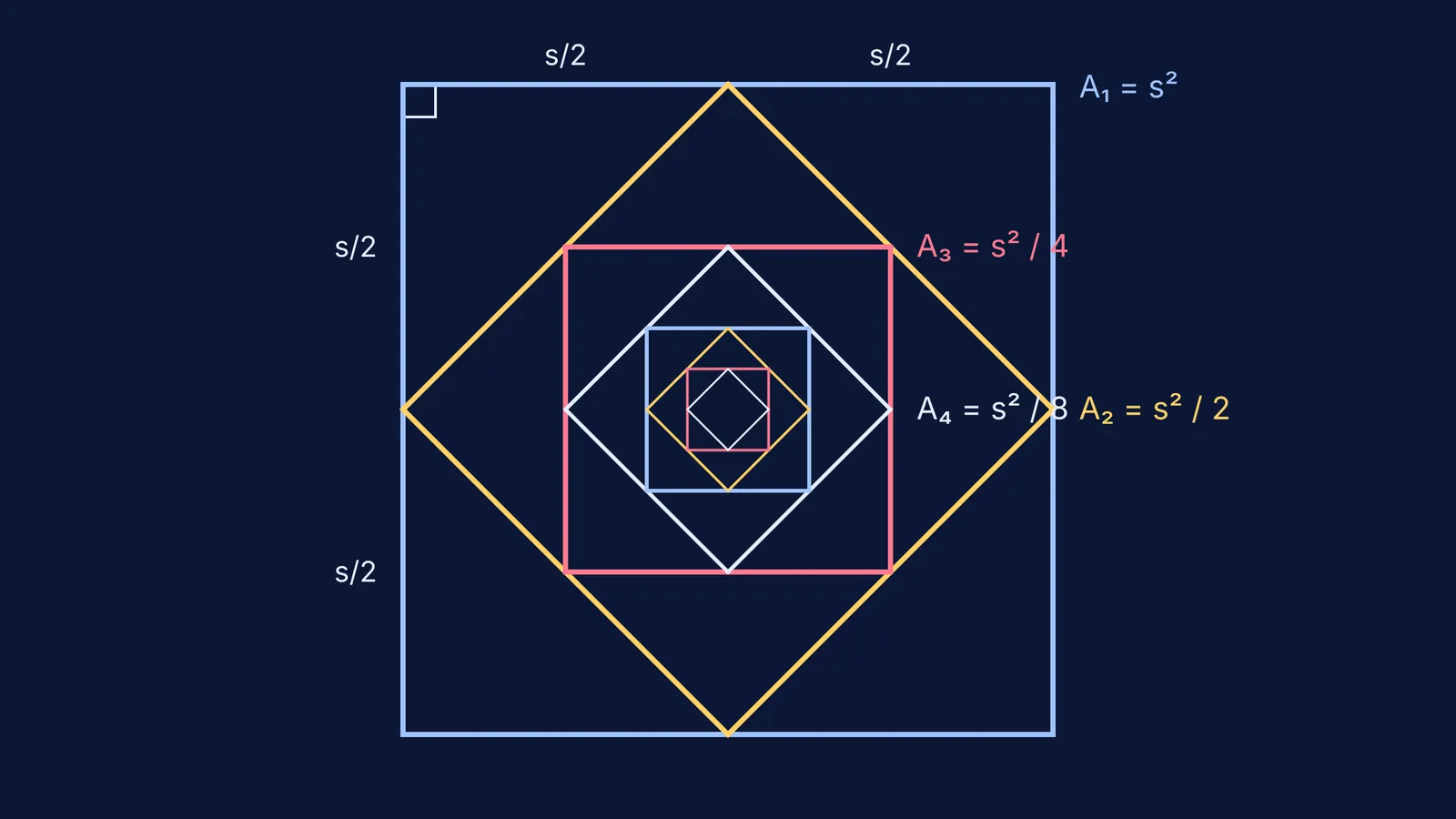
When you take a square, mark the exact middle of each side, and join those points, you get a new, smaller square tilted inside the first one. If you keep doing this forever, you create an infinite tunnel of nested squares. It looks like a fractal that shrinks away to nothing.
Because the squares get smaller infinitely, you might assume their total area adds up to infinity. But mathematically, the sum is finite.
Here is how the geometry and the algebra work together to prove it.
How do you find the side of the new inner square?
To understand how the area changes, we must first find the side length of the second square. We can do this using the Pythagorean theorem, which states that in a right-angled triangle, a² + b² = c².
Let the side of the outermost square be s. Its area is s².
When you mark the midpoints of this square, you divide each side into two equal pieces of length s/2. The corner of the original square forms a right-angled triangle with these two pieces as its base and height.
The hypotenuse of this triangle is the side of the new inner square. Let's call this new side s₂. Using the theorem:
(s/2)² + (s/2)² = s₂²
s²/4 + s²/4 = s₂²
2s²/4 = s₂²
s²/2 = s₂²
The area of the second square is exactly s₂². Therefore, the area of the second square is s² / 2. It is exactly half the area of the original square.
What is the sum of areas of squares formed by joining midpoints?
Because the geometry repeats at every step, every new square will have exactly half the area of the square that surrounds it.
If the first square has an area of A, the sequence of areas is:
First square: A
Second square: A / 2
Third square: A / 4
Fourth square: A / 8
This is an infinite geometric progression (GP). The first term (a) is A, and the common ratio (r) is 1/2. (If you only needed to add up a finite number of squares, you would use the formula for the sum of n terms of a GP).
Why does an infinite series have a finite sum?
You might wonder how adding an infinite number of positive areas does not result in infinity. The answer lies in how quickly the squares shrink.
For an infinite geometric series, if the common ratio r is between -1 and 1, the series converges to a finite number. The formula is S = a / (1 - r).
Since our ratio is 1/2:
S = A / (1 - 1/2)
S = A / (1/2)
S = 2A
No matter how large the original square is, the sum of all the infinitely nested squares inside it will always add up to exactly twice the area of the first square.
If you get stuck trying to set up geometric progressions from word problems, the Fermi Problem Library has worked problems with a step-by-step solver that explains the reasoning rather than printing an answer.
What are the real-world applications of infinite geometric series?
While an infinite tunnel of squares might seem like a purely theoretical exercise, the mathematics behind it appears in many places. The concept that an infinite sequence of shrinking terms can add up to a finite total is foundational for calculus and physics.
For instance, this same mathematical principle resolves Zeno's Paradox of the Tortoise and Achilles. In the paradox, you might think you can never reach a destination because you first have to cover half the distance, then half of the remaining distance, then half of that, infinitely. However, because each step takes half the time of the previous one, the sum of those infinite time intervals is a finite number, allowing you to actually arrive.
It also applies to the bouncing ball problem. If a ball is dropped from a height and bounces back to a fraction of its previous height, the total vertical distance it travels before coming to rest is computed using the same infinite geometric series formula S = a / (1 - r). The ratio r simply changes from 1/2 to whatever fraction the ball bounces.
Step-by-step approach for exams
If you encounter this problem in a competitive exam like JEE or a board exam, you do not need to derive the side lengths from scratch every time. You can follow a simple mental checklist:
Find the first term (a): Calculate the area of the outermost shape. If the side is 10, the first area is 100.
Determine the area ratio (r): For squares formed by joining midpoints, the area ratio is always 1/2.
Verify convergence: Ensure that your ratio is strictly between -1 and 1. Since 1/2 < 1, the series converges.
Apply the formula: Plug your values into S = a / (1 - r). For squares, this will always simplify to exactly 2a.
Worked example: an original square of 100 cm²
Let’s apply this to a real problem. Suppose you have a square sheet of paper with an area of 100 cm². You join the midpoints to draw a second square, then join the midpoints of that one to draw a third, and so on, forever.
What is the sum of the areas of all the squares drawn?
Identify the first term: a = 100
Identify the common ratio: r = 1/2 (because each square is half the area of the previous one)
Apply the sum formula: S = 100 / (1 - 1/2)
S = 100 / 0.5 = 200
The sum of all the areas is 200 cm². (If your starting dimensions are in metres but the answer requires centimetres, remember to properly convert square metres to cm² first).
Setting up the first term and the common ratio is usually the only hard part of an infinite GP problem. Once you find that the ratio is less than one, the sum will neatly fold into a finite number.


