

On this page
When you turn off a heavy motor, pull the plug on an old vacuum cleaner, or even switch off a large power supply, you will sometimes see a sharp blue flash at the switch. That flash is not a fault in your wiring; it is physics stepping in to enforce a strict rule about energy.
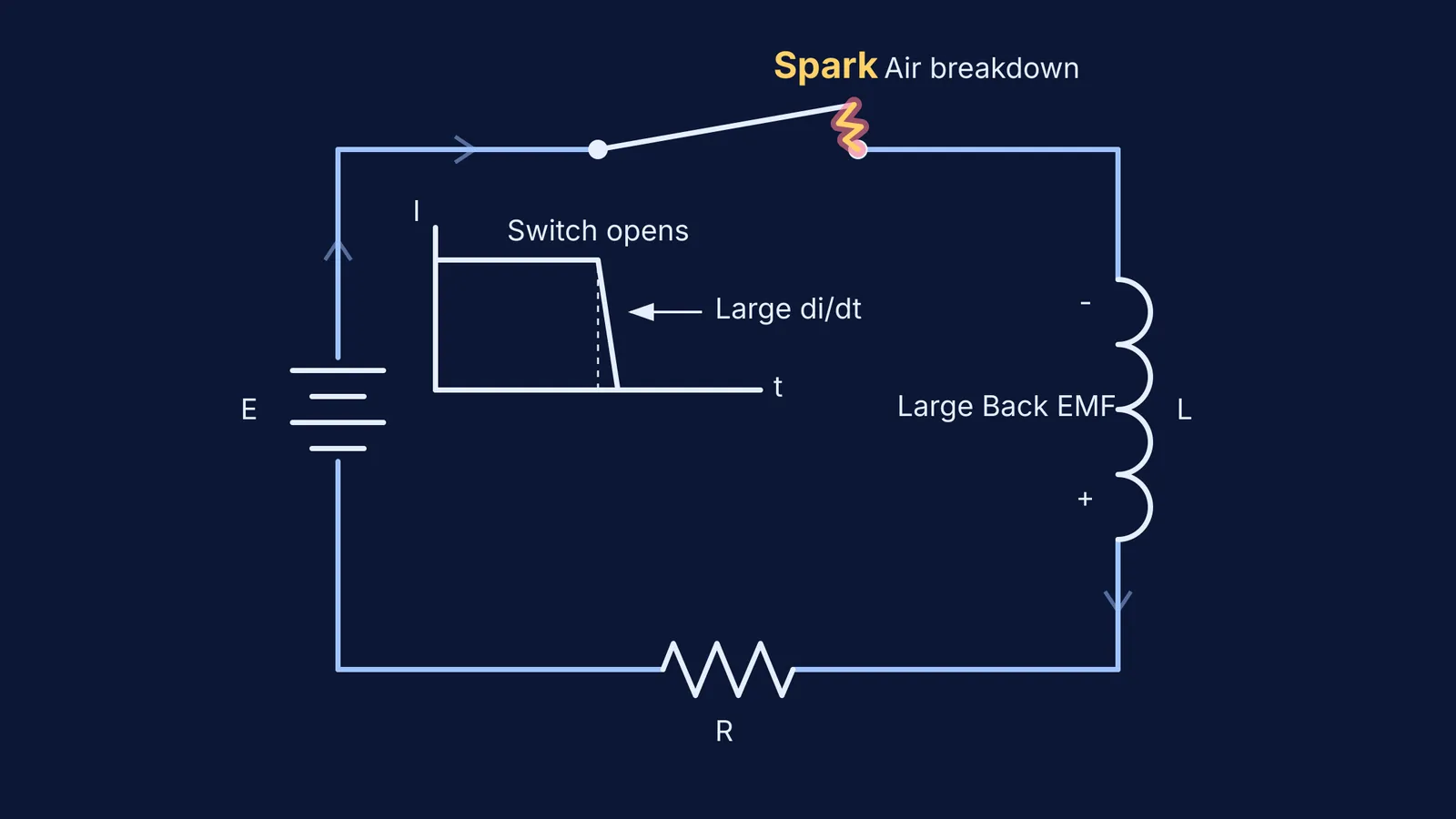
An inductor stores energy in a magnetic field, and according to Faraday's law of induction, it will fight any attempt to change the current flowing through it. If you try to stop that current instantly by opening a switch, the inductor responds by generating whatever voltage it takes to keep the current moving. Often, that means pushing electricity straight through the air.
Why does an inductor spark when a switch is opened?
To understand the spark, we have to follow the energy. When a circuit is closed, a steady current flows through the inductor's coils. This current builds a stable magnetic field around the wire, and the inductor stores energy within that field.
When you open the switch, you are forcing the current to drop to zero very quickly. As the current falls, the magnetic field it created suddenly collapses inward. This rapidly collapsing magnetic field cuts across the coils of the inductor.
By Lenz's law, a changing magnetic field induces a "back emf" (an electromotive force, or voltage) in a direction that opposes the change. Because the current is dropping, the inductor tries to push it back up. The induced voltage is given by the formula V = L(ΔI / Δt), where L is the self-inductance.
Because the time it takes to open a switch (Δt) is incredibly short, the rate of change of current (ΔI / Δt) becomes enormous. This means the induced voltage can easily reach extreme levels. For a brief moment, the passive inductor acts like a temporary, high-voltage battery determined to keep the current going, no matter what is in its path.
How much voltage does it take to spark in air?
Normally, air is an excellent insulator. However, if you apply enough voltage across it, you can rip electrons away from the air molecules. The dielectric strength of dry air is approximately 3.0 × 10⁶ V/m, or 3,000 volts per millimetre (Wikipedia).
Let us look at a worked example to see how easily an inductor can breach this limit. Suppose you have a circuit with a 0.5 H inductor carrying 2 A of steady current. You open the switch, and the current falls to zero in just 0.1 milliseconds (10⁻⁴ s).
The induced voltage is calculated as: V = L × (ΔI / Δt) = 0.5 × (2 / 10⁻⁴) = 10,000 V
Imagine the mechanical switch contacts have just separated and are currently 2 millimetres apart. A 2 mm air gap can only hold back about 6,000 V. Because the inductor is pushing with a massive 10,000 V, the air simply breaks down. The gas ionises, turning into a highly conductive plasma, and the current jumps the gap as a brilliant blue spark.
How do we protect a circuit from inductive kickback?
This high-voltage spike is known as inductive kickback, or flyback. While the spark itself is a fascinating demonstration of physics, it is usually bad news for hardware.
Every time a spark jumps across a mechanical switch, the intense heat of the plasma vaporises a tiny bit of metal off the contacts. Over time, this repeated arcing pits the switch surfaces, eventually ruining the connection. In modern electronics, the problem is even worse. Solid-state switches, like transistors, do not just pit — they fail instantly when hit by such a massive voltage.
To prevent this damage, engineers must give the collapsing magnetic field's energy a safe place to go. In DC circuits, the standard solution is a flyback diode. This diode is placed in parallel across the inductor, wired in reverse so that it blocks normal current. However, when the switch opens and the inductor generates its massive back emf, the diode suddenly becomes a forward-biased, low-resistance path. Instead of forcing a spark across the switch, the inductor harmlessly circulates its current through the diode loop until the stored magnetic energy is dissipated as heat in the wire's resistance.
When you are working through problems involving inductors at t = 0 and t = ∞ or trying to understand transient responses, it is incredibly easy to drop a sign or misplace a time constant. If you bring a tricky LR circuit question to the Fermi Problem Library, Fermi's AI tutor works out what you already know, builds a plan for the session, and teaches through it — drawing the circuit and checking your understanding as it goes. Or, if you just need to review Faraday's law from the ground up, you will find every step explained in the Fermi Concept Library.


