

On this page
A bouncing ball is a classic mechanics problem, but adding an angle changes the maths. When a ball hits a rigid wall at a glancing angle, you cannot simply subtract its initial speed from its final speed. You must split its motion into separate dimensions.
Why does only the normal component change?
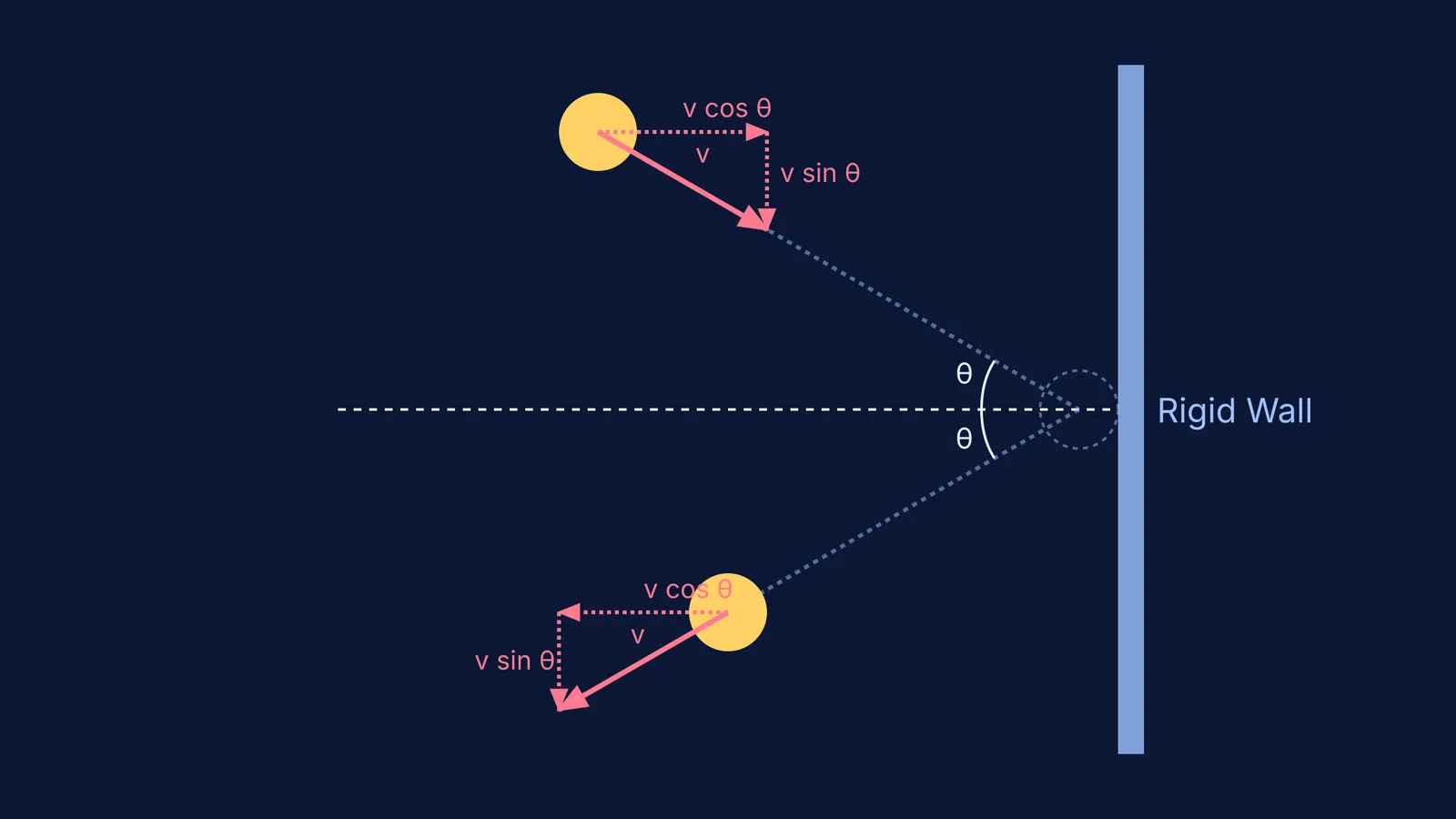
Imagine a ball of mass m travelling with speed v. It strikes a smooth, rigid wall. We measure its angle of incidence, θ, from the normal (the imaginary line drawn perpendicular to the wall).
To find the change in momentum, we must break the ball's velocity into two components: one pointing straight at the wall (v cos θ) and one sliding parallel to the wall (v sin θ).
When the ball hits, the wall can only push outward. Because the wall is perfectly smooth, it exerts no friction along its surface. With no force acting parallel to the wall, the parallel velocity (v sin θ) continues unchanged after the bounce.
However, the solid wall exerts a massive, brief force perpendicular to its surface. If the collision is perfectly elastic, this force reverses the inward velocity completely. The normal component goes from v cos θ inward, to v cos θ outward.
How do you calculate the change in momentum?
Momentum (p) is mass times velocity. To find the change in momentum (Δp), you subtract the initial momentum from the final momentum. Let us define the direction moving away from the wall as positive, and towards the wall as negative.
The initial momentum perpendicular to the wall is -mv cos θ.
The final momentum perpendicular to the wall is mv cos θ.
The change in momentum is Δp = mv cos θ - (-mv cos θ) = 2mv cos θ.
The magnitude of this change is 2mv cos θ. Because the parallel momentum does not change, this quantity is exactly the total impulse that the wall delivers to the ball.
This scenario is a fundamental test of vector resolution. Example 5.5 of the NCERT Class 11 Physics textbook illustrates this by comparing a normal impact (where θ = 0°, giving an impulse of 2mv) with a 30° impact.
Here is how the maths works for that 30° case. If the ball hits the wall at a 30° angle to the normal, the normal inward velocity is v cos 30°. The impulse delivered by the wall is 2mv cos 30°. Because the cosine of 30° is approximately 0.866, the wall delivers roughly 86.6% of the impulse it would have delivered in a head-on crash. The parallel velocity of v sin 30° remains completely unaffected, allowing the ball to slide along the wall's surface with the same parallel speed as it did before the impact.
What if the angle is measured from the wall?
Exam writers will often test whether you are reading the diagram carefully. Sometimes, the angle θ is defined not from the normal, but from the surface of the wall itself.
If θ is the angle with the wall:
The normal component becomes v sin θ.
The parallel component becomes v cos θ.
In this case, it is the v sin θ component that reverses, making the change in momentum 2mv sin θ. This is a common trap in multiple-choice questions. If the problem states the ball strikes the wall at an angle of 30° to the wall, the angle with the normal is actually 60°. If you blindly apply the 2mv cos θ formula using the 30° value, you will calculate the incorrect component. By taking a moment to draw the wall and the incoming velocity vector, you can clearly see whether sine or cosine is required.
If resolving velocity into perpendicular and parallel vectors is hard to picture, the Fermi Simulation Lab has interactive simulations for the ideas that are easier to see than to read.
How does this relate to Newton's laws?
The change in momentum is synonymous with impulse (J = Δp). Because impulse is also force multiplied by time (J = F × Δt), knowing the change in momentum allows you to find the average force exerted by the wall if you know the exact contact time.
According to Newton's second law of motion, a body's rate of change of momentum is proportional to the applied force. When the ball contacts the wall, the wall exerts a normal force over a very short time. This force generates an impulse that alters the ball's trajectory. Because the wall is smooth, it cannot exert any frictional force, meaning there is no force to change the ball's parallel momentum.
This principle connects kinematics directly to forces. You use the exact same vector resolution when solving problems about oblique elastic collisions between two moving objects, or when determining midair trajectories in collisions between projectiles. In all cases, forces only change the momentum along their exact line of action.
When working through physics homework, setting up the coordinate axes correctly is half the battle. If you keep dropping minus signs or mixing up your sine and cosine components, the Fermi Problem Library has worked problems with a step-by-step solver that explains the reasoning rather than printing an answer.


