

On this page
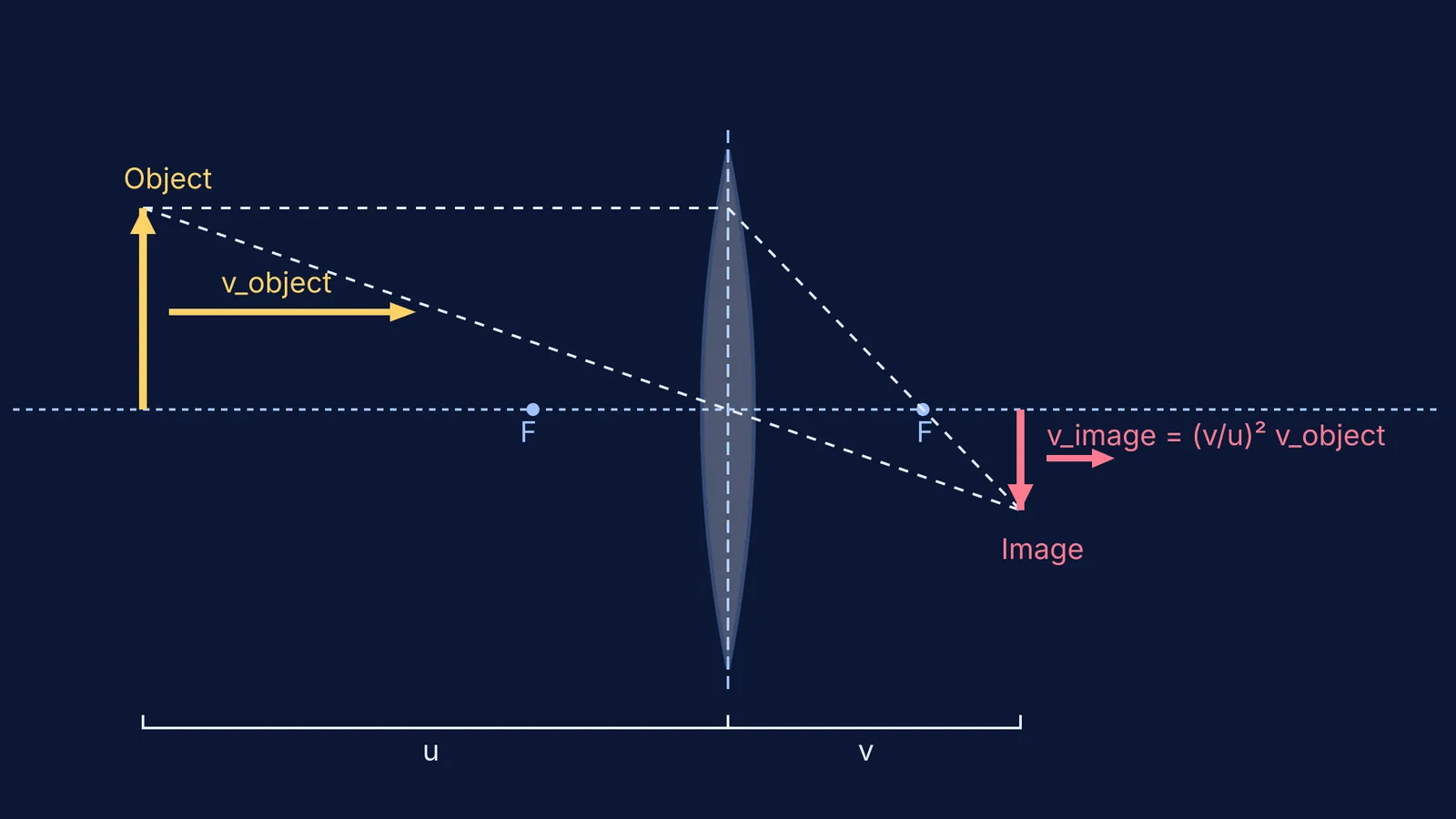
When an object moves towards or away from a thin lens, its image also moves. While the thin lens formula tells you exactly where the image is at any static moment, you need calculus to find out how fast it is going in real time.
Understanding this relationship is crucial for kinematics and optics combination problems in exams like the JEE, and it explains how tracking systems in cameras must adjust focus continuously to keep a moving subject sharp. By taking the derivative of the lens equation, you can find a direct, elegant relationship between the object's velocity and the image's velocity.
How to find the velocity of an image?
We start with the standard thin lens formula, which connects the positions of the object and the image:
1/v - 1/u = 1/f
Here, v is the image distance, u is the object distance, and f is the focal length of the lens.
When the object moves along the principal axis, its distance u changes with time t. This forces the image distance v to change as well. To find the velocities, we must differentiate the entire equation with respect to time:
d/dt (1/v) - d/dt (1/u) = d/dt (1/f)
Since the focal length of a solid glass lens cannot change on its own, f is a constant, making its derivative zero. To differentiate the left side, we apply the chain rule. The derivative of 1/v with respect to time is (−1/v²) (dv/dt), and similarly for u:
(−1/v²) (dv/dt) - (−1/u²) (du/dt) = 0
The rate of change of the image distance (dv/dt) is the image velocity, v_image. The rate of change of the object distance (du/dt) is the object velocity, v_object. Substituting these in and rearranging the terms across the equals sign, we get:
1/v² v_image = 1/u² v_object
Multiplying both sides by v² gives the final formula:
v_image = (v/u)² v_object
Because linear magnification m is defined as v/u, you will frequently see this written as v_image = m² v_object.
If you get tangled up applying the chain rule or differentiating equations with respect to time, Fermi's AI tutor can hold a line of reasoning across a session and check your understanding step by step as you go.
Why do they move in the same direction?
The formula v_image = (v/u)² v_object tells us something absolute about the direction of motion. Because any real number squared is positive, the scaling factor (v/u)² must always be a positive number.
This mathematical fact means that v_image and v_object always share the exact same sign. If the object moves in the positive x-direction (for example, to the right), the image must also move in the positive x-direction. For a convex lens, if you push a real object towards the lens from the left, the real image retreats away from the other side, continuing to the right.
If you make a mistake with signs in these problems, it usually comes from plugging in the wrong initial values for u or v before you even calculate the velocity. Reading Ray optics sign conventions: mirror and lens formula mistakes will help you pin down the coordinates safely.
Worked example: A moving object near a convex lens
Let's put the derived formula to work. Suppose an object is placed 30 cm in front of a convex lens that has a focal length of 10 cm. The object is moving towards the lens at a steady speed of 2 m/s. How fast is the image moving, and in which direction?
Step 1: Find the initial image position (v) Using Cartesian sign conventions, the object is on the left, so u = −30 cm. The convex lens has a positive focal length, f = +10 cm.
1/v - 1/(−30) = 1/10
1/v + 1/30 = 1/10
1/v = 1/10 - 1/30 = 2/30
v = +15 cm.
Step 2: Calculate the image velocity We now know u = −30 and v = +15. The object moves towards the lens, which is to the right (the positive x-direction), so v_object = +2 m/s.
v_image = (v/u)² v_object
v_image = (15 / −30)² × 2
v_image = (−1/2)² × 2
v_image = (1/4) × 2 = +0.5 m/s.
The positive sign in the final answer means the image is also moving to the right. As the object approaches the lens at 2 m/s, the image moves away from the other side at a slower speed of 0.5 m/s.
If you want to practice similar configurations, the Fermi Problem Library has worked optics problems with a step-by-step solver that explains the reasoning for setups exactly like this one rather than just printing an answer.
What if the object moves perpendicularly?
The derivation above only applies to longitudinal motion—movement strictly along the principal axis. If the object moves vertically (perpendicular to the axis), its distance u stays momentarily constant, but its height changes.
In that case, you differentiate the height magnification formula, h_image = m × h_object. Assuming u and v are constant for that instant, the perpendicular velocity of the image becomes m times the perpendicular velocity of the object. Since m can be negative (which happens for inverted, real images), an object moving upwards can create an image moving downwards.
To explore more about how object and image positions constrain each other along the axis, see Why a lens's object and real image are at least 4f apart.


