

On this page
The moment you put a transverse section (TS) slide under the microscope, it is easy to get lost in the sea of blue and red stained cells. Whether you are facing a spotting test in your biology practical or reviewing for your exams, the trick is not to look at everything at once. Instead, you just need a reliable step-by-step decision path.
By locating the vascular bundles—the xylem and phloem—you can quickly tell a root, stem, and leaf apart.
What is the vascular arrangement?
The first thing to check is how the xylem (water-conducting tissue) and phloem (sugar-conducting tissue) are grouped.
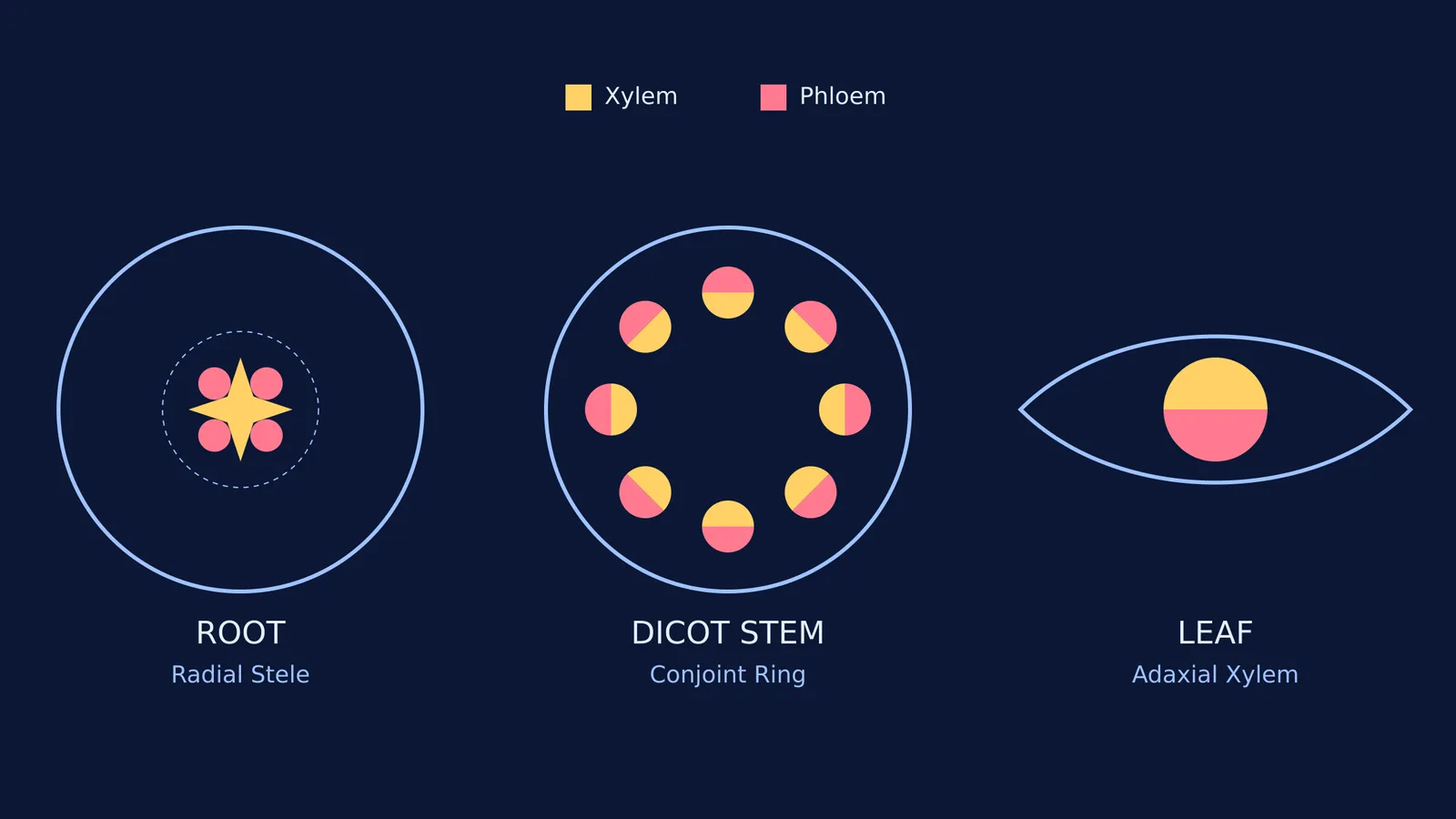
Roots have a radial arrangement. This means the xylem and phloem alternate with each other or form a central core. Stems and leaves, on the other hand, have collateral or conjoint bundles. As noted in the Wikipedia overview of vascular structures, conjoint bundles position the xylem and phloem side-by-side on the same radius.
How do you identify a root TS?
If the vascular tissue sits right in the middle of the section, you are looking at a root. Look for the central vascular cylinder, known as the stele.
According to a botanical summary of root anatomy on Wikipedia, dicot roots usually have their xylem formed in a solid star-shaped or "X" pattern right in the very centre, with the phloem tucked into the pockets between the arms. There is generally no empty space (pith) in the middle.
Monocot roots look slightly different. They lack the solid central star and instead have a large, empty-looking central pith. Surrounding this pith is a polyarch stele, which means they have many protoxylem poles alternating with phloem [[Wikipedia: Stele]](https://en.wikipedia.org/wiki/Stele_(biology)).
How do you identify a stem TS?
If you see conjoint vascular bundles, the slide is likely a stem or a leaf. Because a stem is a cylinder, its cross-section is roughly circular, but the placement of those bundles tells you what type of plant it is.
In dicot stems, the vascular bundles are arranged neatly in a distinct ring around a central pith [[Wikipedia: Plant stem]](https://en.wikipedia.org/wiki/Stem_(botany)). Between the xylem and phloem in these bundles, you will often find a layer of cambium, which allows the plant to undergo secondary growth and eventually produce wood.
In contrast, monocot stems do not bother with a tidy ring. Their vascular bundles are scattered throughout the ground tissue, often more densely packed towards the outer edges [[Wikipedia: Plant stem]](https://en.wikipedia.org/wiki/Stem_(botany)). We have previously explored Stem modifications: tendrils, thorns, rhizomes and more, but when looking at a standard TS, this scattered pattern is the definitive signature of a monocot.
How do you identify a leaf TS?
Leaves are the easiest to spot at first glance because their cross-section is flattened rather than circular, giving them a distinct upper and lower surface.
Inside a leaf's vascular bundle, the xylem is typically located on the upper (adaxial) side, while the phloem sits on the lower (abaxial) side [[Wikipedia: Vascular bundle]](https://en.wikipedia.org/wiki/Vascular_bundle). You will also see an upper and lower epidermis, often punctuated by stomata (pores for gas exchange). In dicot leaves, the tissue between these layers (the mesophyll) is clearly split into tall palisade cells at the top and loosely packed spongy cells at the bottom.
When you need to drill these visual patterns for your practical exams, the Fermi Concept Library has a lesson for every concept in biology and its place in the map, so you know exactly where to look when the timer starts. Understanding tissue placement is just as crucial here as it is when studying Meristems: apical, intercalary and lateral, and where each lies.
A step-by-step decision checklist
Next time you are at the microscope, use this mental flowchart:
Check the overall shape: Is it flat with an upper and lower surface? If yes, it is a leaf.
Check the bundle type: If it is circular, find the vascular bundles. Are they alternating in the centre (radial)? If yes, it is a root.
Check the stele (if root): Is it a solid star in the centre? Dicot root. Is there a wide pith surrounded by many xylem bundles? Monocot root.
Check the bundle placement (if stem): Are the conjoint bundles arranged in a neat ring? Dicot stem. Are they scattered everywhere? Monocot stem.


