

On this page
It is a classic textbook problem for JEE and NEET: an ice block falls from a height *h*, and all its potential energy is used to melt it. From what height must it fall to turn entirely into water?
The answer reveals more than just a passing mark on an exam; it explains why summer thunderstorms bombard us with solid hail instead of just rain.
Setting up the equation: mgh = mL
When a mass of ice *m* falls from a height *h*, it loses gravitational potential energy given by *mgh*, where *g* is the acceleration due to gravity. The problem assumes that upon impact (or through air friction), all of this kinetic energy is converted into heat that goes directly into the ice.
To melt ice at its melting point into water, you must supply energy equal to its latent heat of fusion. According to HyperPhysics, the latent heat of fusion of ice (*L*) is roughly 334,000 J/kg, and standard gravity (*g*) is 9.8 m/s². The total heat *Q* needed to melt the ice is *mL*.
By equating the available potential energy to the required heat, the mass *m* cancels out: *mgh* = *mL* *h* = *L* / *g*
If you are struggling to spot which variables cancel out in mechanics and thermodynamics problems, the Fermi Problem Library has worked problems with a step-by-step solver that explains the reasoning rather than printing an answer.
Substituting the values from HyperPhysics into our rearranged equation gives: *h* = 334,000 / 9.8 *h* ≈ 34,081 metres, or roughly 34.1 kilometres.
If we use the approximation *g* = 10 m/s², the height comes out to exactly 33.4 kilometres. Either way, the ice must fall from the stratosphere to melt completely under these idealised conditions.
Why does hail reach the ground?
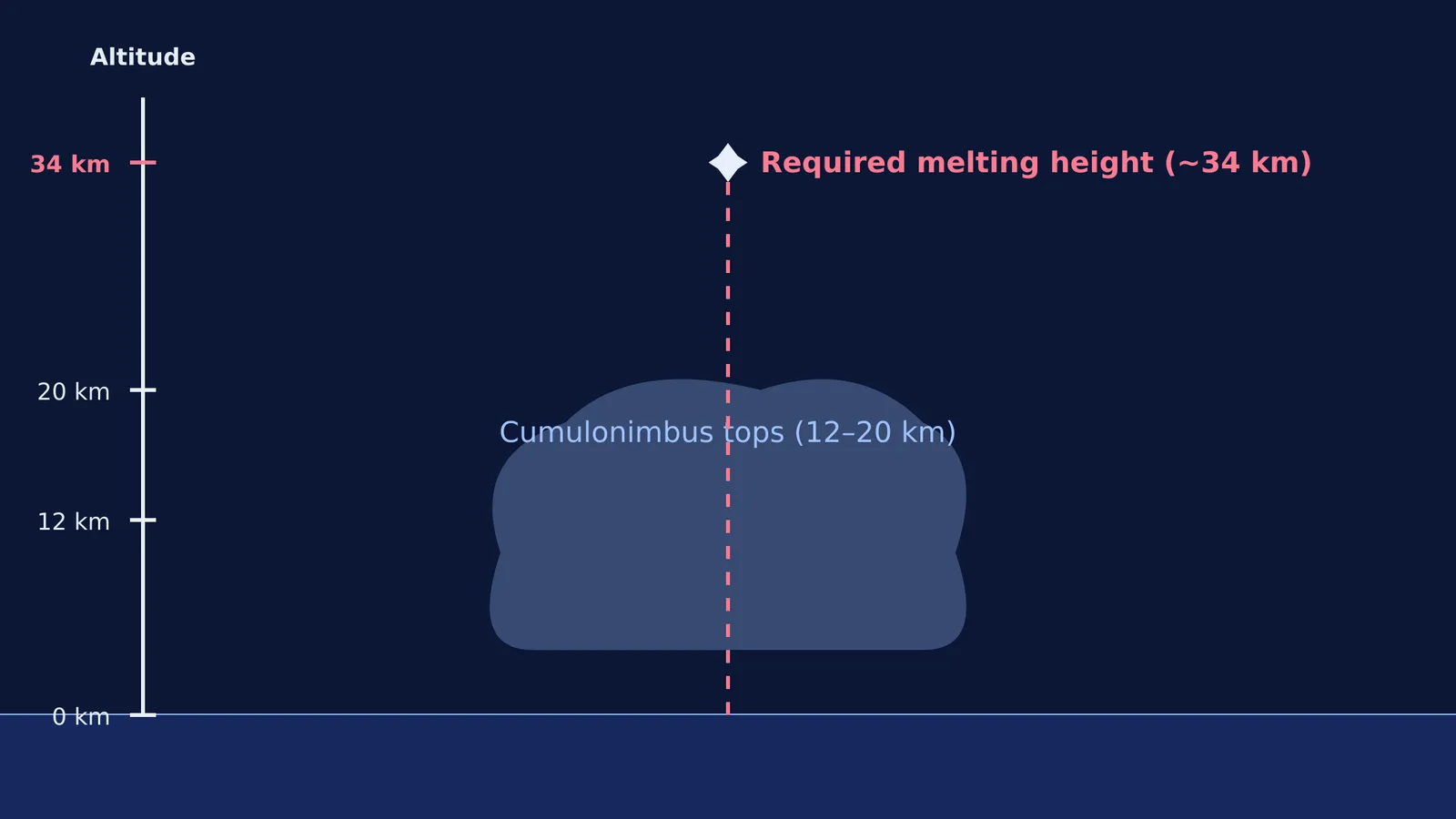
The 34-kilometre result explains a real-world weather phenomenon. Hailstones form in cumulonimbus clouds, which are characterised by massive vertical updrafts. However, according to Wikipedia data, the tops of mature cumulonimbus clouds typically reach heights of about 12 to 20 kilometres (roughly 39,000 to 66,000 feet).
Because the maximum possible drop is less than the required distance, a hailstone simply cannot lose enough potential energy to melt completely before it hits the ground.
What about terminal velocity and air resistance?
In a real storm, the physics is messier. The hailstone reaches a terminal velocity where the pull of gravity is balanced by the upward drag of air resistance. According to the National Weather Service, a typical golf-ball-sized hailstone (1.75 inches across) falls at a terminal velocity of 64 mph.
At this steady speed, the hailstone is no longer gaining kinetic energy. Instead, the work done by gravity continuously turns into heat through air friction. However, this frictional heat is largely swept away by the cold air rushing past the hailstone. Even if the stone did absorb all the frictional heat, it still falls from too low an altitude to melt completely.
A checklist for phase-change falling problems
When you face a variation of this problem in an exam—such as a lead bullet melting on impact, or ice melting only partially—follow these steps:
Identify the energies: Set the potential energy (*mgh*) or kinetic energy (½*mv*²) equal to the heat energy (*mc*Δ*T* + *mL*).
Check the initial temperature: If the object is below its melting point, you must add the energy needed to warm it up (*mc*Δ*T*) before adding the latent heat of fusion.
Note the efficiency: If the question states that only a fraction of the energy goes into the object, multiply the mechanical energy side by that fraction.
Cancel the mass: In most cases, the mass *m* appears in every term and cancels out, meaning the required height or speed is independent of the object's size.
This structured approach turns a daunting thermodynamics crossover into a routine algebra problem.


