

On this page
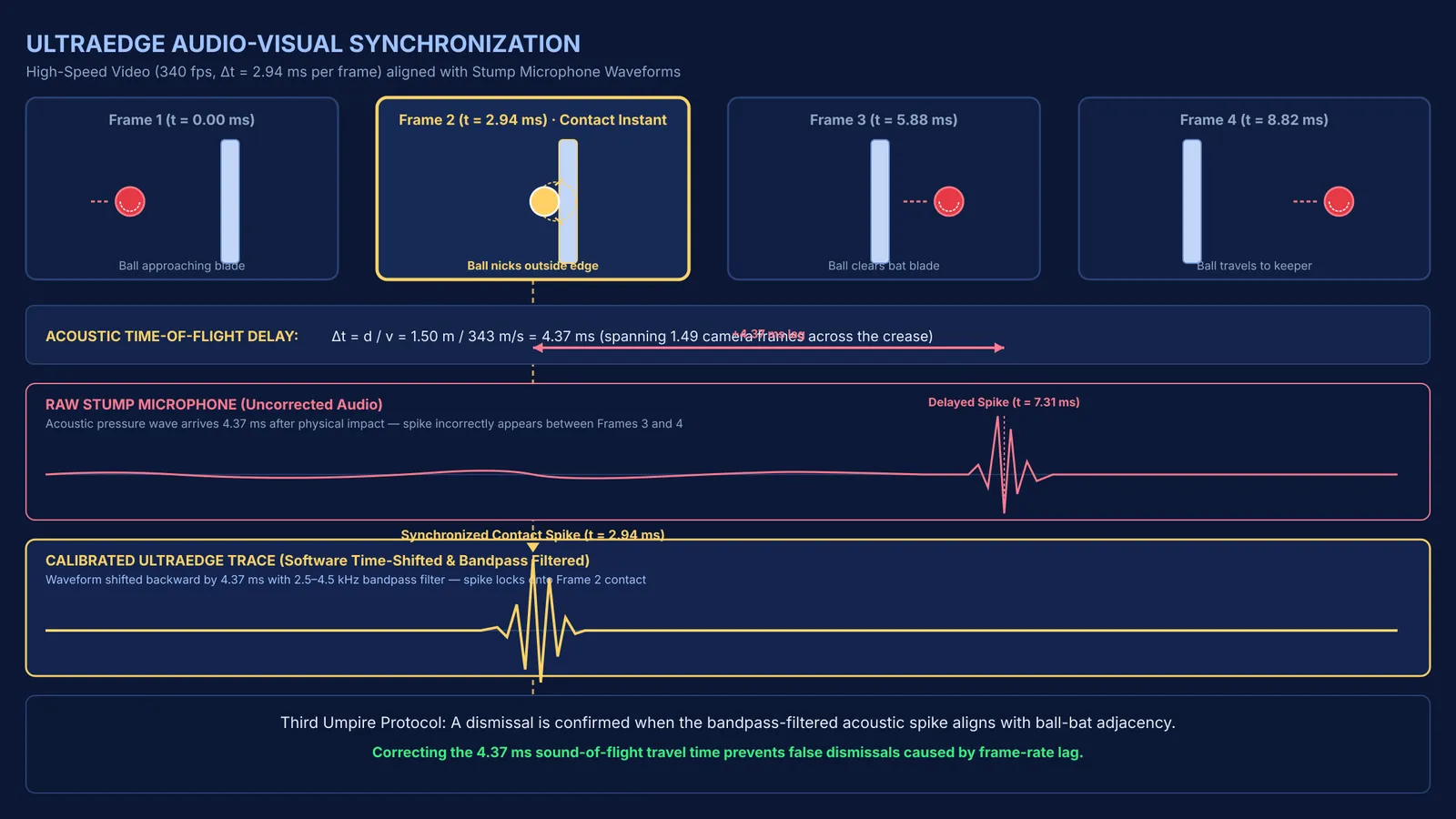
When a fast delivery flies past the outside edge of a cricket bat, the difference between a nick and clean air is often a matter of millimetres. The fielding side appeals, the on-field umpire signals not out, and the bowling captain calls for a Decision Review System (DRS) review. Within seconds, broadcast screens display synchronized footage: an ultra-motion camera tracks the ball passing the blade, while an oscilloscope trace monitors acoustic pressure. A sharp spike erupts on the waveform at the exact instant of contact.
This edge-detection technology, known as UltraEdge, translates wave mechanics into objective officiating. Governed by official ICC Playing Conditions, the system pairs high-speed video captured at up to 340 frames per second with sensitive microphones embedded inside the stumps. By connecting acoustic waves with visual frames, UltraEdge turns sound propagation into a precise measurement of time.
How does UltraEdge detect a nick in cricket?
At the heart of the system is the stump microphone, a directional condenser microphone mounted inside the middle stump. Whenever a ball collides with another surface, mechanical deformation launches a longitudinal pressure wave through the air. You can read how acoustic disturbances travel as displacement and pressure waves in sound.
The microphone diaphragm detects these micro-fluctuations in air pressure and converts them into an electrical voltage plotted over time. While frequency filtering principles evaluated in US Patent US10509138B2 isolate genuine contact vibrations from background acoustic disturbances, cricket DRS officiating guidelines recognise distinct wave signatures for different impact types:
Ball on bat: Hard wood striking leather generates an intense, high-frequency contact transient, appearing on the oscilloscope display as a sharp, narrow spike.
Ball on pad: Softer foam and fabric dampen high frequencies, producing a broader, flatter wave packet of lower intensity.
Bat on ground: Scraping the turf produces an irregular cluster of lower-frequency oscillations, which umpires separate from an edge by checking visual synchronization across consecutive frames.
Why must edge detection account for the speed of sound?
The key physical challenge in edge detection is that sound and light travel at vastly different speeds. While light from the impact reaches camera sensors almost instantaneously, sound waves travel far slower through air.
At 20 °C, the speed of sound in air is roughly 343 metres per second. Because a batter typically stands 1.2 to 2.0 metres ahead of the stumps, sound requires 3.5 to 6.0 milliseconds to reach the microphone. To maintain officiating accuracy under ICC Playing Conditions, edge-detection systems must correct for this acoustic delay.
On standard television broadcasts at 50 frames per second, each frame lasts 20 milliseconds, which can easily mask this delay. But UltraEdge uses ultra-motion cameras running at 340 frames per second, where each frame lasts only 2.94 milliseconds. A 4.4-millisecond acoustic delay spans 1.5 camera frames. Without correction, the sound spike would appear nearly two frames after the ball clears the bat. UltraEdge software shifts the audio backward by the acoustic travel time so the spike aligns with the contact frame. Across the 20.12-metre pitch, sound takes roughly 58.6 milliseconds to reach the opposite stumps—a delay that would produce an alignment error of nearly 3 frames on standard broadcast video and 20 frames at 340 frames per second, showing why edge detection relies exclusively on the striker's stump microphone.
How do engineers filter out bat scrapes and crowd noise?
Cricket stadiums are filled with roaring crowds, wind gusts, and sliding boots. To eliminate false spikes, UltraEdge relies on frequency filtering developed through research at the Massachusetts Institute of Technology (MIT) by Professor Sanjay Sarma, Dr. Jacob Pretorius, and Stephen Ho, documented in US Patent US10509138B2.
The system transforms time-domain microphone signals into the frequency domain using the Fast Fourier Transform (FFT). Solid wood-on-leather collisions concentrate acoustic energy in the 2.5 kHz to 4.5 kHz band, as described in US Patent US10509138B2. Ambient crowd rumble, wind gusts, and footwear scrapes remain below 1.0 kHz. Digital bandpass filters discard out-of-band noise, isolating the true contact transient.
Worked example: calculating the acoustic frame offset
Using the acoustic calibration procedures outlined in ICC Playing Conditions, here is how technicians calculate the time offset between high-speed video frames and the stump microphone:
A batter nicks a ball 1.70 metres from the stumps at 25 °C, where sound travels at 346 metres per second, recorded by a 340-frame-per-second camera.
Acoustic travel time: t = d / v = 1.70 m / 346 m/s ≈ 0.00491 seconds = 4.91 milliseconds.
Camera frame duration: T_frame = 1 / 340 s ≈ 0.00294 seconds = 2.94 milliseconds per frame.
Frame lag: Offset = 4.91 ms / 2.94 ms per frame ≈ 1.67 frames.
The software subtracts 4.91 milliseconds from the audio timecode, shifting the spike 1.67 frames backward so the peak matches visual impact.
Connecting wave physics to active learning
Connecting classroom wave theory to technology like UltraEdge shows how mechanical vibrations, wave speeds, and time-of-flight principles operate in practice. You can explore these relationships with wave frequency and phase simulations.
To see these principles visually, the Fermi Simulation Lab provides interactive simulations for ideas that are easier to see than to read, showing how wave pulses travel across varying distances. When preparing for physics exams, the Fermi Problem Library offers worked problems with a step-by-step solver that explains the reasoning rather than printing an answer, helping you master acoustic formulas and frame timing with confidence.


