

On this page
For decades, taking a train in India meant dealing with "drop-chute" toilets that discharged raw sewage directly onto the tracks. This archaic system corroded the steel rails, compromised the structural integrity of track fastenings, and created highly unhygienic conditions at railway stations. Traditional toilets also consumed a massive amount of water—up to 10 to 15 litres of water per flush—depleting the limited water storage on passenger coaches. Today, Indian Railways has installed over 1.25 lakh bio-digesters in its coaches to solve this problem permanently.
These bio-toilets act as miniature treatment plants on the move. They eliminate the need for manual scavenging and drastically cut down the foul odours associated with train journeys. Moreover, they save the railways hundreds of crores in track maintenance every year. But how exactly does a compact stainless steel tank, suspended under a fast-moving train, manage to break down tons of human waste without overflowing?
What is inside a bio-toilet tank?
The secret lies in a liquid bacterial consortium known as the Anaerobic Microbial Inoculum (AMI). Developed by the Defence Research and Development Organisation (DRDO), this technology was originally created to manage waste for the Indian Army stationed in high-altitude, freezing environments like the Siachen Glacier. The AMI is a carefully selected colony of cold-active bacteria that includes psychrophilic strains originally collected from Antarctica.
Because these bacteria are psychrophilic, they naturally thrive in extreme cold. However, for railway applications across India's diverse climates, DRDO scientists acclimatised them to survive in a wide range of temperatures, from freezing winters in the north to scorching summers in the tropical plains. Most importantly, they are obligate anaerobes—they live, multiply, and digest organic matter entirely without oxygen. Once the bio-digester tank is charged with AMI, the bacteria self-propagate by feeding on the incoming waste, meaning the tank rarely needs to be emptied, cleaned, or re-inoculated.
What are the four stages of anaerobic digestion?
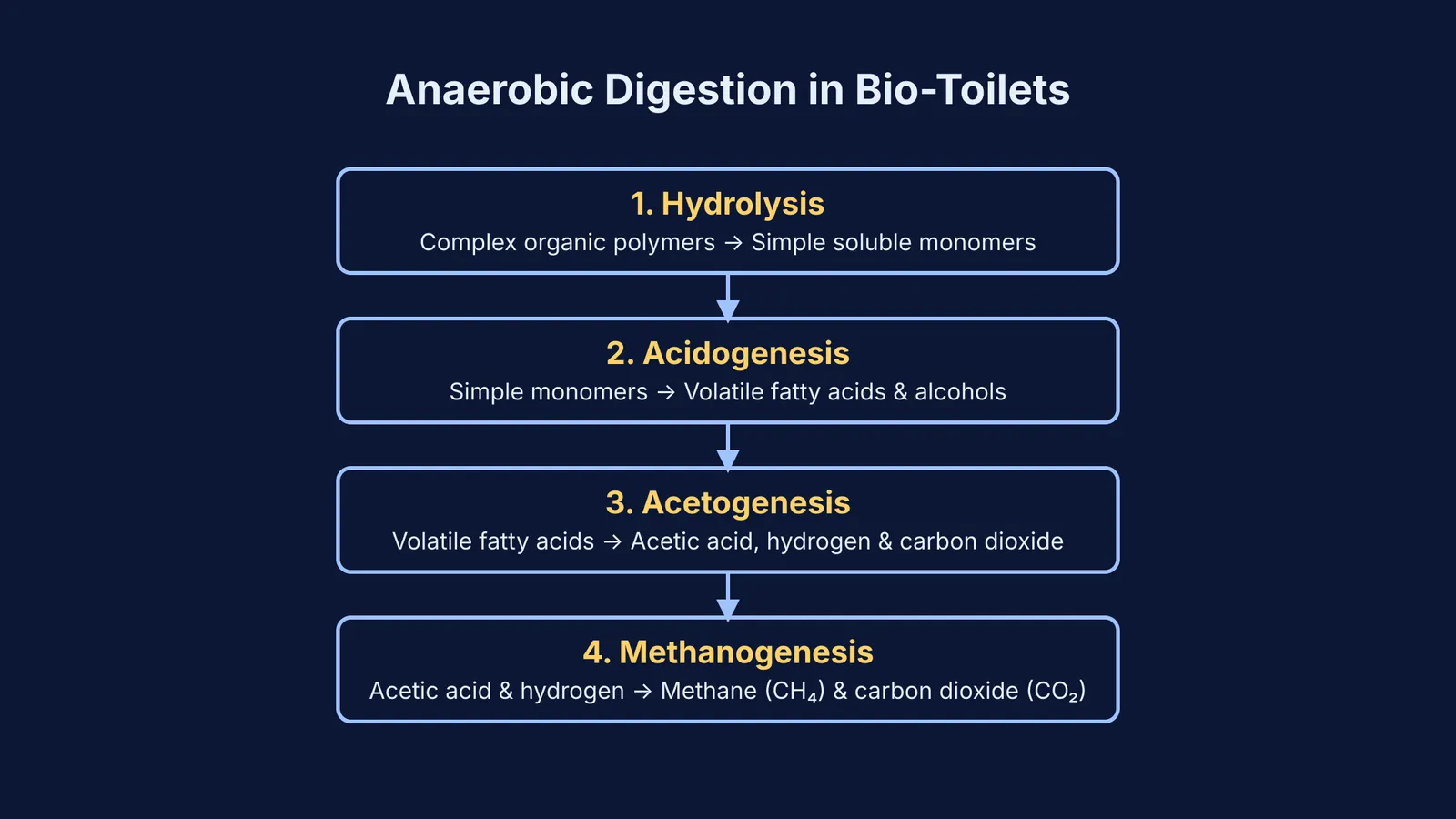
When waste enters the multi-chambered stainless steel tank, the bacteria break it down through a carefully orchestrated sequence of biochemical reactions. This process is very similar to the biological breakdown taught in Sewage treatment and BOD, but it takes place in a completely sealed, oxygen-free environment.
Hydrolysis: In the first chamber, hydrolytic enzymes split complex, insoluble organic polymers—such as proteins, fats, and carbohydrates—into simpler, soluble monomers like amino acids, fatty acids, and simple sugars.
Acidogenesis: Next, acidogenic bacteria take over, fermenting these newly formed soluble molecules into volatile fatty acids (VFAs), alongside smaller amounts of alcohols, ammonia, and hydrogen sulfide.
Acetogenesis: A third group of specialised bacteria converts these volatile fatty acids into acetic acid, hydrogen gas (H₂), and carbon dioxide (CO₂).
Methanogenesis: Finally, methanogens consume the acetate and hydrogen to produce biogas, which is primarily a mixture of methane (CH₄) and carbon dioxide (CO₂).
If a concept like anaerobic digestion is easier to see than to read, the Fermi Simulation Lab has interactive simulations that let you explore the chemistry of these reactions in real time.
What happens to the water and gas?
The efficiency of this anaerobic digestion process is remarkable; it converts up to 90% of the solid waste into liquid and gas. The resulting biogas—the methane and carbon dioxide—is simply vented out into the atmosphere through an exhaust pipe above the train roof, ensuring no flammable gases build up inside the coach.
The remaining liquid is mostly odourless, pathogen-free water. However, before it is allowed to leave the train, it passes through a final chlorination chamber to ensure that any surviving harmful microbes, such as coliform bacteria, are completely destroyed. The resulting clear, safe water is then discharged directly onto the tracks, causing no environmental harm or metallic corrosion.
Because this process relies entirely on complete biological breakdown, it produces almost no residual solid sludge. The chemistry here is a perfect real-world example of how organisms extract energy in the absence of oxygen, a concept you might recognise from how respiration acts as an amphibolic pathway.
Why do bio-vacuum toilets save even more water?
While standard gravity-based bio-toilets solve the solid waste discharge problem, they still rely on traditional flushing mechanisms, which require significant amounts of water to push waste down into the digester tank. To address this, Indian Railways is now upgrading its premium fleets—like the Vande Bharat and Rajdhani expresses—to advanced bio-vacuum toilets. Similar to the toilets used in commercial aircraft, these modern systems use a high-pressure suction pump to actively pull waste out of the bowl and into the tank.
This powerful vacuum mechanism cleans the toilet bowl far more effectively while using only 0.5 to 1.0 litre of water per flush. The suction also pulls away foul air, completely eliminating toilet odours in the passenger cabin. By combining the water-saving vacuum suction with the efficient anaerobic digestion of the DRDO bacteria, trains can carry more passengers over much longer distances without running out of water or damaging the vital tracks beneath them.


