

On this page
Turning a piece of fruit into a power source is one of the most famous science experiments you can do at home. By inserting two different metals into a lemon, you can create a working electrochemical cell. While a single lemon will not charge your phone or power your laptop, it is the perfect way to see how batteries and fuel cells work in the real world. It is also an excellent weekend activity for curious students.
How to make a battery from lemons at home?
You can build a simple cell using household items. Here is a checklist of what you need to gather:
One fresh lemon
A galvanised nail or screw (the zinc coating is essential)
A copper coin or a piece of thick copper wire
Wires with alligator clips
A digital multimeter to measure the output
A low-voltage digital clock or a light-emitting diode (LED)
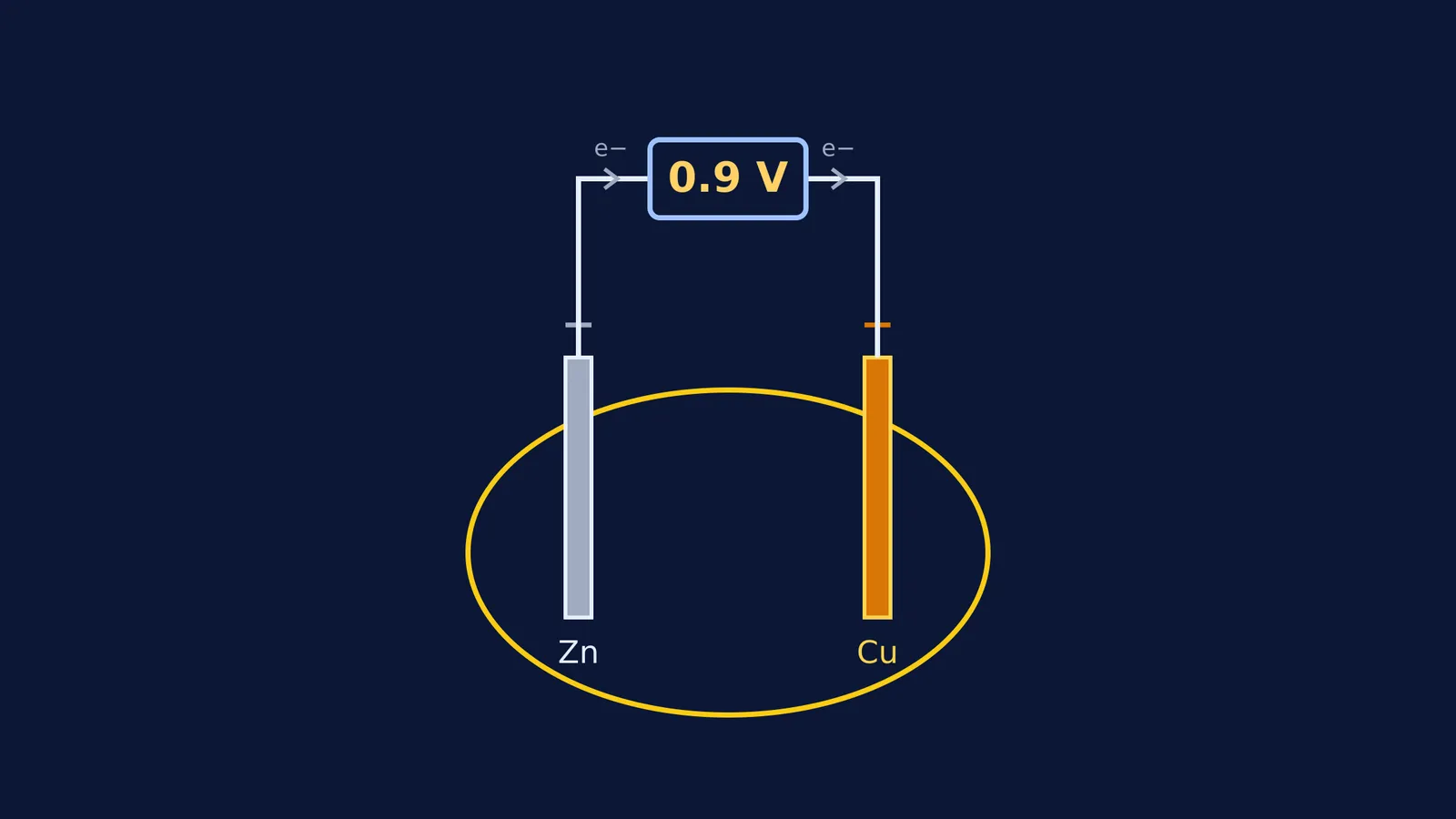
Insert the galvanised nail into one side of the lemon, and the copper coin into the other side. Make sure the two metals do not touch each other inside the fruit. If they touch, they will create a short circuit and no electricity will flow through your external wires.
Attach one wire to the zinc nail and another to the copper coin. When you connect the free ends of these wires to a multimeter, it will typically read a voltage of about 0.9 V.
What is the chemistry behind the lemon battery?
The lemon battery is a classic example of a galvanic cell. The lemon juice contains citric acid, which acts as the electrolyte—a medium that allows ions to move between the two electrodes. The two metals act as your electrodes.
At the zinc nail (the anode), an oxidation reaction occurs. Zinc metal reacts with the acid, dissolving into the juice as zinc ions (Zn²⁺) and leaving behind two electrons.
At the copper coin (the cathode), a reduction reaction takes place. Hydrogen ions (H⁺) from the acidic juice move to the copper surface, where they pick up the electrons flowing through your external wire. This forms hydrogen gas (H₂), and you might even spot tiny bubbles forming around the copper electrode.
This flow of electrons from the zinc to the copper creates a small electric current, usually around 1 milliampere (mA). Because the current is so low, a lemon battery cannot power high-energy items like incandescent light bulbs.
When you are studying these reactions for exams, Fermi's AI tutor can help. The tutor teaches rather than answers: it holds a line of reasoning across a session, notices where a student is stuck on redox concepts, and checks understanding as it goes.
Why does the choice of metal matter?
The voltage of your battery depends entirely on the metals you choose for your electrodes. In our standard setup, the difference in reactivity between zinc and copper generates 0.9 V. The zinc is more willing to give up its electrons than the copper.
If you replace the zinc nail with a more reactive metal, the voltage will change. For example, using a magnesium electrode instead of zinc can increase the voltage to about 1.6 V. The lemon itself merely provides the acid; the electrical energy comes from the chemical change in the metals.
If you want to explore these circuits further without buying different metals, the Simulation Lab provides interactive simulations for the ideas that are easier to see than to read. It lets you test how changing the electrodes alters the voltage.
How do you connect lemons in series for more voltage?
A single lemon cell produces about 0.9 V, which is not enough to power a standard LED. To light an LED, you need to combine multiple cells.
You can increase the total voltage by connecting three lemons in series. Run a wire from the copper coin of the first lemon to the zinc nail of the second. Then, connect another wire from the copper of the second lemon to the zinc of the third. The remaining zinc nail at one end and the copper coin at the other form the negative and positive terminals of your new three-cell battery.
This setup mirrors how real battery packs are made. By wiring components in series, the individual voltages of the cells add together. In this case, three cells provide a total output of nearly 2.7 V. While the current remains low, this increased voltage is finally enough to light up a small LED or run a low-power digital clock.
To learn more about the equations that govern these series setups and how they are used in real devices, read our detailed guide on cells, EMF and internal resistance.


