

On this page
In 1997, during a match against France, Brazilian footballer Roberto Carlos lined up a free kick. He struck the ball from a distance of 35 metres. The ball was recorded travelling at an estimated 137 km/h. It flew so far to the right that a ballboy ducked, expecting to be hit, before it abruptly hooked left and grazed the inside of the post to score.
It looked impossible to the millions watching on television, but it was a perfect demonstration of fluid dynamics at work. The sudden swerve was entirely dictated by the laws of physics. Here is exactly how spin, speed and air pressure combine to make a football curve around a wall.
What causes the Magnus effect?
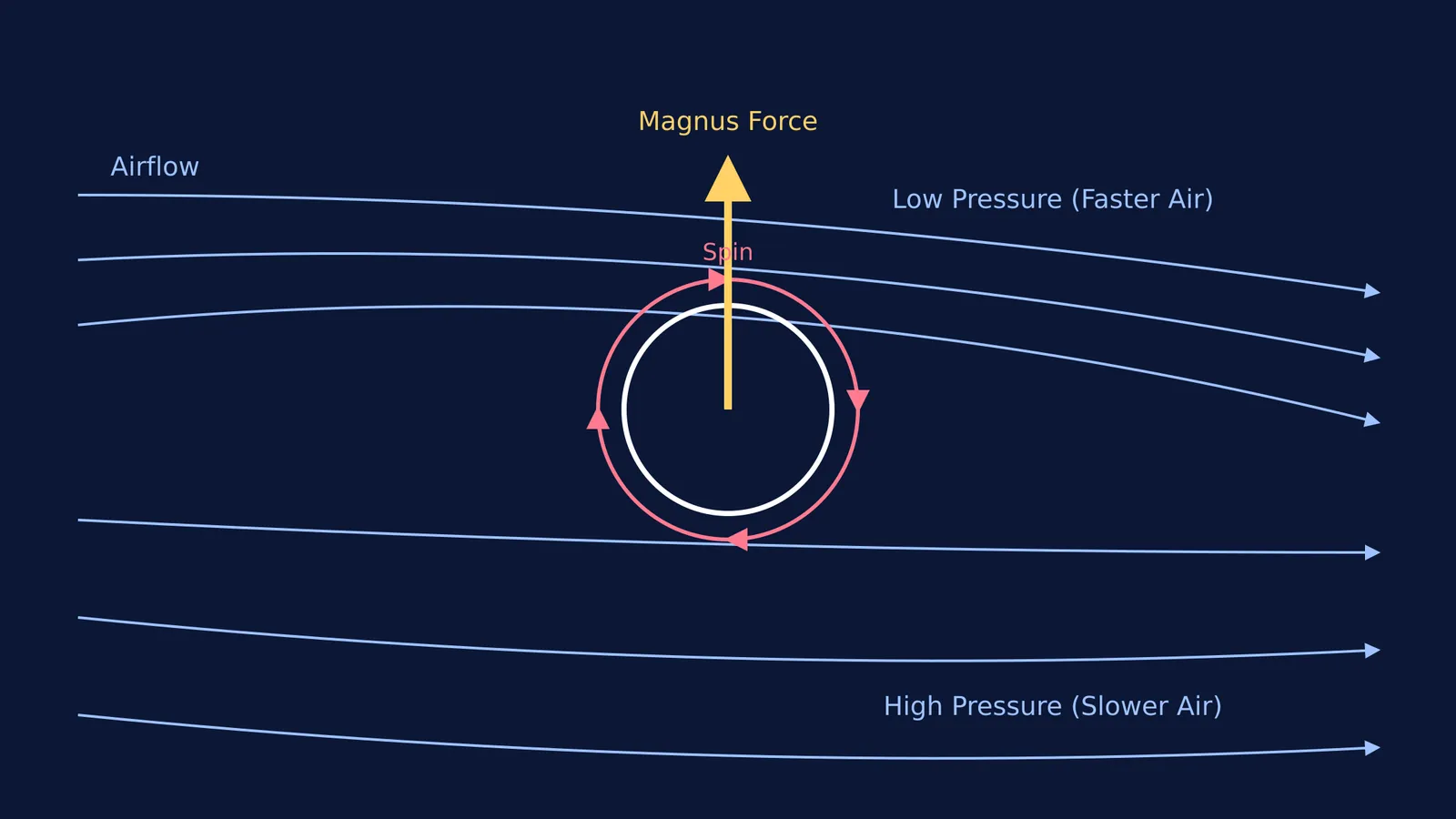
When you kick a football off-centre, you apply a torque that makes it spin rapidly as it flies through the air. As it travels forward, the ball drags a thin layer of air, known as the boundary layer, along its surface.
This spinning motion interacts with the oncoming wind. On one side of the spinning ball, the surface moves in the same direction as the oncoming air. This pulls the air along, making it travel significantly faster. According to Bernoulli's principle, an increase in the speed of a fluid occurs simultaneously with a decrease in pressure. Therefore, this faster-moving air creates a low-pressure zone.
On the opposite side, the surface spins against the oncoming wind, which slows the air down and creates a higher pressure zone. The ball is naturally pushed away from the high pressure and towards the low pressure. This sideways push is called the Magnus force, a concept detailed further in our article on Gustav Magnus and the physics of a spinning ball's curve.
Why does the curve happen so suddenly?
You might reasonably expect a curving free kick to follow a smooth, predictable circular arc. Instead, Carlos's kick travelled relatively straight for the first half of its journey before snapping hard to the left at the last moment, leaving the goalkeeper rooted to the spot.
A 2010 study in the *New Journal of Physics* found that a spinning ball actually follows a tightening spiral, rather than a perfect circle. When the ball is first kicked, it travels extremely fast. At high speeds, the air flowing around the ball is highly turbulent. This turbulence reduces aerodynamic drag and allows the forward momentum to completely dominate the Magnus force. As a result, the trajectory is nearly a straight line, much like standard projectile motion explored in the Equation of trajectory of a projectile: finding u and θ from it.
However, as air resistance gradually slows the ball's forward speed, the airflow transitions from turbulent to laminar, or smooth. The drag increases sharply, slowing the ball even more, but the ball's rotational spin remains high. This makes the Magnus force far more influential relative to the forward speed, causing the curve to tighten dramatically just as it nears the goal.
How can you bend a free kick?
The famous 1997 goal was a rare perfect storm of physical variables. To replicate it successfully, a player needs three specific ingredients to manipulate the air around the ball.
Extreme sidespin: Strike the ball heavily off-centre with the outside or inside of the foot.
High initial velocity: Kick the ball incredibly hard to guarantee the turbulent airflow needed to delay the swerve.
Substantial distance: The spiral needs physical space to tighten. If Carlos had been much closer, the ball would not have had time to slow down.
Mastering these forces on the pitch takes years of practice. If you want to picture how invisible pressure differences create real forces, the Fermi Simulation Lab has interactive simulations for the ideas that are easier to see than to read.


