

On this page
When you glance at your screen, it opens instantly. But how it achieves this depends entirely on whether it relies on a flat picture or a three-dimensional sculpture.
Is 2D facial recognition secure?
Most standard smartphones use their front-facing selfie camera for 2D facial recognition. The camera captures a standard colour image using standard RGB sensors, and software algorithms analyse facial landmarks, such as the distance between your eyes and the shape of your mouth.
Because a 2D system only sees a flat image, it lacks depth perception. It is generally considered low-security and is inherently vulnerable to presentation attacks. It can often be spoofed by a high-resolution printed photo, a digital photograph, or even a video played on another screen to bypass basic motion checks. It also struggles in low light and can fail if you are wearing glasses or a hat. Due to these limitations, the industry has largely shifted toward 3D solutions for applications requiring higher security.
How does facial recognition work on a phone?
Modern 3D systems, such as Apple's Face ID, use 3D structured light to create a mathematical model of your face. This requires a specialised sensor array built into the top of the display, rather than just a simple camera.
The system relies on infrared light, which is invisible to the human eye, meaning it works perfectly in total darkness. First, a flood illuminator bathes your face in a beam of infrared light. Then, a dot projector beams a precise, invisible pattern of over 30,000 dots onto your face Apple.
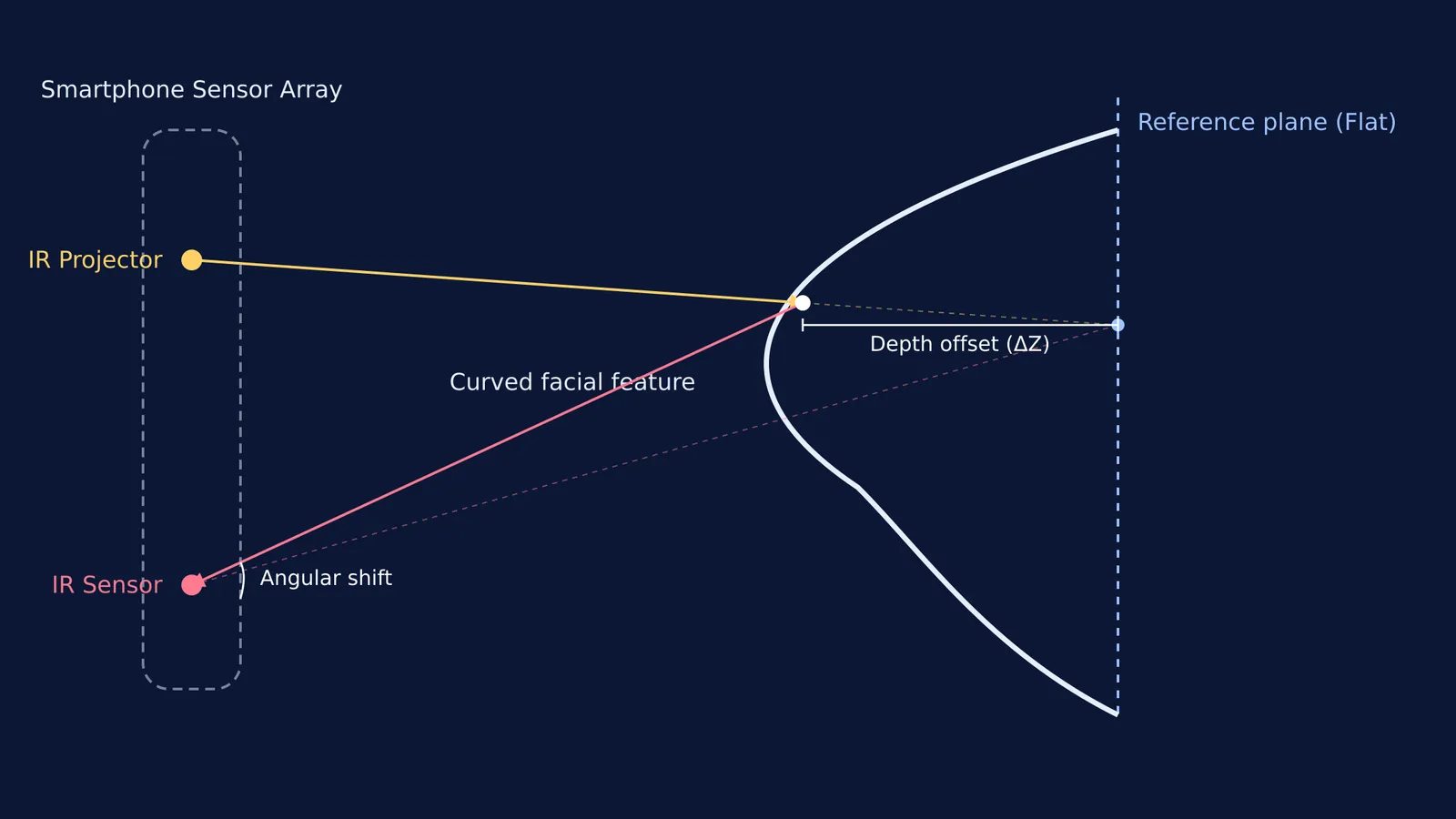
When these dots land on your curved features—like the tip of your nose or the indent of your chin—the grid pattern deforms according to your facial contours. The phone's infrared lenses and cameras read this distorted pattern. Because the system knows exactly where the dots should be on a flat surface, it uses geometric triangulation to calculate the precise distance or depth offset of every single point. This creates a high-resolution 3D depth map of your unique physical structure.
If you struggle to visualise how rays of light and geometric shifts map out depth, Fermi's AI tutor can set up a virtual optics problem for you. Rather than just printing an answer, the tutor works out what you already know and guides you step-by-step through the geometry. You can also experiment with these physical concepts directly in the Fermi Simulation Lab, adjusting light sources and angles to see how they behave.
What does the phone store?
Your phone does not store a picture of you. Instead, the 3D depth map and infrared image are sent to a secure, hardware-isolated processor on the device, often known as a secure enclave Apple.
A neural network transforms this visual geometry into a unique mathematical signature—a long string of numbers that represents your facial features. Every time you try to use the device, the system repeats the 3D mapping process, generates a new signature, and compares it against the stored one. If the numbers match within a strict threshold of mathematical probability, the device opens. This process even adapts to minor daily changes, like facial hair growth.
Troubleshooting checklist
If your phone is struggling to recognise you, check these physical factors:
Clean the sensor array: Smudges over the dot projector or infrared camera scatter the light before it reaches you, confusing the depth map.
Avoid direct sunlight: The Sun emits massive amounts of infrared radiation, which can occasionally drown out the phone's dot projector and prevent a successful scan.
Hold it at a natural distance: Structured light is calibrated for a specific focal range; holding the device too close stops the dots from spreading properly, while holding it too far away reduces accuracy.


