

On this page
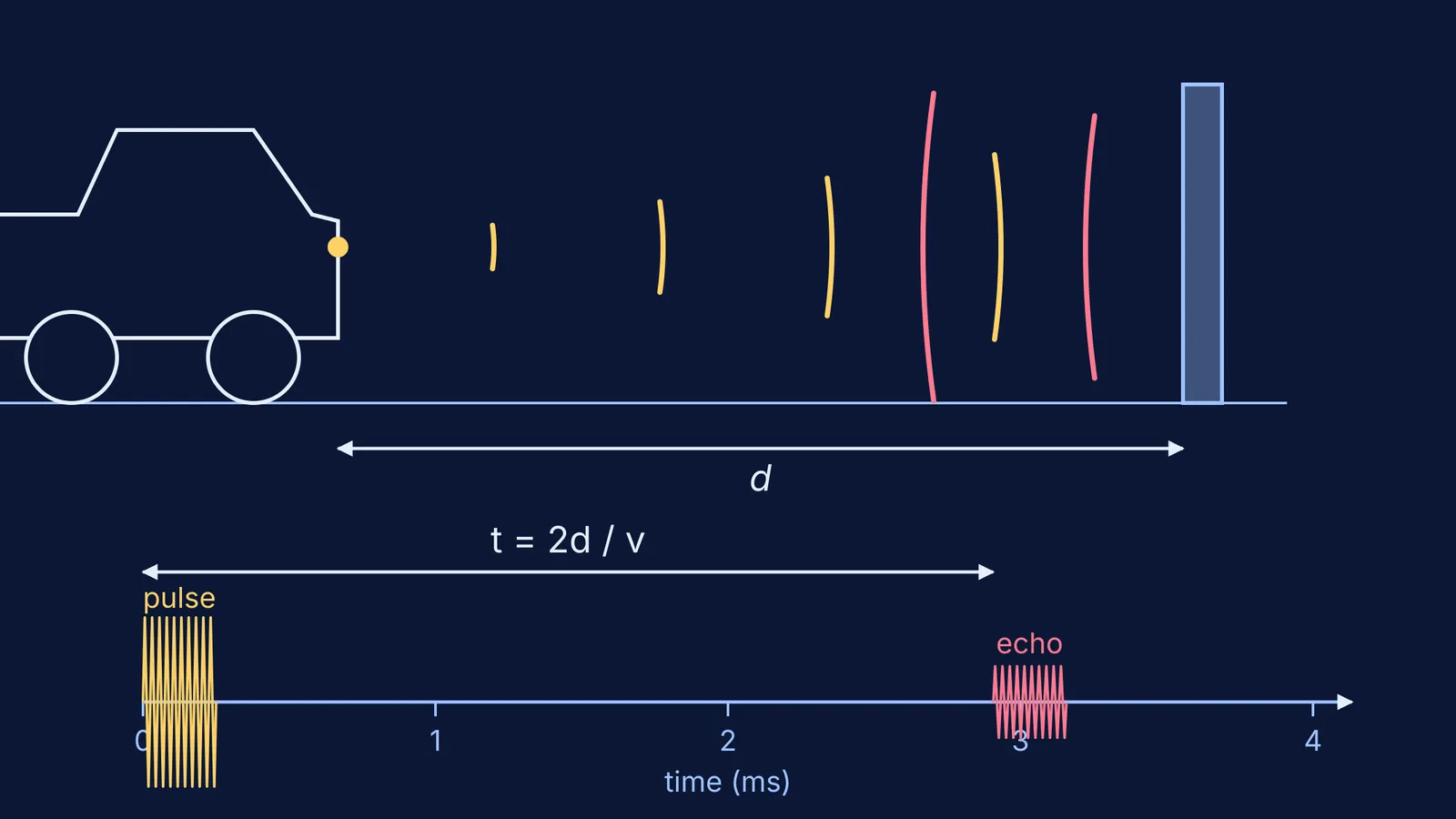
When you reverse a car and the beeping changes as the wall gets closer, you are hearing the echo method from the Class 9 sound chapter, run by a machine. The sensor makes a sound, waits for it to bounce back, and turns the waiting time into a distance.
How do car reverse parking sensors work?
The small round discs in a car's bumper are ultrasonic sensors. A Texas Instruments article on ultrasonic park assist by TI engineer Arun T. Vemuri describes up to four transducers in each of the front and rear bumpers, with the ultrasonic wave's time of flight used to calculate the distance to objects.
Each sensor is both speaker and microphone. In Pico Technology's guide to parking sensors, a piezoelectric element sends a short ultrasonic pulse, then turns any reflection back into a voltage. The time the reflection takes to arrive gives the distance.
Why do parking sensors use ultrasound and not ordinary sound?
Ultrasound is sound with frequencies above 20 kilohertz, beyond the range of human hearing (Wikipedia: Ultrasound). Pico puts the parking-sensor frequency at around 40 kHz, and the Bosch Generation 6 ultrasonic sensor factsheet lists a variable frequency between 43 kHz and 60 kHz.
That keeps the sensor silent to you and gives a short wavelength. With wavelength = speed ÷ frequency and sound at 344 m/s (HyperPhysics), a 43 kHz wave is about 8 mm long, much smaller than a pillar or a bumper. Bats hunt with the same echo trick, and Wikipedia notes they can detect frequencies beyond 100 kHz. See more examples of where infrasound and ultrasound are used.
How does the sensor turn an echo into a distance?
The sound goes to the obstacle and comes back, so it travels twice the distance d. That gives the echo formula from your textbook: 2d = v × t, or d = v × t ÷ 2. The speed of sound in air is about 344 m/s at 20 °C, according to HyperPhysics, Georgia State University's physics reference.
Worked example, using distances from the Bosch factsheet:
A wall 50 cm behind you: the round trip is 1.0 m, so t = 1.0 ÷ 344 ≈ 0.0029 s, about 2.9 ms.
Bosch's minimum measuring range of 15 cm: round trip 0.30 m, so t ≈ 0.87 ms.
The 5.5 m maximum range Bosch lists for its version 6.5 sensor: round trip 11 m, so t ≈ 32 ms.
Even the slowest returns within a few hundredths of a second, so the electronics do the timing.
Why can't a parking sensor measure things right next to the bumper?
After sending its pulse, the piezoelectric element keeps vibrating for a moment. This is called ringing, and Pico explains that the control unit pauses before listening for reflections; TI's measured traces show it too. An echo from something very close would arrive during the ringing and could be missed, which helps explain why sensors have a minimum range. The Bosch factsheet lists 15 cm as the minimum measuring range, though its sensors can still detect that an object is present at 6 cm, or 3 cm for version 6.5.
Echoes also get weaker with distance. The TI article explains that the sound pressure is inversely proportional to distance, and the air absorbs some more on the way, so a far-off object gives a faint echo that must be picked out from noise.
Does hot or cold weather change the reading?
A little. HyperPhysics gives 331.5 m/s at 0 °C, against 344 m/s at 20 °C. Suppose a sensor assumed 344 m/s on a 0 °C morning. For a wall exactly 1 m away the echo takes 2 ÷ 331.5 ≈ 6.03 ms, and the sensor would calculate 344 × 0.00603 ÷ 2 ≈ 1.04 m, about 4 cm too far. More on this in how temperature and humidity change the speed of sound.
How can you practise this with a parking sensor?
Turn the beeps into a ten-minute revision drill:
Write 2d = v × t and say out loud why the 2 is there.
Work out echo times for 15 cm, 50 cm, 1 m and 2.5 m at 344 m/s, the HyperPhysics value at 20 °C. (Answers: 0.87 ms, 2.9 ms, 5.8 ms, 14.5 ms.)
Run it backwards: if an echo returns after 4 ms, d = 344 × 0.004 ÷ 2 ≈ 0.69 m.
Redo the 1 m case at 0 °C and explain why the reading comes out too long.
Explain it to a parent in one line: the sensor claps, listens for the echo, and halves the time.
Parents: ask for that one-line version while the car is parked, not moving.
If waves bouncing off walls are hard to picture, the Fermi Simulation Lab has interactive simulations for ideas that are easier to see than to read. If your echo numericals keep coming out double, the Fermi Problem Library has worked problems with a step-by-step solver that explains the reasoning.
For the rest of the chapter, start with our guide to sound in Class 9.


