

On this page
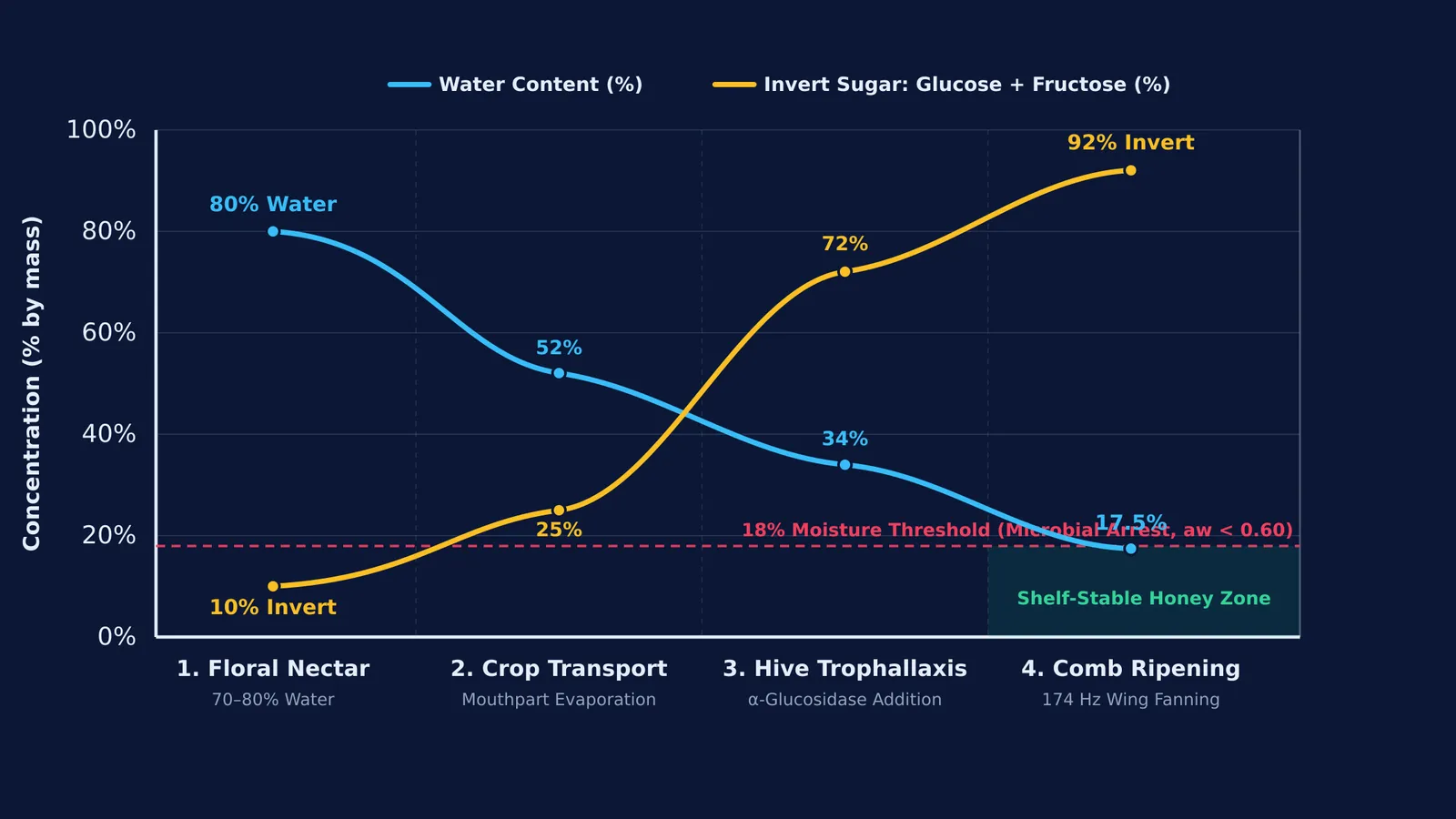
When an *Apis mellifera* worker bee lands on an open flower, she draws in an aqueous solution secreted by floral nectaries to reward visiting pollinators. This fluid is calorie-dense but perishable. Fresh nectar contains 70% to 80% water by mass, making it vulnerable to fermentation by wild yeasts and bacteria within days 10.1038/s41598-022-20626-5. To transform this dilute liquid into shelf-stable honey, honey bee colonies combine enzymatic hydrolysis with cooperative fluid mechanics.
How do bees gather floral nectar?
Angiosperms secrete nectar from specialized glandular structures called nectaries to recruit insect pollinators, an evolutionary mutualism explored in Christian Konrad Sprengel's work on floral pollination. Foragers draw nectar through their proboscis into an expandable honey stomach, or crop, where a muscular valve called the proventriculus prevents it from entering their digestive midgut during flight.
Dehydration begins before the forager even reaches the nest entrance. In a field study in *Scientific Reports*, Susan W. Nicolson and colleagues found that foraging honey bees eliminate up to 75% of initial water from crop nectar through mouthpart droplet evaporation before returning to the nest. Nicolson calculated that this pre-concentration saves colonies on average 35 times more energy in nest dehydration than the minor reduction in flight transport costs.
Which enzymes convert nectar sucrose into honey sugars?
Upon returning to the hive, the forager regurgitates her nectar load and transfers it to younger receiver bees through mouth-to-mouth transfer, or trophallaxis. During this handoff, receiver bees blend the fluid with secretions from their paired hypopharyngeal glands located in the head. In *Bioscience, Biotechnology, and Biochemistry*, Masaki Kubota and colleagues identified α-glucosidase III (EC 3.2.1.20) as the dominant invertase in worker hypopharyngeal glands that hydrolyses nectar sucrose into free D-glucose and D-fructose.
Belonging to the hydrolases among the six enzyme classes, α-glucosidase cleaves each sucrose molecule by adding a water molecule (C₁₂H₂₂O₁₁ + H₂O → C₆H₁₂O₆ + C₆H₁₂O₆), turning a non-reducing disaccharide into reducing and non-reducing sugars that give honey its high solubility and sweetness. Simultaneously, receiver bees add glucose oxidase. In *Naturwissenschaften*, Marcela Bucekova and co-authors demonstrated that honeybee glucose oxidase oxidizes free glucose into D-glucono-δ-lactone and hydrogen peroxide (H₂O₂). The lactone hydrolyses into gluconic acid, driving honey's pH down to an acidic range between 3.2 and 4.5 10.1007/s00114-014-1205-z.
Students exploring catalytic mechanisms and reaction equilibria can examine enzyme kinetics in the Fermi Concept Library, which covers every concept in physics, chemistry, biology, mathematics and computing.
How do bees evaporate water from nectar?
Enzymatic hydrolysis alters nectar's chemistry, but long-term preservation requires removing most of the remaining water. Receiver bees begin with active evaporation through droplet manipulation, often called tongue-lashing. A bee extends her proboscis, pushes out a droplet of nectar, flattens it against her mouthparts, and draws it back in. This repeated motion maximizes surface area, accelerating convective moisture transfer into hive air before the bee deposits the partially thickened syrup into open wax comb cells 10.1242/jeb.149476.
To prevent humidity from saturating the nest, worker bees initiate active ventilation. In the *Journal of Experimental Biology*, Jacob M. Peters, Nick Gravish, and Stacey A. Combes showed that fanning honey bees anchor their tarsi to the comb and use their wings as impellers. Fanning bees beat their wings at roughly 174 Hz (with high stroke amplitudes reaching 120°)—about 25% to 30% lower than their ~230 Hz flight frequency—generating directed surface air currents of nearly 1 m/s 10.1242/jeb.149476.
In a related study in the *Journal of The Royal Society Interface*, Peters, Orit Peleg, and L. Mahadevan showed that colonies self-organize into fanning clusters at hive openings, establishing separate streams of cool inflow and warm, humid exhaust. To see how fluid flow, temperature differentials, and convective boundary layers accelerate moisture loss, students can inspect interactive aerodynamic models in the Fermi Simulation Lab.
How does 100 grams of nectar turn into ripe honey?
A quantitative mass balance illustrates this water loss, using benchmarks from the *Journal of Food Engineering*:
Initial nectar: Suppose foragers collect 100 g of floral nectar containing 20% sucrose (20.0 g) and 80% water (80.0 g) 10.1016/j.jfoodeng.2004.12.009.
Chemical hydration: Hydrolysing sucrose (342.3 g/mol) consumes water (18.0 g/mol) at a 1:1 molar ratio. Hydrolysing 20.0 g of sucrose consumes (20.0 / 342.3) × 18.0 ≈ 1.05 g of water 10.1271/bbb.68.2346, yielding 21.05 g of monosaccharides and leaving 78.95 g of free water.
Target concentration: Fully ripened honey contains 18.0% water and 82.0% dissolved solids by mass 10.1016/j.jfoodeng.2004.12.009. The final honey mass is 21.05 / 0.82 ≈ 25.67 g, containing 4.62 g of water.
Water evaporated: Bees evaporate 78.95 − 4.62 = 74.33 g of water, an overall 92.9% reduction in liquid water to produce 25.67 g of honey 10.1016/j.jfoodeng.2004.12.009.
Why does finished honey never spoil?
Once moisture falls below 18%, honey becomes biologically invulnerable to ordinary decay. In the *Journal of Food Engineering*, Jorge Chirife, María Clara Zamora, and Aldo Motto demonstrated that reducing honey moisture below 18% drives its water activity (a_w) below 0.60. Water activity reflects the chemical potential of unbound water molecules available to support microbial metabolism.
Common bacteria require an a_w above 0.91 to divide, typical food moulds cease growth below 0.70, and specialized osmophilic yeasts fail to proliferate once water activity drops below 0.61 10.1016/j.jfoodeng.2004.12.009. When a bacterial cell contacts honey, the immense osmotic pressure gradient draws water across the cell membrane, inducing severe plasmolysis.
Protected by an acidic pH of 3.2 to 4.5, trace hydrogen peroxide, and a water activity below 0.60, the sealed honey in beeswax comb cells remains edible indefinitely 10.1007/s00114-014-1205-z 10.1016/j.jfoodeng.2004.12.009.
Understanding how honey bees coordinate enzyme secretion, aerodynamics, and evaporative mass transfer turns a familiar kitchen staple into a masterclass in living physical chemistry.


