

On this page
Every time you drag a pencil across a notebook, you perform a precision feat of materials science. The pencil core is not lead, but a composite of graphite and clay developed by Nicolas-Jacques Conté in 1795. Graphite consists of planar sheets of carbon atoms in a hexagonal lattice. While carbon atoms within each sheet share strong covalent bonds, adjacent parallel sheets are held together only by weak intermolecular van der Waals forces.
Why does a pencil mark stick to paper?
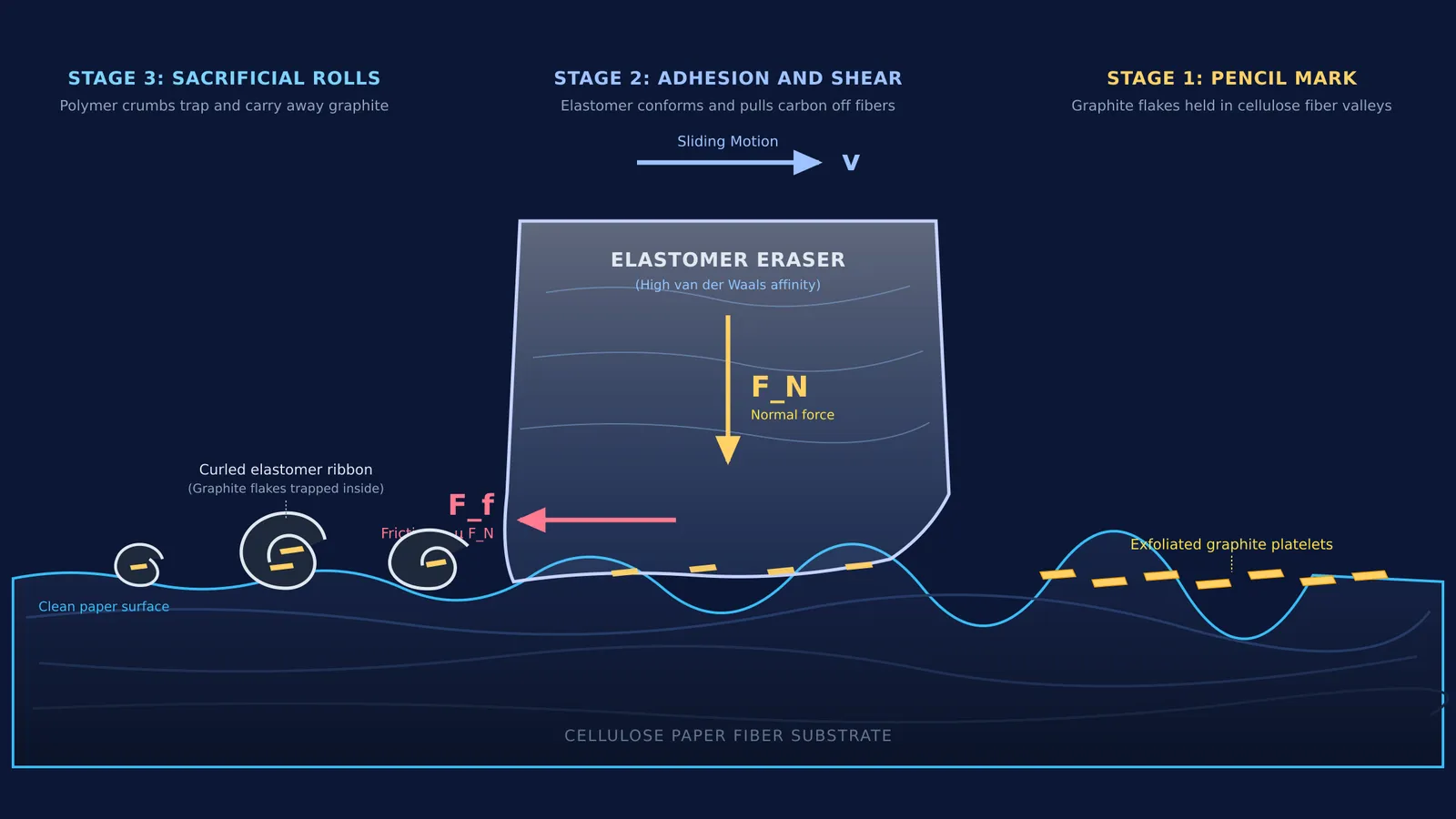
Under magnification, paper is a tangled, porous network of cellulose fibers. When you write, the rough cellulose asperities act like microscopic graters, creating frictional shear stress that cleaves the weak interlayer van der Waals bonds of the graphite core.
In their 2013 study published in *Lab on a Chip*, Narendra Kurra and Giridhar U. Kulkarni showed that pencil strokes exfoliate microscopic graphite flakes into the crevices between paper fibers. These flakes do not chemically bond to cellulose; they rest loosely on the fiber canopy, held by weak van der Waals forces and mechanical entrapment. Understanding how friction works at the microscopic level explains why these carbon flakes shear away easily during writing.
How does an eraser lift graphite off paper?
Erasing is a molecular tug-of-war between paper and polymer. Erasers are made of flexible elastomers like synthetic styrene-butadiene rubber or plasticized polyvinyl chloride. The long polymer chains in these materials exert a stronger van der Waals attraction on graphitic carbon than the paper's cellulose fibers do.
When you press an eraser against the page, normal force deforms the elastomer into the microscopic valleys of the paper. As the eraser slides, kinetic friction dislodges the graphite flakes, and the rubber's higher adhesive affinity pulls the carbon off the fibers.
English optician Edward Nairne discovered this in 1770 when he accidentally picked up raw rubber instead of breadcrumbs—the standard erasing tool of the day—and began selling half-inch rubber cubes for 3 shillings, as documented on Wikipedia's history of erasers. That same year, chemist Joseph Priestley coined the term "rubber" because it rubbed out marks. To visualize how normal force, friction, and microscopic asperities interact, the Fermi Simulation Lab provides interactive simulations for the ideas that are easier to see than to read.
Why do erasers crumble into little rolls?
If an eraser did not wear away, lifted graphite would quickly coat its contact face and smudge a dark film across the page.
To prevent smearing, erasers undergo controlled, sacrificial wear. As the elastomer drags across paper, friction shears away thin shreds of rubber. These shreds curl into cylindrical crumbs that trap and encapsulate the loosened graphite flakes inside their rolls.
Brushing away the crumbs removes the trapped graphite, while shedding continually exposes a fresh, uncontaminated polymer surface.
How much force should you use to avoid tearing paper?
Clean erasing balances frictional shear force against paper strength. According to contact mechanics principles detailed in OpenStax College Physics, frictional force equals the kinetic friction coefficient multiplied by the normal force: F_f = μ_k × F_N.
The kinetic friction equation shows that lateral drag scales directly with downward push. Rubber materials exhibit high coefficients of friction (typically 0.6 to 0.8 against rough surfaces), so pushing down harder multiplies the dragging force across the page. As seen in friction problems involving static and kinetic thresholds, excessive normal force increases shear stress. A heavy downward push exceeding 10 to 15 N on standard 70 gsm notebook paper generates enough lateral force to reach the yield threshold of cellulose fibers, causing the sheet to buckle or tear.
Instead, applying a light downward force of 2 to 4 N across several short, unidirectional strokes lifts graphite incrementally while keeping shear stress safely below the paper's tearing limit.
Which eraser should you choose for everyday study?
Different eraser materials balance adhesion and abrasion:
Vinyl plastic erasers: Made from plasticized PVC, these white blocks produce cohesive crumb ribbons that roll away graphite with minimal fiber damage. In a 1982 conservation study in the *Journal of the American Institute for Conservation*, E. J. Pearlstein, D. Cabelli, A. King, and N. Indictor found that vinyl erasers caused the least alteration to paper texture, making them ideal for exam papers.
Pink rubber erasers: Blended with vulcanized rubber and powdered pumice. The pumice acts as a gritty abrasive to scrub graphite from deep crevices, but it also scratches paper fibers and alters surface pH.
Kneaded putty erasers: Made of unvulcanized rubber with mineral oil, these soft blocks do not crumble; you press them onto paper to blot graphite purely by adhesion.
Mastering force vectors and contact mechanics connects directly to calculating coefficients of friction. When exploring force laws, students can turn to the Fermi Concept Library, which covers every concept in physics, chemistry, biology, mathematics and computing, each with its own lesson and its place in the map.


