

On this page
Solving a system of equations where all constant terms are zero means you are dealing with a homogeneous system. These systems appear everywhere in physics and mathematics, from finding the equilibrium of forces to calculating eigenvectors.
Unlike standard equations, a homogeneous system is never inconsistent. You never have to worry about whether a solution exists. Instead, the question is whether it has only the obvious solution, or infinitely many hidden ones.
What is a homogeneous system?
A linear system is homogeneous if every equation equals zero.
For example, a system with three variables looks like this:
a₁x + b₁y + c₁z = 0
a₂x + b₂y + c₂z = 0
a₃x + b₃y + c₃z = 0
In matrix notation, this is written simply as A x = 0, where A is the coefficient matrix, x is the column vector of variables, and 0 is the zero vector.
What is the trivial vs non-trivial solution?
Because the right side of every equation is zero, setting every variable to zero (x = 0, y = 0, z = 0) always works. This guaranteed answer is called the trivial solution.
A non-trivial solution is any solution where at least one of the variables is not zero. If a non-trivial solution exists, it means the equations are not completely independent. Instead of crossing at a single point, they overlap along a line or a plane, creating infinitely many solutions.
What is the homogeneous system of equations non trivial solution condition?
For a square matrix, the system has non-trivial solutions if and only if the determinant of the coefficient matrix A is zero (det A = 0) (Wikipedia).
Here is why: if the determinant is not zero, the matrix A has an inverse. You could multiply both sides of A x = 0 by the inverse, leaving x = 0. That means the trivial solution is the only one.
When the determinant is zero, the matrix cannot be inverted. This tells you that one of the equations is just a combination of the others, leaving you with free variables and an infinite number of non-trivial solutions.
What does a zero determinant mean geometrically?
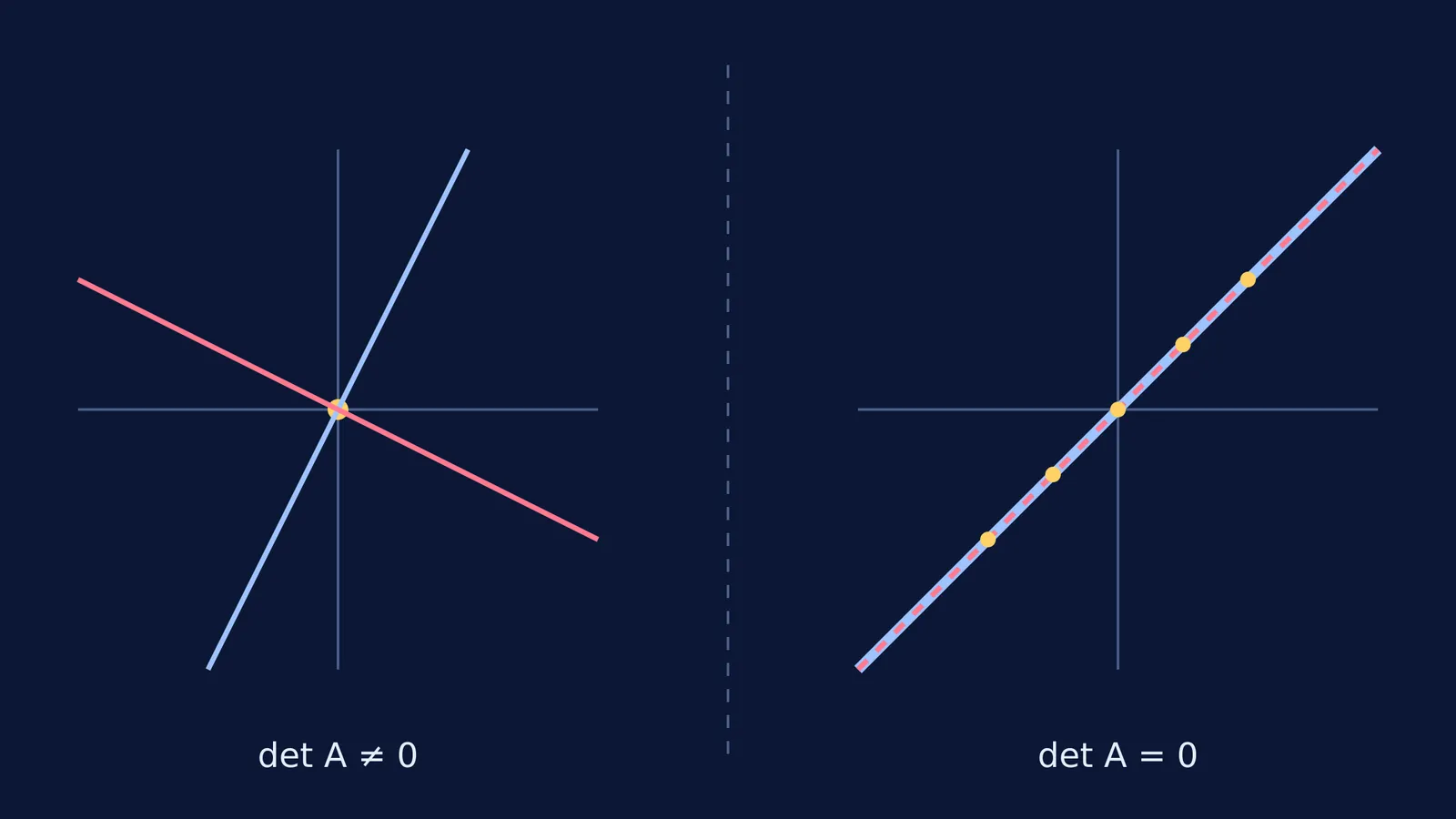
When dealing with two variables, a homogeneous system represents two straight lines that both pass through the origin. If the determinant of their coefficient matrix is not zero, the lines have different slopes. They intersect only at the origin, giving you just the trivial solution. If the determinant is zero, the lines have the exact same slope and overlap completely. This means any point on that line is a valid non-trivial solution.
In three dimensions, each equation represents a plane through the origin. If the determinant is non-zero, they intersect at exactly one point: the origin. However, if the determinant is zero, the planes do not meet at just a single point. Instead, two of the planes might be identical, or all three planes might intersect along a common line. Every coordinate along that line of intersection represents a valid non-trivial solution. This geometric view helps you visualise why equations that are not independent lead to an infinite number of solutions.
Worked example: Finding the unknown parameter
Exams like the JEE often test this condition by hiding a variable, usually k, inside the matrix.
Problem: Find the value of k for which the following system has a non-trivial solution.
x + y + z = 0
x - y + z = 0
kx + y - 2z = 0
Step 1: Extract the coefficient matrix A.
Row 1: 1, 1, 1
Row 2: 1, -1, 1
Row 3: k, 1, -2
Step 2: Set the determinant to zero.
det A = 1((-1)(-2) - (1)(1)) - 1((1)(-2) - (1)(k)) + 1((1)(1) - (-1)(k)) = 0
Step 3: Expand and solve for k.
1(2 - 1) - 1(-2 - k) + 1(1 + k) = 0
1 + 2 + k + 1 + k = 0
2k + 4 = 0
k = -2
For the system to have a non-trivial solution, k must be -2.
If you get stuck on a similar problem while studying, the Fermi Problem Library provides a step-by-step solver that explains the reasoning rather than just printing an answer.
How to check your work?
Once you find the parameter, you can check your answer by substituting it back into the equations and solving for the variables.
If we substitute k = -2 back into our example:
x + y + z = 0
x - y + z = 0
-2x + y - 2z = 0
Adding equation 1 and equation 2 gives 2x + 2z = 0, which simplifies to z = -x.
Substituting z = -x into equation 1 gives x + y - x = 0, so y = 0.
Now test these in equation 3: -2x + 0 - 2(-x) = -2x + 2x = 0.
Because we found a consistent relationship (z = -x and y = 0) that works for all three equations, we have proved that infinitely many non-trivial solutions exist.
Mastering this condition is a core part of linear algebra. It bridges the gap between calculating determinants and understanding vector spaces, a skill you will use in everything from balancing chemical equations to solving matrix word problems on cost and sales. If you want to explore how these ideas connect, the Fermi Concept Library maps out every concept in mathematics and its place in the map.


