

On this page
Imagine you have two metal spheres that look identical. They have the same outer radius, they are painted the same color, and they even have the exact same mass. However, one is solid throughout, and the other is a hollow shell made of a denser metal. How can you tell which is which without breaking them open or using complex equipment?
Which sphere reaches the bottom first?
The simplest way to identify the solid sphere is to race them. If you place both spheres at the top of a ramp and let them roll down simultaneously, the solid sphere will always reach the bottom first.
We can see exactly how much faster the solid sphere is by calculating its acceleration. For any round object rolling without slipping down a slope of angle θ, the acceleration a of its center of mass is given by the formula a = g sin θ / (1 + I/MR²), as shown in OpenStax University Physics.
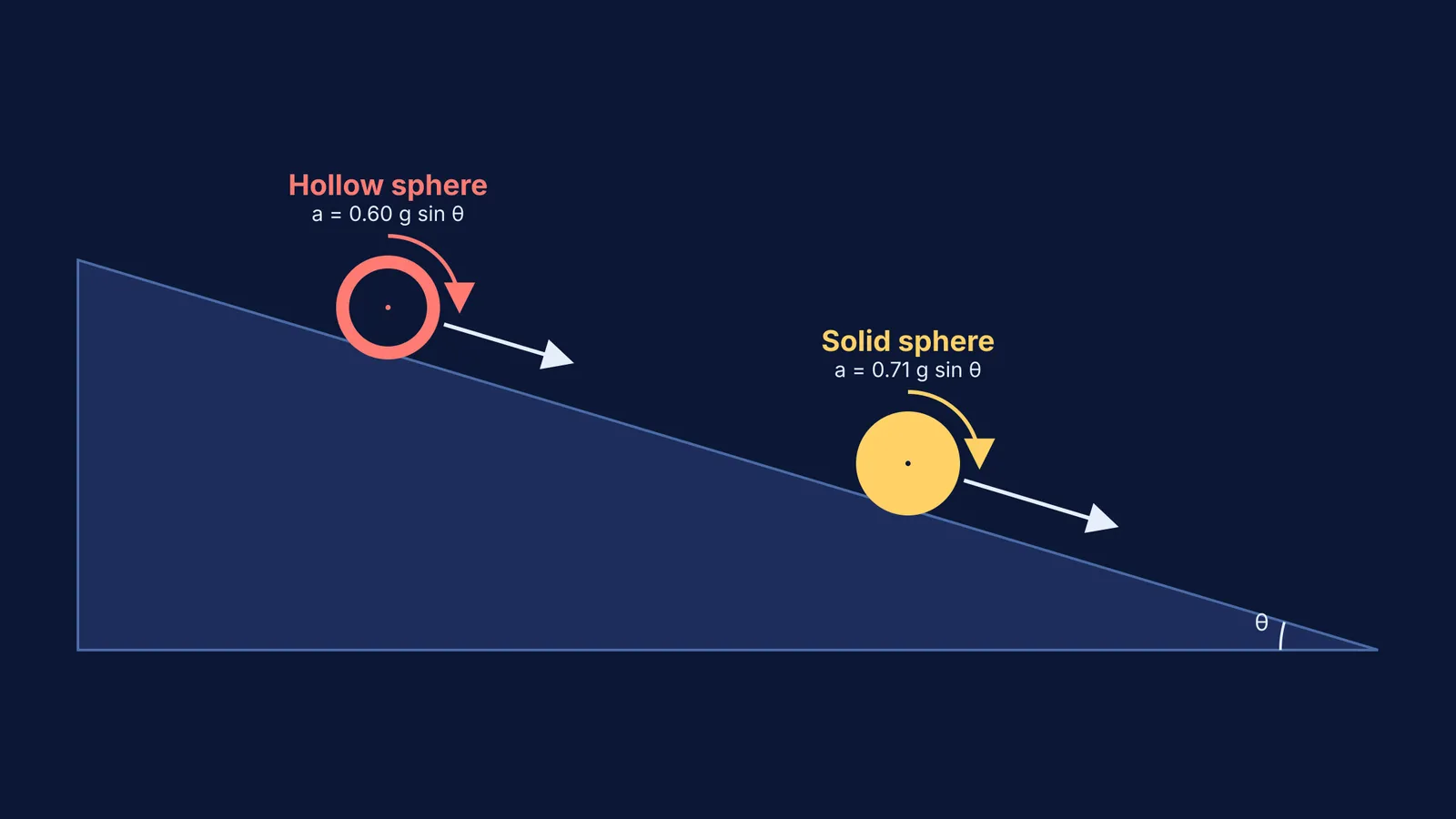
By plugging in the moment of inertia for each sphere, we get their exact accelerations:
Solid sphere: a = g sin θ / (1 + 2/5) = (5/7) g sin θ ≈ 0.71 g sin θ
Hollow sphere: a = g sin θ / (1 + 2/3) = (3/5) g sin θ = 0.60 g sin θ
The solid sphere accelerates down the ramp about 19% faster than the hollow one (0.71 is about 19% larger than 0.60), allowing it to easily win the race and reveal its identity without any weighing or measuring.
Why does the solid sphere win?
The answer lies in how their mass is distributed and how that affects their rotation. When a sphere rolls down an incline, gravity pulls it downward. This gravitational potential energy is converted into two forms of kinetic energy: translational (moving forward) and rotational (spinning). Energy conservation demands that the sum of these two kinetic energies equals the potential energy lost.
Because the hollow sphere has all of its mass concentrated at its outer shell, it is harder to set into a spin. In physics terms, it has a higher moment of inertia (I). The moment of inertia for a hollow sphere is I = (2/3)MR², while for a solid sphere it is a smaller I = (2/5)MR².
You can think of this like an ice skater spinning. When they pull their arms in close to their body, they spin much faster because they are decreasing their moment of inertia. The solid sphere is like the ice skater with their arms pulled in—its mass is naturally packed closer to the axis of rotation. The hollow sphere is like the skater with their arms stretched out—its mass is pushed as far from the center as possible, making it sluggish to rotate.
Since the hollow sphere is more resistant to spinning, it uses a larger fraction of its total energy just to rotate. That leaves less energy available for actual forward motion, making it roll more slowly.
What if the spheres have different masses?
A common follow-up question in physics exams like the JEE is what happens if the spheres do not have the same mass or radius. Surprisingly, the mass and radius do not matter at all.
If you look at the acceleration formula a = g sin θ / (1 + I/MR²), you can substitute I = (2/5)MR² for any solid sphere. Because both the numerator and the denominator of the fraction I/MR² contain the mass M and the radius squared R², these variables completely cancel out, leaving a = (5/7) g sin θ.
This means a massive solid bowling ball and a tiny solid marble will roll down a ramp at the exact same rate. Similarly, a heavy hollow sphere and a light hollow sphere will tie each other. However, any solid sphere will always beat any hollow sphere, regardless of their size or weight, because the deciding factor is purely the shape and how the mass is distributed relative to the center.
How can Fermi help with rolling motion?
Rotational mechanics is full of counter-intuitive results. You might expect two objects of the exact same mass to fall or roll at the exact same rate. When you encounter tricky ideas like this, reading the formula often isn't enough to make it click.
This is where the Fermi Simulation Lab comes in, providing interactive simulations for the ideas that are easier to see than to read. You can roll them down a virtual incline and watch the energy shift between linear and rotational forms in real time.
If you get stuck on a homework question about moment of inertia or calculating kinetic energy, Fermi's AI tutor can help. It works out what you already know and builds a plan for the session, teaching by asking guiding questions, drawing the forces on a whiteboard, and checking understanding as it goes.
For more worked examples of tricky physics topics—such as predicting whether a spool pulled by its string rolls forward or backward, or finding the position when acceleration is given as a function of velocity—you can explore the Fermi Concept Library.


