

On this page
If you stretched out the DNA in a single human cell, it would be remarkably long. To fit inside a nucleus that is microscopically small, that DNA must be coiled, folded, and compacted into a dense package. The first and most crucial step in this packaging process is winding the DNA around specialised proteins called histones.
This tight wrapping is not a random tangle. It is a highly organised process that relies on a strong electrical attraction between the DNA thread and the histone proteins it winds around.
Why are histones positively charged?
A protein acquires its net electrical charge from its specific amino acid sequence. Histones are rich in the basic amino acid residues lysine and arginine. Both of these amino acids carry positive charges on their side chains at the physiological pH found inside a living cell.
Because lysine and arginine are so exceptionally abundant in their molecular structure, the entire histone protein takes on a strong overall positive charge. This is a deliberate evolutionary design, ensuring that the proteins are perfectly matched to their partner molecule in the nucleus. Without this heavy concentration of basic amino acids, histones would not have the electrostatic pull required to do their job.
How does the positive charge help package DNA?
DNA is a highly negatively charged molecule. This negative charge comes from the phosphate groups that form the outer backbone of the DNA double helix. Every single nucleotide base in the DNA sequence brings a negatively charged phosphate group to the chain.
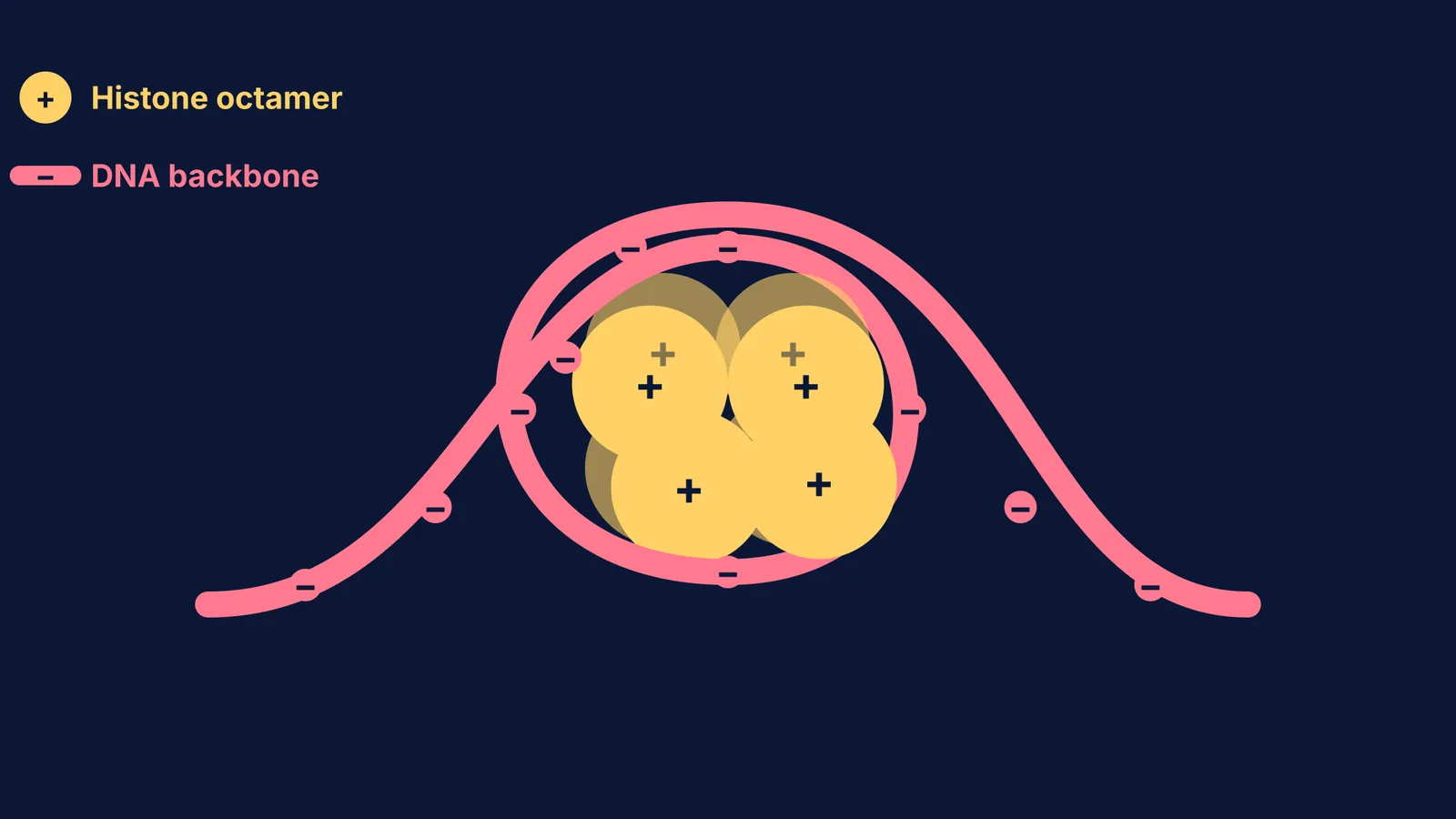
Opposites attract in physics, and the same rule applies in biology. The positively charged histone proteins act like tiny molecular magnets for the negatively charged DNA. This strong electrostatic interaction allows the stiff DNA thread to wrap tightly around the proteins without repelling itself. The attraction neutralises the negative charges, preventing the DNA strands from pushing away from one another as they are packed into tight spaces.
If you are struggling to picture how these structures fit together in three dimensions or how electrical forces act on a molecular level, the Fermi Concept Library has every concept in physics, chemistry, biology, mathematics and computing, each with its own lesson and its place in the map.
What is a histone octamer?
Histone proteins do not act as single, isolated units when packaging DNA. They group together to form a larger, barrel-shaped complex called a histone octamer. As the name suggests, this is a unit composed of eight histone molecules. Specifically, it contains two copies each of the four core histones: H2A, H2B, H3, and H4.
The negatively charged DNA wraps around this positively charged histone octamer to form a fundamental repeating unit called a nucleosome. A typical nucleosome contains 200 base pairs of DNA helix. The DNA wraps around the octamer just under two full turns before continuing on to the next one.
When viewed under a high-powered electron microscope, this arrangement looks exactly like beads on a string. The "beads" are the nucleosomes, and the "string" is the linker DNA connecting one nucleosome to the next. This bead-on-a-string structure is called chromatin, which acts as the basic building block for further folding. The chromatin coils and condenses repeatedly to eventually form the thick, dense chromosomes you can see under a light microscope during cell division.
A revision checklist for NEET biology
Questions about DNA packaging in eukaryotes: histones, nucleosomes and chromatin are a staple in board exams and competitive tests. The topic blends molecular biology with basic principles of electrical charge, making it a favourite for examiners testing conceptual clarity.
When revising the molecular basis of inheritance for NEET: DNA to the lac operon, use this framework based on the NCERT biology syllabus to verify you can recall the exact structural facts in order:
The charge: DNA is always negatively charged due to its phosphate backbone; histones are positively charged.
The amino acids: The positive charge of histones comes specifically from a high abundance of lysine and arginine.
The core: The histone octamer consists of exactly eight histone molecules (two each of H2A, H2B, H3, and H4).
The nucleosome: One nucleosome includes the central octamer and the 200 base pairs of DNA wrapped around it.
The chromatin: Nucleosomes repeating continuously along the DNA thread form chromatin, which provides the classic "beads-on-string" appearance.
By mastering these exact definitions and their sequence, you ensure that you will not be caught out by statement-based or assertion-reason questions that rely on confusing the structural levels.


