

On this page
A denominator like sin x + √3 cos x looks awkward because it mixes two functions, and no single substitution jumps out. The way in is to see it as one shifted sine wave. Once you do, the integral turns into one you already know from the standard list. Below is the full working, a second method and a quick way to check your answer.
What is the R sin(x + α) form?
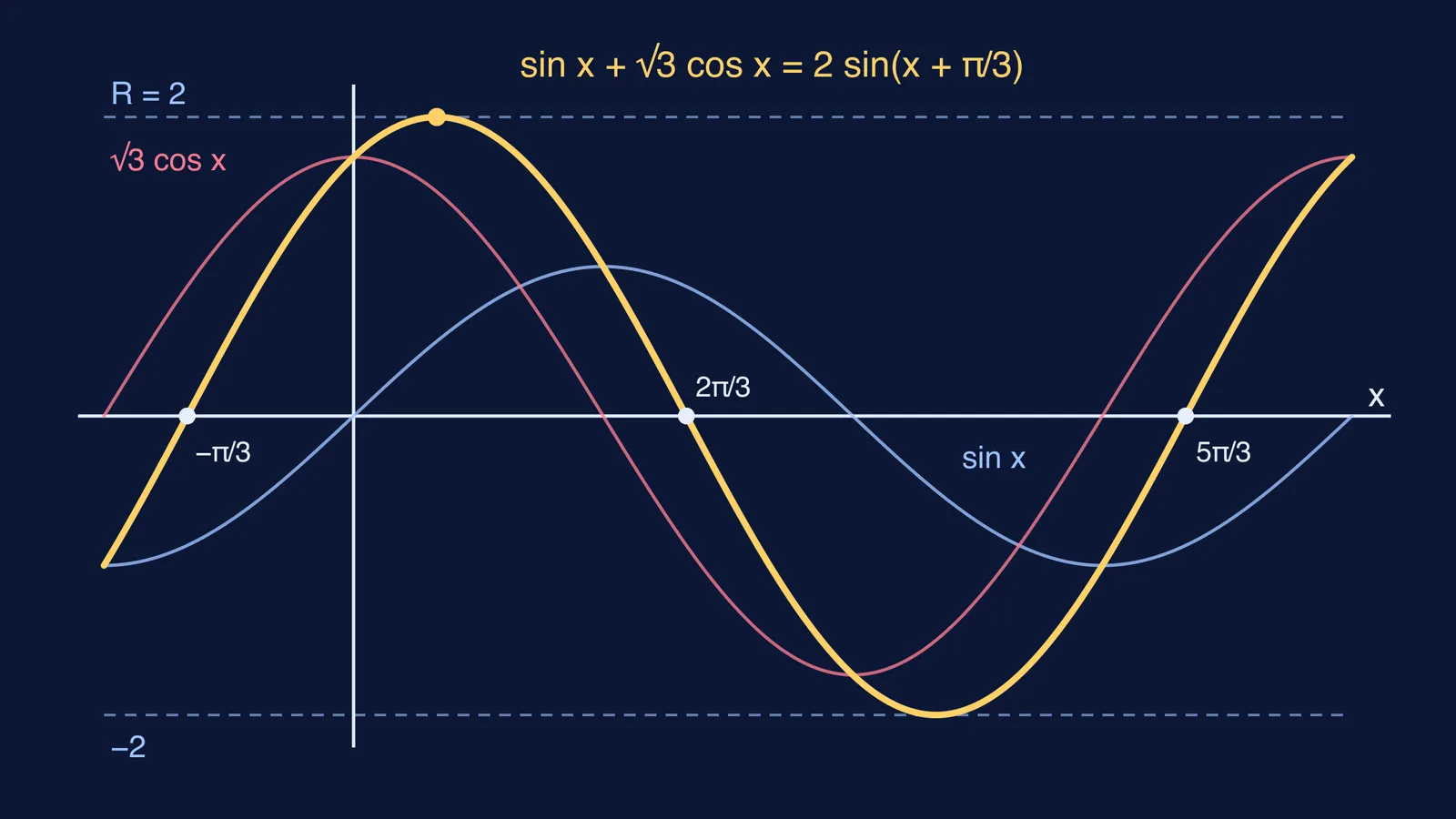
Any expression a sin x + b cos x can be written as one wave, R sin(x + α), where R = √(a² + b²), cos α = a/R and sin α = b/R. To see why, expand the right side: R sin(x + α) = (R cos α) sin x + (R sin α) cos x. Match the coefficients with a and b, then square and add to get R² = a² + b².
For our denominator, a = 1 and b = √3:
R = √(1 + 3) = 2.
cos α = 1/2 and sin α = √3/2, so α = π/3.
So sin x + √3 cos x = 2 sin(x + π/3).
Test it at x = 0. The left side is √3, and the right side is 2 sin(π/3) = √3. They match.
How do you integrate 1/(sin x + √3 cos x) step by step?
Rewrite the integral: ∫ dx/(sin x + √3 cos x) = ∫ dx/(2 sin(x + π/3)) = ½ ∫ cosec(x + π/3) dx.
Put u = x + π/3, so du = dx.
Use the standard result ∫ cosec u du = log|cosec u − cot u| + C, which is derived in the Integrals chapter of the NCERT Class 12 Mathematics Part II textbook. Here log means the natural logarithm.
Tidy up with the identity cosec u − cot u = tan(u/2), shown in the tangent half-angle substitution article.
So the answer is ∫ dx/(sin x + √3 cos x) = ½ log|tan(x/2 + π/6)| + C. Both forms, ½ log|cosec(x + π/3) − cot(x + π/3)| + C and the tan version, are correct.
Can you use the tan(x/2) substitution instead?
Yes. The substitution t = tan(x/2) uses sin x = 2t/(1 + t²), cos x = (1 − t²)/(1 + t²) and dx = 2 dt/(1 + t²), as set out in the tangent half-angle substitution article. The same source notes that Leonhard Euler used it in his 1768 integral calculus textbook.
Here the (1 + t²) terms cancel and you get:
∫ 2 dt/(√3 + 2t − √3t²).
Factor the bottom: √3 + 2t − √3t² = −√3(t − √3)(t + 1/√3).
Partial fractions: 1/((t − √3)(t + 1/√3)) = (√3/4)[1/(t − √3) − 1/(t + 1/√3)].
Integrate: the result is ½ log|(tan(x/2) + 1/√3)/(tan(x/2) − √3)| + C.
This looks different from the first answer, but it isn't wrong. Expand tan(x/2 + π/6) with the tan addition formula and you get √3(t + 1/√3)/(√3 − t). The two logs differ only by the constant ½ log √3, which disappears into C.
Which method should you pick in an exam?
Use this quick decision list:
Denominator is a sin x + b cos x with nothing added: use the R-form, then cosec.
Denominator is a sin x + b cos x + c with c not zero: use t = tan(x/2). The R-form only gives you R sin(x + α) + c, which is still not a standard integral.
Numerator is p sin x + q cos x too: write the numerator as A × (denominator) + B × (derivative of the denominator), then integrate each part.
Not sure: t = tan(x/2) turns any rational function of sin x and cos x into a rational function of t, so it always works, even if the algebra is longer.
For your own versions, the Fermi Problem Library has a step-by-step solver that explains the reasoning rather than printing an answer, which helps when you are not sure which route fits.
What mistakes cost marks on this integral?
Dropping the ½ that comes from R = 2.
Choosing α from tan α = b/a alone. Check the signs of cos α and sin α so α lands in the right quadrant. Here both are positive, so α = π/3.
Forgetting the 2/(1 + t²) in dx when you switch to t.
Deciding two different-looking answers can't both be right. Differentiate one, or subtract them and see if you get a constant.
If the compound-angle step is what slows you down, the Fermi Concept Library covers every concept in mathematics, each with its own lesson and its place in the map. Revise sin(A + B) there, then retry this integral without looking.


