

On this page
A satellite TV dish on a rooftop stays pointed at a satellite that never seems to move. That works only at one particular height, and you can find it with one formula and a calculator. Here is the method, plus the two conditions people forget.
What is a geostationary satellite?
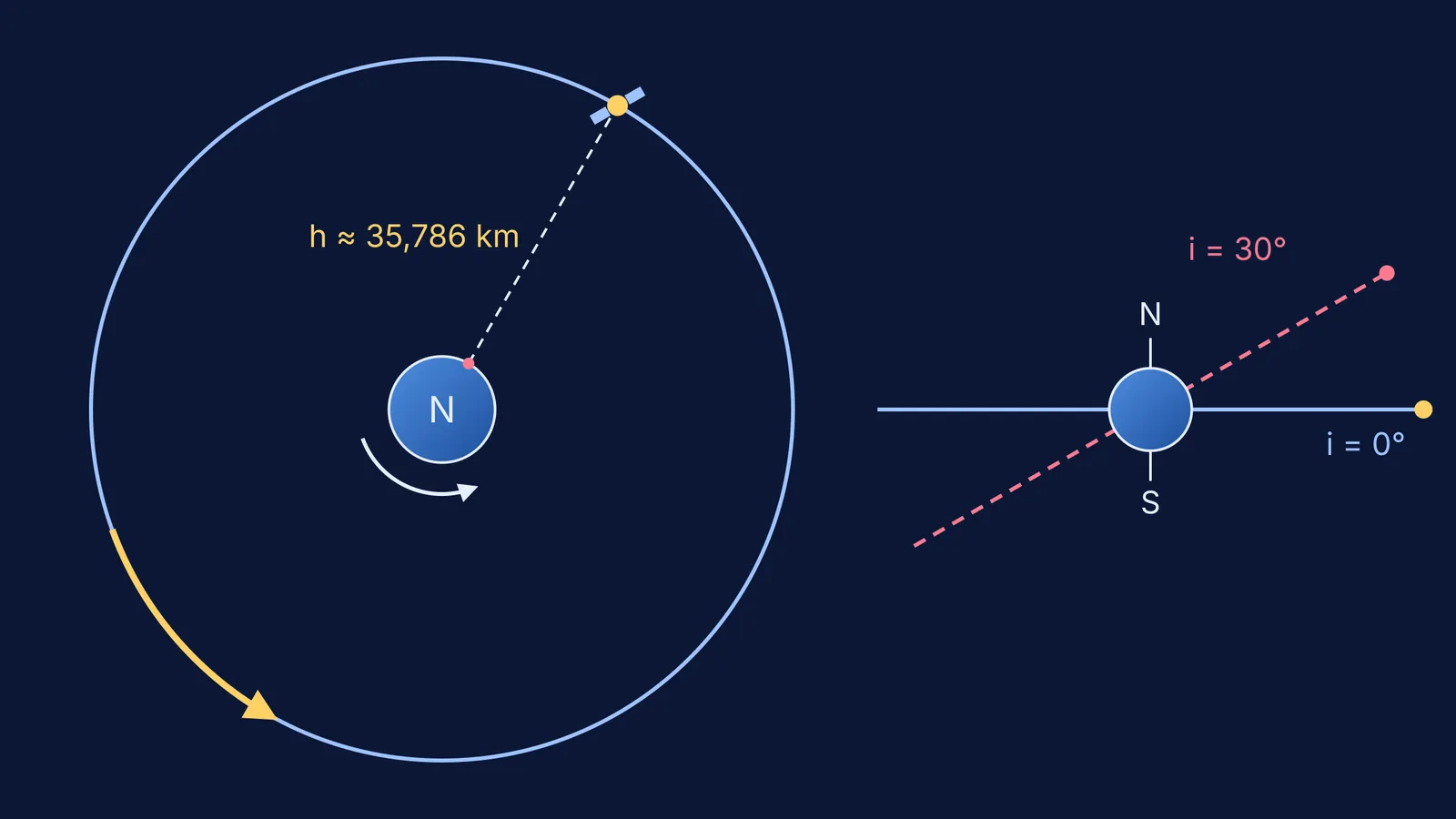
A geostationary satellite goes round the Earth once in the time the Earth takes to turn once, in the same direction, directly above the equator, so it stays over the same spot on the ground. The European Space Agency's guide to types of orbits puts geostationary orbit at 35,786 km up, moving west to east, with one orbit taking 23 hours 56 minutes 4 seconds. NASA's catalog of Earth satellite orbits gives the same orbit as 42,164 km from Earth's centre, about 36,000 km above the surface.
ISRO lists its climate and disaster-management satellite INSAT-3DR as working from geosynchronous orbit.
How do you calculate the height of a geostationary satellite?
For a circular orbit, gravity supplies the centripetal force: GMm/r² = mω²r, with ω = 2π/T. Rearranging gives Kepler's third law for an Earth satellite: r³ = GMT²/4π². The satellite's mass cancels, so every geostationary satellite sits at the same radius. For the history, read how Kepler found his three laws in Tycho Brahe's data.
NASA's Earth fact sheet gives GM = 0.39860 × 10⁶ km³/s² (that is 3.986 × 10¹⁴ m³/s²) and an equatorial radius of 6,378.137 km. Now work through it:
Convert the period to seconds: T = 24 × 3600 = 86,400 s, so T² = 7.465 × 10⁹ s².
Multiply: GMT² = 3.986 × 10¹⁴ × 7.465 × 10⁹ = 2.976 × 10²⁴ m³.
Divide by 4π² = 39.48: r³ = 7.537 × 10²² m³.
Take the cube root: r = 4.224 × 10⁷ m, or about 42,240 km from Earth's centre.
Subtract Earth's radius: h = 42,240 − 6,378 = about 35,860 km, roughly 36,000 km.
Check the speed: v = 2πr/T = about 3.07 km/s, which matches ESA's figure of about 3 km per second.
If your question gives only g = 9.8 m/s² and R = 6,400 km, use GM = gR² = 4.01 × 10¹⁴ m³/s². That gives h of about 35,900 km, still close to 36,000 km. A handy check: r comes out near 6.6 Earth radii, so the height is about 5.6 Earth radii. For the speed, energy and escape-speed problems that come with this one, see our post on orbital speed, energy and escape speed.
Should you use 24 hours or 23 hours 56 minutes?
The Earth turns once relative to the stars in 23.9345 hours, the sidereal rotation period on NASA's Earth fact sheet. Put T = 86,164 s into the same steps and you get r = 42,164 km and h = 35,786 km, matching ESA exactly. In a school or JEE problem, use whatever period the question gives. If it gives none, 24 hours is the usual assumption and about 36,000 km is the expected answer.
Why must a geostationary orbit be above the equator?
Gravity always pulls towards Earth's centre, so the plane of every orbit passes through Earth's centre. To hover over a city north of the equator, a satellite would have to circle a point on Earth's axis above the centre. Nothing pulls it towards that point, so no such orbit exists.
A 24-hour orbit tilted to the equator is still geosynchronous, but it is not geostationary. NASA's orbit catalog notes that such a satellite may drift north to south, and only a circular orbit with zero tilt over the equator stays fixed relative to the ground.
Why does it have to move west to east?
The Earth spins west to east, which is why the Sun rises in the east. The satellite has to turn the same way to keep pace with the ground below it, and ESA describes geostationary satellites as moving from west to east. A satellite at the same height going east to west would have a relative angular speed of 2ω, so it would lap the ground once every 12 hours instead of standing still.
A quick checklist before you write the answer
Period in seconds, not hours.
GM in m³/s², or G and M kept in SI units.
r found first, then h = r − R.
Answer about 3.6 × 10⁷ m, and speed about 3 km/s, as ESA gives it.
Mass of the satellite not used anywhere.
If your answer is way off, the Fermi Problem Library has worked problems with a step-by-step solver that explains the reasoning, so you can find the step that went wrong. If gravitation itself feels shaky, the Fermi Concept Library gives each physics concept its own lesson. For the other law that orbit questions test, read Kepler's second law from angular momentum.


