

On this page
Why was the genetic code believed to be universal?
In 1968, Francis Crick published his classic paper on the origin of the genetic code90392-6), proposing the "frozen accident" hypothesis. Crick argued that because the translation machinery maps 64 triplet codons to 20 amino acids across all cellular life, any sudden shift in codon meaning would be lethal. Altering a triplet would simultaneously alter thousands of proteins across the proteome. After Har Gobind Khorana and how the genetic code was cracked confirmed the triplets, textbooks treated the standard dictionary as universal.
From human cells to *Escherichia coli*, the rules held firm. The triplet UUU incorporated phenylalanine, AUG initiated translation, and UAA, UAG, and UGA signaled termination. This uniformity enabled recombinant technology, allowing bacteria to express synthetic human proteins as studied in the molecular basis of inheritance. Yet Crick recognized that in systems encoding only a small number of proteins, reassignment might not prove fatal. In 1979, sequencing tools put that exception to the test.
Which codons differ in mitochondrial DNA?
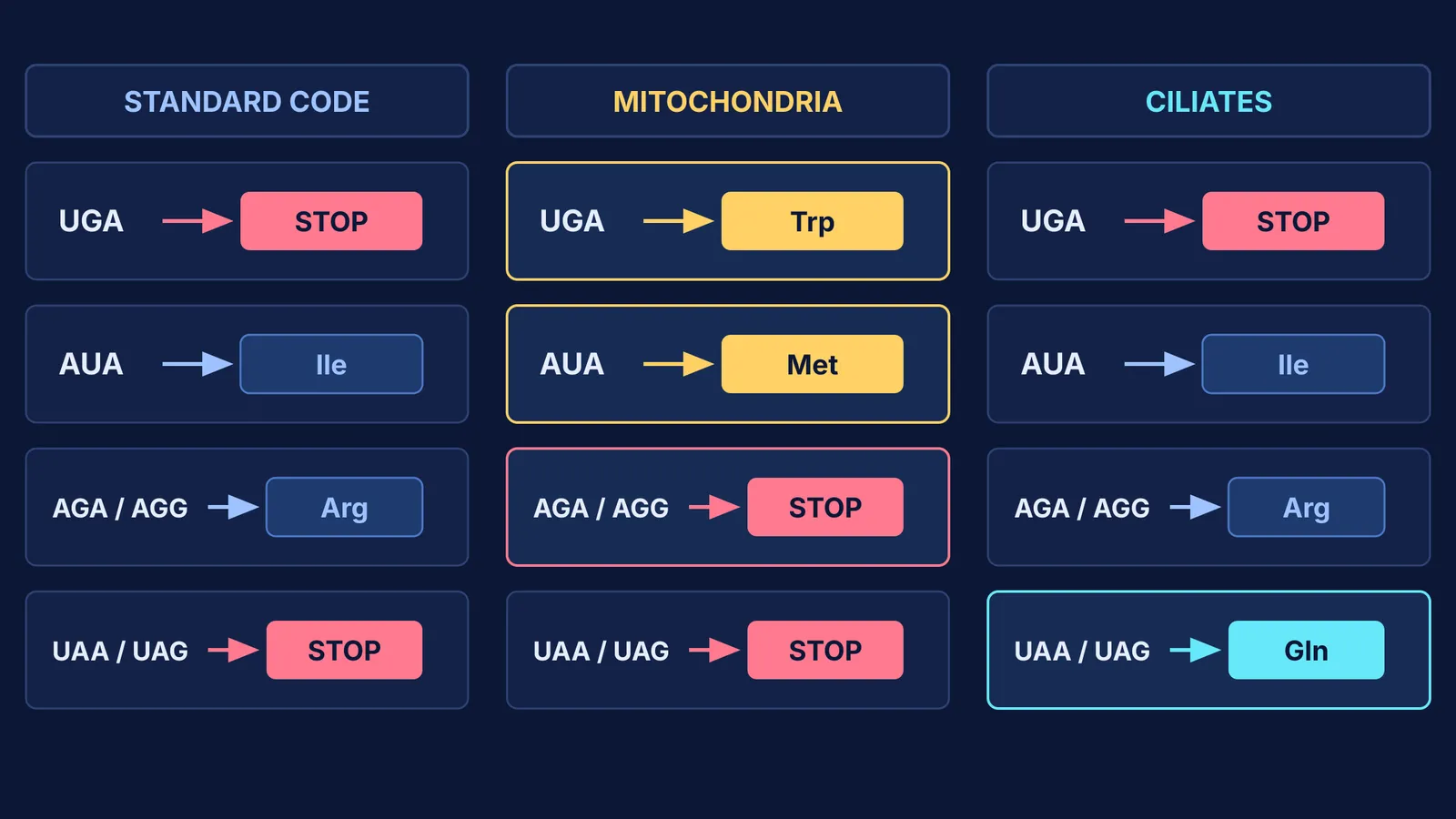
The first definitive break appeared in human mitochondria. In 1979, B. G. Barrell and colleagues published their landmark analysis in Nature comparing bovine proteins with human mitochondrial genes. They uncovered two startling deviations:
UGA, universally a stop codon, codes for tryptophan in mitochondria.
AUA, which canonically specifies isoleucine, encodes methionine.
Subsequent sequencing of the 16,569 base pair human mitochondrial genome in 1981 revealed another twist: AGA and AGG do not code for arginine, but act as stop codons alongside UAA and UAG.
Mitochondria can tolerate these alterations because their genome is tiny. Human mitochondria carry just 13 protein-coding genes and 22 transfer RNAs (tRNAs), compared to dozens of tRNAs in the cytoplasm. With fewer genes to disrupt and flexible wobble pairing, mitochondria reshuffled their code without destabilizing the host cell.
How do protozoans like Paramecium break the rules?
Mitochondria are not the only exception. In 1985, researchers discovered non-canonical codes in the nuclear genomes of single-celled ciliates. Investigating surface antigens in *Paramecium*, François Caron and Eric Meyer demonstrated that internal reading frames carried abundant UAA and UAG codons translated as glutamine.
In the same year, S. Horowitz and M. A. Gorovsky showed that nuclear histone genes in Tetrahymena also translate UAA and UAG as glutamine. In these ciliates, UGA serves as the sole stop signal. Specialized tRNAs recognize UAA and UAG, while their release factor eRF1 has evolved to terminate only at UGA. Today, the NCBI taxonomy translation tables record dozens of alternative codes across protozoans, algae, and invertebrates.
Why did these exceptions evolve without killing the cell?
How does a codon change meaning without lethal consequences? In 1989, Syozo Osawa and Thomas H. Jukes proposed the codon capture hypothesis:
Directional mutational pressure drives an underused codon out of coding sequences. In AT-rich or GC-rich genomes, a codon can disappear entirely.
The cognate tRNA or release factor is lost through neutral drift without harming the organism.
The vacant codon eventually reappears by mutation and is captured by a mutated tRNA charging a different amino acid.
If you are mapping the relationship between triplets, amino acids, and translation factors across molecular genetics, the Fermi Concept Library maps every concept in physics, chemistry, biology, mathematics and computing, each with its own lesson and its place in the map.
Worked example: decoding canonical vs non-canonical mRNA
To master how codons dictate peptide assembly during translation on exams, compare how three systems cataloged in the NCBI translation tables translate this identical mRNA sequence:
`5'-AUG AUA UGA GAA-3'`
Standard nuclear translation:
AUG codes for methionine. AUA codes for isoleucine. UGA triggers termination. Resulting peptide: Met-Ile (2 amino acids). GAA remains untranslated.
Vertebrate mitochondrial translation:
AUG codes for methionine. AUA codes for methionine. UGA codes for tryptophan (no termination). GAA codes for glutamic acid. Resulting peptide: Met-Met-Trp-Glu (4 amino acids).
Ciliate nuclear translation (*Paramecium*):
AUG codes for methionine. AUA codes for isoleucine. UGA triggers termination. Resulting peptide: Met-Ile (2 amino acids).
By contrast, for the sequence `5'-AUG CAA UAA UAG UGA-3'`, canonical translation terminates at UAA to yield Met-Gln. In *Paramecium*, UAA and UAG both insert glutamine, producing Met-Gln-Gln-Gln before terminating at UGA.
When practicing pedigree charts, codon reading frames, and molecular genetics problems, the Fermi Problem Library provides worked problems with a step-by-step solver that explains the reasoning rather than printing an answer.


