

On this page
Have you ever spotted an amphibian in the garden and wondered if it was a frog or a toad? The answer lies in their skin, their legs and their habitat. Interestingly, both belong to the same biological order, but there are clear physical differences that dictate how they survive.
Is a toad a frog?
Yes, all toads are technically frogs. Both frogs and toads belong to the amphibian order Anura, which translates to "without a tail". In biology, the number of known amphibian species is approximately 8,000, of which nearly 90% are frogs (Wikipedia).
Within this massive group, the word "toad" is a generic common name for certain groups of frogs, especially those in the family Bufonidae (Wikipedia). While the distinction between a frog and a toad is heavily used in everyday language and folk taxonomy, it does not strictly reflect their evolutionary history. The difference is largely based on their cosmetic traits and environmental adaptations rather than strict taxonomic separation.
What is the difference between a frog and a toad?
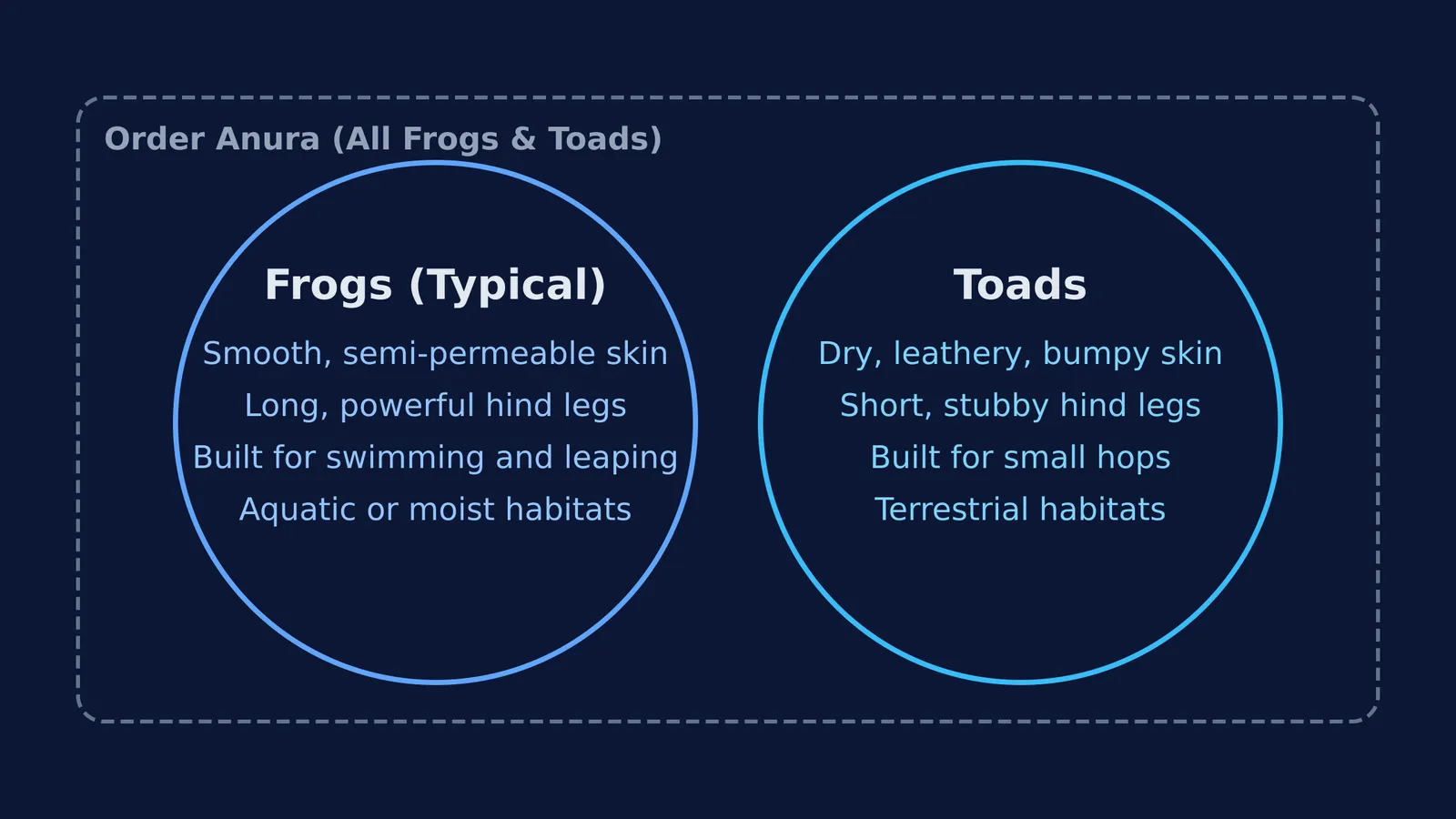
The most obvious difference lies in their skin and moisture requirements. Frogs possess smooth, glandular skin that is semi-permeable, allowing them to absorb oxygen. This semi-permeable nature makes them highly susceptible to dehydration, meaning they must live in moist niches or aquatic environments (Wikipedia). To keep their skin hydrated, they secrete mucus, which gives them their characteristic slippery feel.
Toads have evolved differently. They are distinguished by short legs and dry, leathery skin covered in large bumps made of parotoid glands (Wikipedia). These bumps are often colloquially referred to as warts, but they actually secrete toxins to deter predators. Because a toad's skin is tougher and retains moisture better, toads are associated with much more terrestrial habitats than frogs. You are far more likely to find a toad wandering in dry woods or a garden away from a pond.
Their legs and movement patterns also differ drastically. Frogs have long, powerful hind limbs built for swimming and taking massive leaps to escape danger. They have an athletic, streamlined body profile. Conversely, toads have shorter, stubbier hind legs and a much more stout, squat body. Because of these short legs, they tend to take small hops or even crawl rather than perform the huge leaps characteristic of frogs.
Do frogs and toads have teeth?
Another key difference between these amphibians lies in their mouths. Most frogs possess maxillary teeth along their upper jaw, which they use to grip and hold onto their prey before swallowing (Wikipedia). They also use an unusual anatomical trick to eat: they can retract their eyeballs into their skulls to help push food down their throats. In contrast, true toads typically lack teeth entirely, relying completely on their sticky tongues and strong jaws to consume their meals.
How do frog and toad eggs differ?
The differences extend to how they reproduce. While both amphibians typically return to the water to spawn, the shape of their egg masses is distinct. Frogs generally lay their eggs in large, gelatinous clumps, often referred to as frogspawn (Wikipedia). Toads, on the other hand, tend to lay their eggs in long, jelly-like strings that wrap around underwater vegetation.
How do you identify a frog vs a toad?
If you spot an amphibian and need to identify it, use this quick checklist:
Skin texture: Is it smooth and slimy (frog), or dry, leathery and bumpy (toad)?
Body shape: Is it lean and streamlined (frog), or squat and stout (toad)?
Leg length: Does it have very long hind legs that fold sharply (frog), or shorter, stubby hind legs (toad)?
Movement: Does it take huge, springing leaps (frog), or does it prefer small, short hops (toad)?
Habitat: Is it right next to a body of water (frog), or is it wandering in dry soil or a garden (toad)?
Understanding these distinct adaptations helps students bridge the gap between everyday observation and formal biology. In a broader biological context, amphibians also exhibit fascinating diversity in how they process waste—for example, comparing them to ammonotelic, ureotelic and uricotelic animals helps illustrate how water availability drives evolution.
When preparing for exams, memorising the distinctions between closely related groups—whether it is amphibians or viruses, viroids and lichens—can be challenging. The Fermi Concept Library maps every concept in biology, each with its own lesson and its place in the map. To check your understanding, Fermi's AI tutor can ask you questions about these physical and behavioral adaptations, checking your understanding as it goes.


