

On this page
Imagine this question: *Aadya spent 1/3 of her allowance on books, and 1/4 of the remaining amount on food. If she had ₹600 left, how much did she start with?*
These "fraction of the remainder" problems are notorious for tripping up students. Research by Siegler and colleagues found that a student's grasp of fractions is a unique and significant predictor of their long-term mathematical success in high school algebra (10.1177/0956797612440101). As explored in Fractions and division predict later maths, the difficulty in these problems is not the arithmetic; it is identifying what the fraction is a fraction *of*.
Why do fraction of the remainder problems confuse students?
When a student reads that Aadya spent 1/3 and then 1/4, their first instinct is often to find a common denominator and add the fractions together. But in "fraction of the remainder" problems, the second fraction applies to a new, smaller whole.
The 1/4 spent on food is not 1/4 of her original allowance; it is 1/4 of what she had left *after* buying books.
How do you draw a bar model for fractions?
A 2017 study demonstrated that teaching the visual bar model strategy significantly improves the accuracy of students solving multi-step word problems (10.1177/0731948717690116). Here is how to build one step by step:
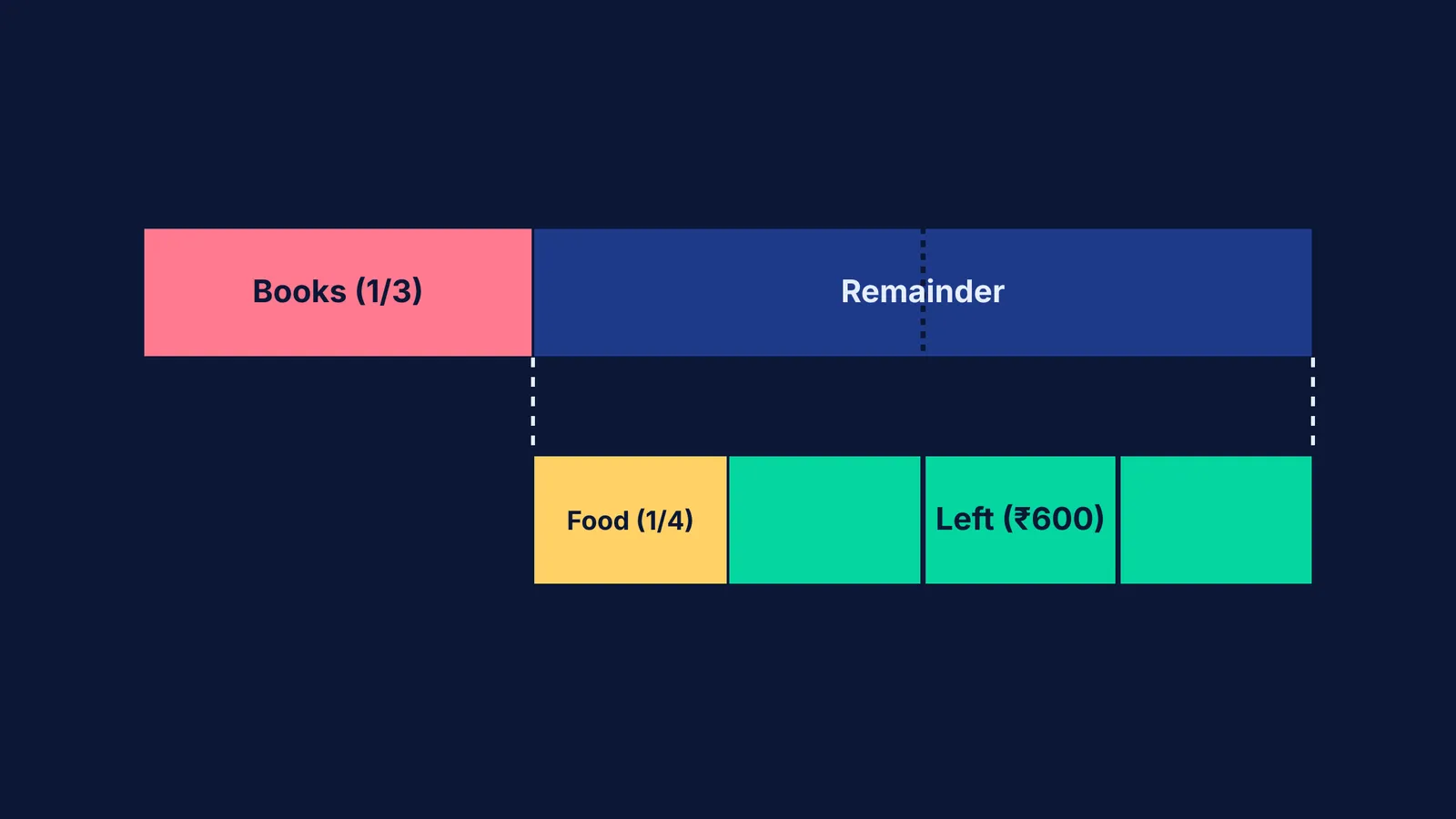
Draw the original whole: Draw a long rectangle to represent Aadya's starting allowance. Cut it into three equal sections.
Remove the first part: Shade one section to show the 1/3 spent on books. Two sections remain.
Redefine the whole: Look at the two remaining sections. The problem says she spent 1/4 of this remaining amount. To easily take 1/4, cut each of your two sections in half. You now have four smaller pieces making up the remainder.
Remove the second part: Shade one of those four smaller pieces to show the 1/4 spent on food.
See what is left: You have three smaller pieces remaining unshaded.
How do you work backwards from the final amount?
Now that you have a visual map of the problem, you can "work backwards" from the final known amount to find the beginning. We know Aadya had ₹600 left at the end.
Your bar model shows that 3 smaller pieces are left unshaded.
Therefore, 3 pieces = ₹600.
This means 1 small piece = ₹200.
To find the original total, we need to know how many of these small pieces made up the entire starting bar. Since we cut the remaining 2/3 of the bar into 4 pieces, the shaded first third would also equal 2 small pieces. The entire bar was made of 6 small pieces.
Total amount = 6 pieces × ₹200.
Aadya started with ₹1200.
How can students build the habit of working backwards?
Working backwards with a bar model turns a confusing narrative into a simple counting exercise. If your child struggles with these, try helping your child with maths word problems by asking them to sketch the first sentence before reading the second.
When they practice, the Fermi Problem Library offers worked problems with a step-by-step solver that explains the reasoning rather than printing an answer. If a student tries to add 1/3 and 1/4 together, Fermi's AI tutor notices where they are stuck, and decides to ask what the 1/4 applies to, helping them build the reasoning skills they will need for algebra. If they still feel stuck on the basics, revisiting working with fractions in Class 7 can help secure the foundation.


