

On this page
A common JEE and Class 11 question hands you a focus, a directrix and an eccentricity, then asks for the equation of the conic. When the directrix is slanted, like x − y + 3 = 0, no standard form fits and you need the definition itself. Here is that method, a full worked example, and two checks that catch slips.
What does PS = e·PM mean?
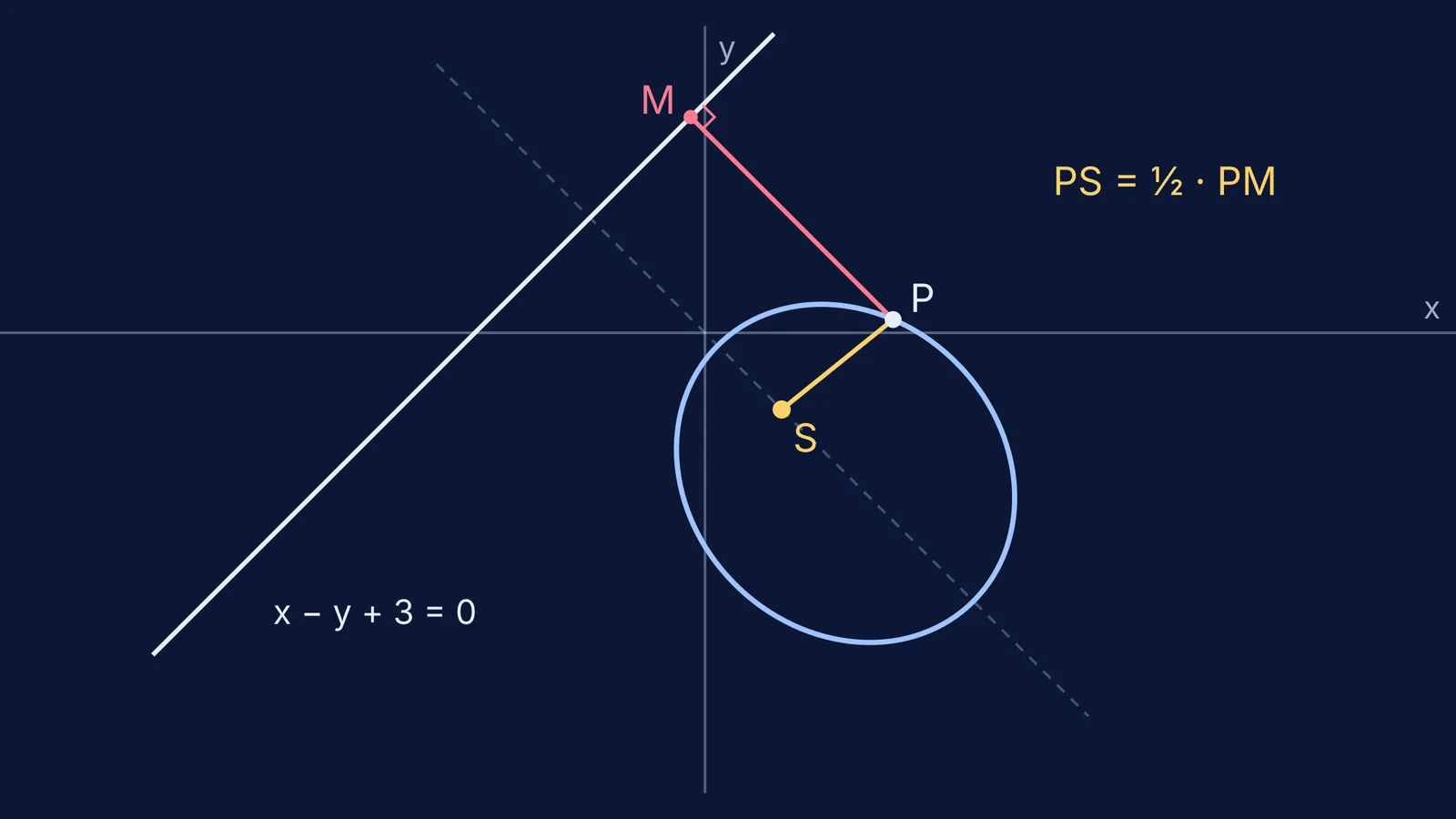
A conic is the locus of a point P whose distance from a fixed point S (the focus) is a constant multiple e of its distance from a fixed line (the directrix), with the focus not on that line, as Wolfram MathWorld's entry on conic sections defines it. M is the foot of the perpendicular from P to the directrix, so PM is the shortest distance from P to that line.
The constant e is the eccentricity, and it alone decides the type of curve. According to the Wikipedia article on conic sections:
0 < e < 1 gives an ellipse.
e = 1 gives a parabola.
e > 1 gives a hyperbola.
How do you find the equation of a conic from its focus and directrix?
The same five steps work for every focus, directrix and e.
Let P(x, y) be any point on the conic.
Write PS using the distance formula between P and the focus.
Write PM using the perpendicular distance from (x₀, y₀) to the line ax + by + c = 0, which is |ax₀ + by₀ + c| / √(a² + b²), as given in this reference on the distance from a point to a line.
Square both sides of PS = e·PM. This removes the square root and the modulus in one move: PS² = e²·PM².
Expand, collect like terms, and run the checks below.
If step 3 is rusty, our guide to straight lines in coordinate geometry: forms, distances and angles covers it. The whole method is a locus problem in disguise, so the five-step method for locus problems will feel familiar.
Worked example: what if the directrix is slanted?
Question. Find the equation of the conic with focus S(1, −1), directrix x − y + 3 = 0 and eccentricity e = 1/2. Name the conic.
Sanity check. Put the focus into the directrix: 1 − (−1) + 3 = 5, not zero, so the focus is not on the line.
Step 1: PS². PS² = (x − 1)² + (y + 1)².
Step 2: PM². PM = |x − y + 3| / √2, so PM² = (x − y + 3)² / 2.
Step 3: apply PS² = e²·PM². With e² = 1/4:
(x − 1)² + (y + 1)² = (x − y + 3)² / 8
Step 4: clear the fraction and expand. Multiply both sides by 8. The left side becomes 8x² + 8y² − 16x + 16y + 16. The right side becomes x² + y² − 2xy + 6x − 6y + 9.
Step 5: collect terms.
7x² + 2xy + 7y² − 22x + 22y + 7 = 0
Since e = 1/2 is less than 1, this is an ellipse. The xy term appears because the directrix is slanted, so the ellipse's axes are tilted at 45° to the coordinate axes.
How can you check the answer and the type?
Check 1: the discriminant. For a non-degenerate conic Ax² + Bxy + Cy² + Dx + Ey + F = 0, the Wikipedia article on conic sections states that B² − 4AC < 0 gives an ellipse, B² − 4AC = 0 a parabola and B² − 4AC > 0 a hyperbola. Here B² − 4AC = 4 − 196 = −192. Negative, so ellipse, agreeing with e.
Check 2: a vertex. The axis is the line through S perpendicular to the directrix, x + y = 0. One vertex divides the segment from S to the directrix internally in the ratio e : 1, which puts it at (1/6, −1/6). Substitute: 7/36 − 2/36 + 7/36 − 22/6 − 22/6 + 7 = 1/3 − 22/3 + 7 = 0. It lies on the curve.
Now change only e. Keep the same focus and directrix:
e = 1: x² + 2xy + y² − 10x + 10y − 5 = 0, and B² − 4AC = 4 − 4 = 0, a parabola.
e = 2: x² − 4xy + y² + 14x − 14y + 16 = 0, and B² − 4AC = 16 − 4 = 12, a hyperbola.
Where do students usually lose marks?
Squaring PM but forgetting to square e, so the ellipse uses 1/2 where it needs 1/4.
Squaring the numerator of PM and forgetting the denominator, a² + b².
Sign slips when expanding (x − y + 3)²: there are six terms, and the xy term is −2xy.
Skipping both checks. A discriminant that disagrees with e means an arithmetic error.
If your expansion keeps going wrong, the Fermi Problem Library has worked problems with a step-by-step solver that explains the reasoning rather than printing an answer, so you can compare your working line by line. For the next layer, see our five-step method for any conic sections problem in JEE.


