

On this page
The concepts of factors and multiples are foundational to understanding how numbers relate to each other. They are introduced early in school, usually around Class 6, but remain essential throughout all arithmetic and algebra. Yet, because both deal with multiplication and division, students often confuse the two terms.
What is a factor?
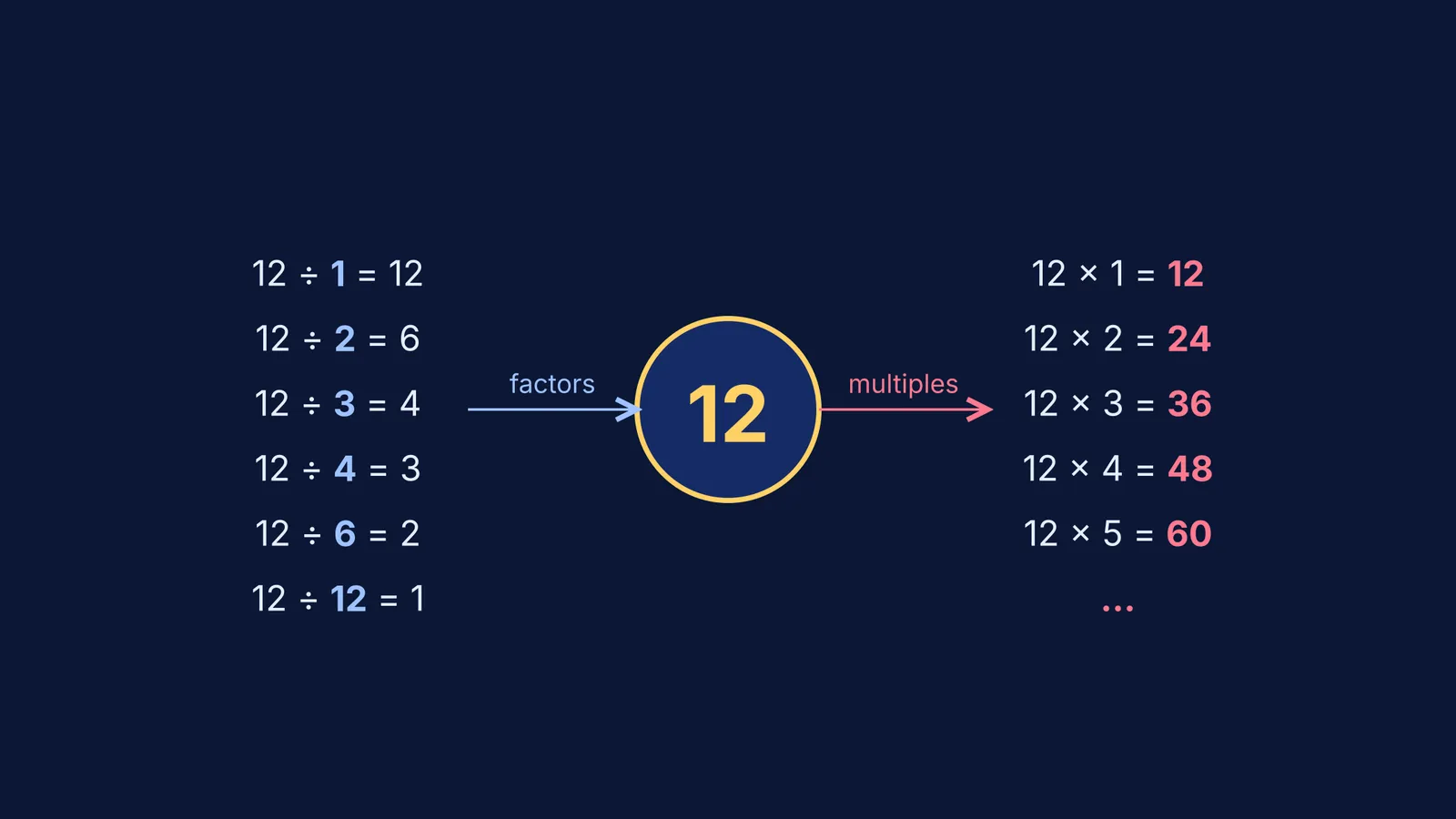
A factor is an exact divisor of a number. This means that if you divide a number by its factor, the remainder is exactly zero. For instance, the factors of 12 are 1, 2, 3, 4, 6, and 12.
There are a few steady rules that apply to factors:
1 is a factor of every number, because 1 divides into everything perfectly.
Every number is a factor of itself, because any number divided by itself is 1.
Factors are finite. There is a fixed, countable list of factors for any given number.
Factors are smaller than or equal to the number you started with.
What is a multiple?
A multiple is the result you get when you multiply a given number by an integer (a whole number like 1, 2, 3, and so on). You can think of multiples as the "times table" for that number. For example, the multiples of 12 are 12, 24, 36, 48, 60, and they keep going.
The rules for multiples are the mirror image of those for factors:
Every number is a multiple of itself, because the number multiplied by 1 equals itself.
Multiples are infinite. Because numbers go on forever, you can never write down every multiple of a number.
Multiples are greater than or equal to the number you started with.
How are factors different from multiples?
The core difference lies in the operation they represent in relation to the original number. Factors divide into the number, whereas the number divides into its multiples.
If you take an equation like 4 × 5 = 20, both terms are present:
4 and 5 are factors of 20.
20 is a multiple of both 4 and 5.
This relationship is also why students sometimes mix up the methods for finding the Highest Common Factor (HCF) and the Lowest Common Multiple (LCM) when working with fractions or quadratic word problems in Class 10. If you find yourself confusing the steps for these algorithms, the Fermi Problem Library has worked problems with a step-by-step solver that explains the reasoning rather than printing an answer.
Finding factors and multiples
When you need to list the factors of a number, a good strategy is to find them in pairs. For the number 12, start with 1 and the number itself (1 × 12). Then test 2 (2 × 6). Then test 3 (3 × 4). By working inwards from both ends, you ensure you do not miss any factors. When the pairs meet in the middle, you have a complete list. This finite nature means you can always be certain when you have found every single factor.
For multiples, the process is as simple as reciting a times table. You start at the number and add it repeatedly. Because numbers are infinite, you will only ever list multiples up to a certain boundary, such as "the first five multiples of 12". The lists are boundless, reflecting how multiplication builds numbers up indefinitely.
Common mistakes in exams
Students frequently lose marks in mathematics tests by confusing the two concepts when reading questions. If a question asks for the "highest common factor", it is looking for a divisor. The answer will be equal to or smaller than the numbers you are given. If it asks for the "lowest common multiple", it wants a product. The answer will be equal to or larger than the given numbers.
Another common trap is the number 0. While 0 is a multiple of every number (since any integer multiplied by zero is zero), it is never a factor. Division by zero is undefined, so 0 cannot divide exactly into any other number.
Putting it together
When you simplify fractions or are working with fractions in Class 6, knowing whether you are looking for a piece of a number (a factor) or a larger target number (a multiple) helps you choose the right tool. To find a factor, use division. To find a multiple, use multiplication.


