

On this page
Some olympiad problems look impossible until you ask one question: what is the smallest, or the largest, thing here? That move is the extremal principle, and it turns many long arguments into short ones.
What is the extremal principle in olympiad maths?
The extremal principle means choosing the object that maximises or minimises some quantity, then using the fact that nothing can beat it. Jacob Tsimerman's University of Toronto problem-solving handout puts it this way: pick such an object, and "any perturbation of it must yield something less extreme." Arthur Engel's training book Problem-Solving Strategies (Springer, 1998) gives the extremal principle its own chapter, pages 39 to 57.
It works in two directions:
Contradiction: assume the bad thing happens, look at the extreme case, and find something more extreme still. That is impossible.
Construction: to show a good arrangement exists, take the best one by some measure and show any flaw could be fixed to make it better.
How does the smallest element force a contradiction?
Worked example 1 is a version of a problem on Alexander Bogomolny's Cut-the-Knot page on the extremal principle. Every square of an infinite chessboard holds a positive whole number, and each number is the average of its four neighbours. Prove that all the numbers are equal.
Any collection of positive whole numbers has a smallest member, so some square holds the minimum value m.
Its four neighbours are each at least m, and their average is m.
If any neighbour were bigger than m, the average would be bigger than m. So all four equal m.
Repeat from each neighbour. You can walk to every square, so every square holds m.
Step 1 matters. If negative numbers were allowed, there might be no smallest one, and the claim fails: write each square's column number in it, and every number is still the average of its neighbours.
How can the extremal principle prove that something exists?
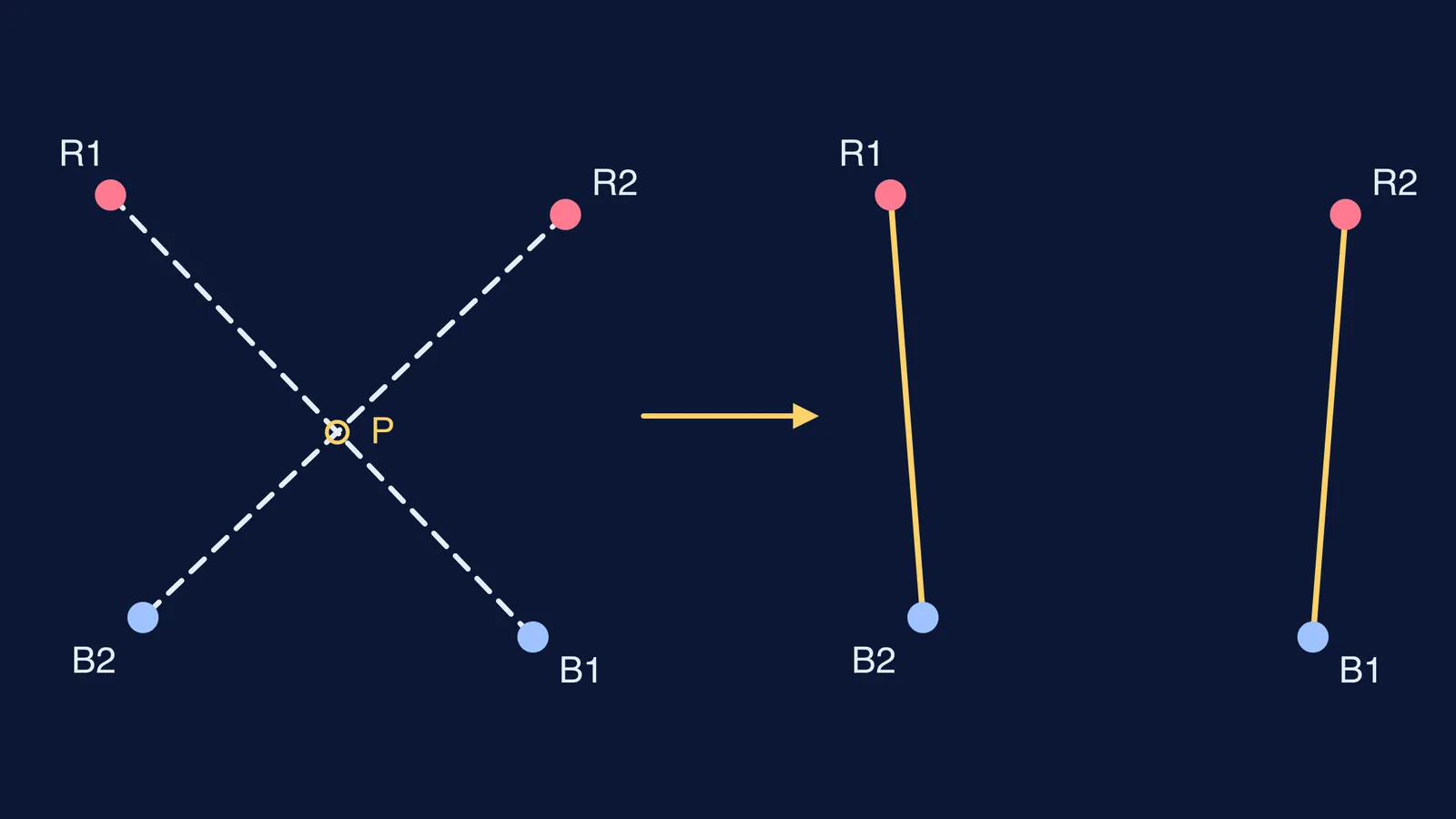
Worked example 2 is from the Toronto handout. You have 2n points in the plane, no three on a line; n are red and n are blue. Can you join them in red-blue pairs with n segments, no two of which touch? The handout's hint: consider the matching with the shortest total length.
There are finitely many ways to pair red with blue, so one has the smallest total length. Call it M.
Suppose two segments of M, say R1B1 and R2B2, cross at a point P.
Swap partners. By the triangle inequality, R1B2 is shorter than R1P + PB2, and R2B1 is shorter than R2P + PB1 (strictly, since no three points are on a line).
Adding these, the new segments are shorter than R1B1 + R2B2, giving a matching shorter than M. Impossible.
So M has no crossings, and a non-crossing matching always exists. You never had to draw it; choosing the minimum did the work.
How do you decide which extreme to pick?
Use this checklist when you are stuck:
Name the quantity the problem cares about: a value, a distance, an area, a count, a total length.
Check that a maximum or minimum exists.
Pick the extreme that makes the bad case look worst, or the good case look closest.
Ask: if the claim failed for this object, could I build something more extreme? If yes, that is your contradiction.
Write it as "Consider the ... with the smallest ..., which exists because ...".
Tsimerman's hints show how varied the choice can be: the same-coloured triangle of smallest area, the row or column with the fewest rooks, the sheet of paper whose removal uncovers the least area. The Sylvester-Gallai theorem, posed by J. J. Sylvester in 1893, has a short proof by L. M. Kelly that starts from the point-line pair at the smallest positive distance, as the account of the Sylvester-Gallai theorem on Wikipedia explains.
If your trouble is picking the wrong extreme, study solved problems where you can see why one choice works. The Fermi Problem Library has worked problems with a step-by-step solver that explains the reasoning rather than printing an answer.
Where should you practise next?
Two other olympiad tools sit beside this one: see our guide to pigeonhole principle problems and our explainer on the invariants method for puzzles. When you are ready to write full solutions, read how to write proofs for INMO. To revise the triangle inequality or proof by contradiction, the Fermi Concept Library covers every concept in mathematics, each with its own lesson.


