

On this page
Equations like 4ˣ − 6·2ˣ − 16 = 0 look strange until you notice that 4ˣ is just (2ˣ)². Once you see that, the problem is a quadratic you already know how to solve. Below: the substitution, the log method for different bases, and the check where marks are lost, rejecting roots that cannot happen.
When should you substitute t = aˣ?
Substitute when every exponential term can be written as a power of one quantity, aˣ. Look for these patterns:
Squares of one base: 4ˣ = (2ˣ)², 9ˣ = (3ˣ)², 25ˣ = (5ˣ)².
Shifted exponents: 2^(x+1) = 2·2ˣ and 3^(x−2) = 3ˣ/9.
Reciprocal pairs: 2^(−x) = 1/2ˣ.
If the index rules feel shaky, revise them first with our post on exponents and the laws of indices in Class 8. The whole method rests on (aᵐ)ⁿ = aᵐⁿ and aᵐ·aⁿ = aᵐ⁺ⁿ.
The key fact for checking answers is that the range of aˣ (with a > 0, a ≠ 1) is (0, ∞), as OpenStax College Algebra 2e, section 6.2 lists. So t = aˣ is always strictly positive, whatever real x is.
How do you solve an exponential equation by substitution?
Work through 4ˣ − 6·2ˣ − 16 = 0 in five steps.
Rewrite in one base: (2ˣ)² − 6·2ˣ − 16 = 0.
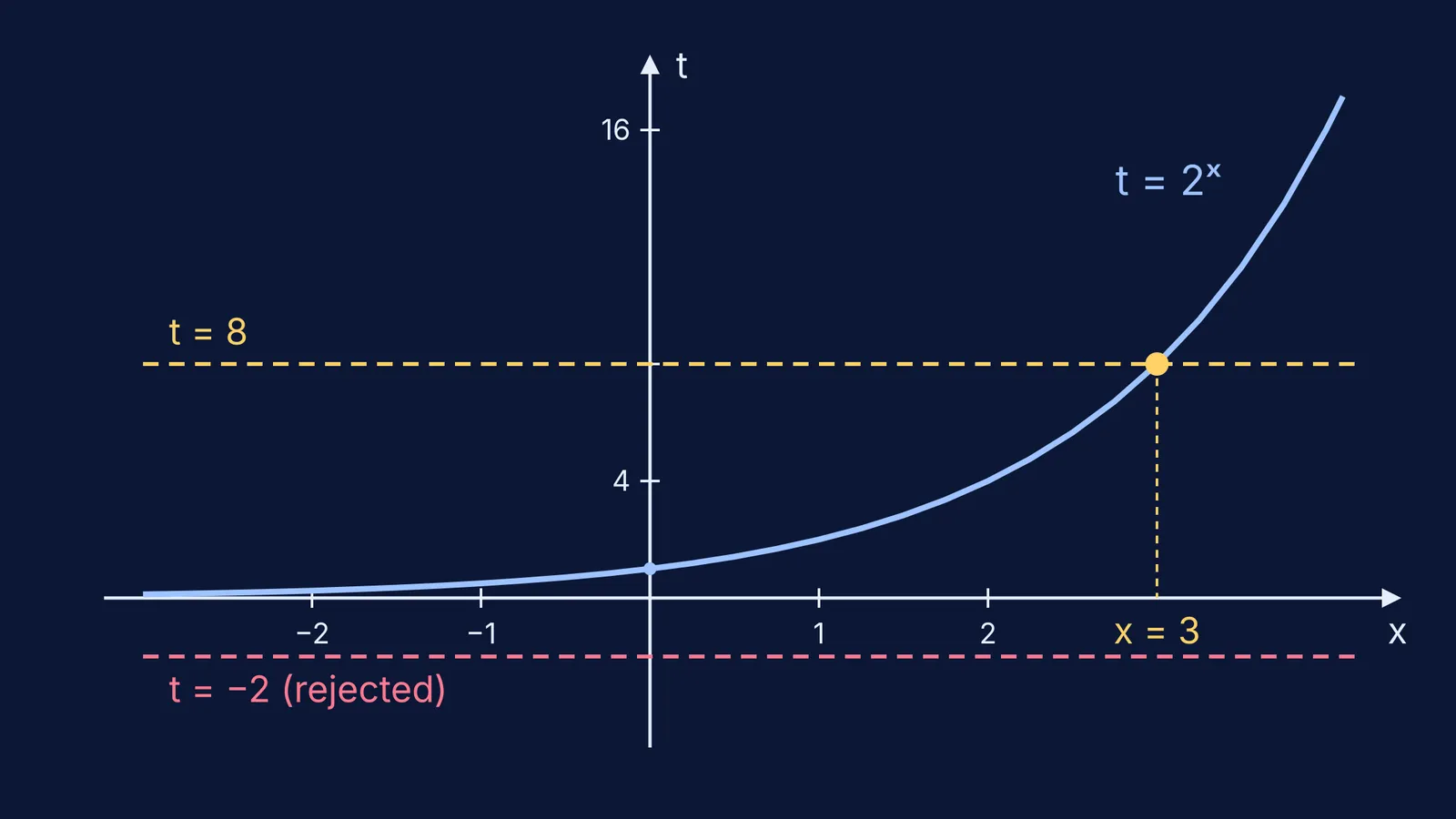
Put t = 2ˣ, and note t > 0: t² − 6t − 16 = 0.
Solve the quadratic: (t − 8)(t + 2) = 0, so t = 8 or t = −2.
Reject t = −2, because 2ˣ is never negative. Keep t = 8.
Convert back: 2ˣ = 8 = 2³, so x = 3.
Check in the original: 4³ − 6·8 − 16 = 64 − 48 − 16 = 0. Step 5 uses the one-to-one property, which OpenStax College Algebra 2e, section 6.6 states as bˢ = bᵀ if and only if S = T. The same section treats equations "in quadratic form" this way and rejects a root such as eˣ = −7 because a positive number never equals a negative one.
What about aˣ + a⁻ˣ?
For 2ˣ + 2^(−x) = 5/2, put t = 2ˣ so that 2^(−x) = 1/t. Multiply through by 2t: 2t² − 5t + 2 = 0, giving t = 2 or t = 1/2. Both are positive, so x = 1 or x = −1.
There is a fast impossibility test here. For t > 0, t + 1/t ≥ 2, so an equation like 2ˣ + 2^(−x) = 1 has no real solution at all. Our post on the AM-GM inequality in JEE maths explains where that bound comes from.
How do you solve exponential equations with different bases?
If the bases cannot be made equal, as in 3^(x+1) = 5ˣ, take the logarithm of both sides. That is the first step of the OpenStax procedure for unlike bases, in the same section on exponential and logarithmic equations.
Take ln of both sides: (x + 1) ln 3 = x ln 5.
Collect x terms: x (ln 5 − ln 3) = ln 3.
Solve: x = ln 3 / (ln 5 − ln 3) = ln 3 / ln(5/3), which is about 2.15.
Check: 3^3.15 and 5^2.15 both come to about 31.8. Any base works for the log, so base 10 gives the same x; the story of how base-10 tables were first built is in our piece on Henry Briggs and common logarithms.
A common slip is writing log(3^(x+1)) as log 3^x + 1. The whole exponent comes down as a factor: (x + 1) log 3.
Which roots should you reject, and why?
Run this checklist before you write the final answer.
Is every value of t positive? Reject t ≤ 0, because aˣ never reaches zero or goes below it.
Did both roots of the quadratic come out negative? Then the equation has no real solution. For example, 4ˣ + 3·2ˣ + 2 = 0 gives t = −1 or t = −2, so it has no real root.
Did you multiply by an expression in t? Multiplying by t is safe because t > 0, but substitute each answer back into the original anyway.
Did you take a log? Both sides must be positive before you take it.
Is t = 1? Then x = 0, a valid root.
Many errors here are method errors, not arithmetic. If you keep getting a different answer from the key, the Fermi Problem Library has worked problems with a step-by-step solver that explains the reasoning rather than printing an answer, so you can see the step where your working went wrong. If the gap is in logs or indices themselves, the Fermi Concept Library gives each mathematics concept its own lesson.
Try it now: solve 9ˣ − 4·3ˣ + 3 = 0, check which values of t survive, and confirm that x = 0 and x = 1 both work in the original.


