

On this page
This conversion asks for two things: one extra carbon on the ethyl group, and an –OH on the end of the new chain. Ethylmagnesium chloride has the formula C₂H₅MgCl, so it brings two carbons (PubChem, CID 75432). Propan-1-ol has the formula C₃H₈O, with its –OH on carbon 1 (PubChem, CID 1031). The missing carbon must also be the one that ends up holding the –OH.
How do you convert ethylmagnesium chloride to propan-1-ol?
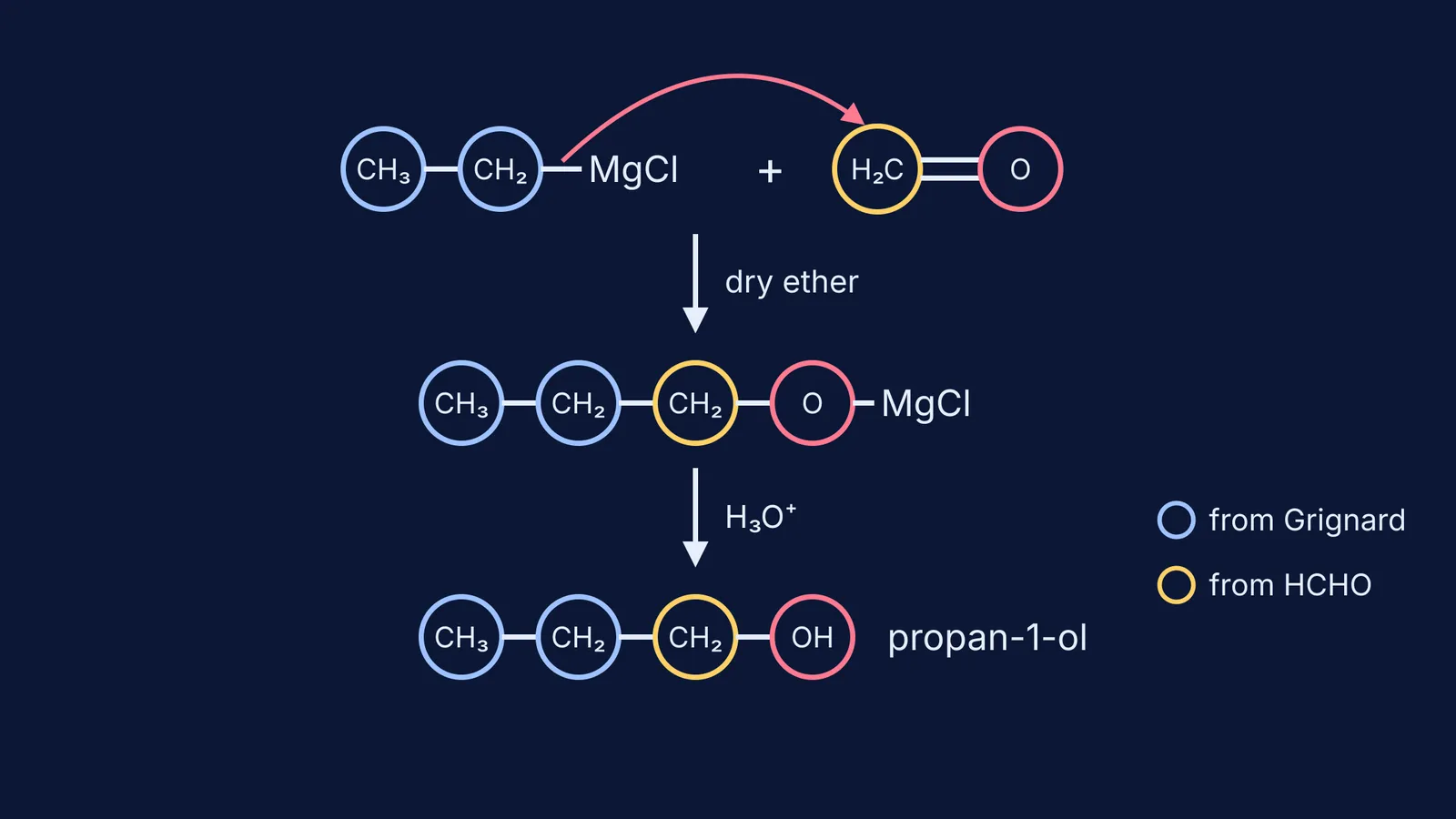
The NCERT Class 12 chemistry textbook gives the general equation: HCHO + RMgX gives RCH₂OMgX, which hydrolyses to RCH₂OH + Mg(OH)X (NCERT Class 12 Chemistry, Unit 7, "From Grignard reagents"). Put R = C₂H₅ and X = Cl and you have the answer:
Addition: CH₃CH₂MgCl + HCHO, in dry ether, gives CH₃CH₂CH₂OMgCl. The ethyl carbon bonded to magnesium attacks the carbonyl carbon of methanal and forms a new C–C bond.
Hydrolysis: CH₃CH₂CH₂OMgCl with dilute acid (H₃O⁺) gives CH₃CH₂CH₂OH, which is propan-1-ol, plus Mg(OH)Cl.
LibreTexts describes the same mechanism. The Grignard carbanion adds to the carbonyl carbon to form a C–C bond, and the alkoxide intermediate becomes an alcohol when an acidic aqueous solution is added (LibreTexts, Alcohols from Carbonyl Compounds: Grignard Reagents/17:_Alcohols_and_Phenols/17.05:_Alcohols_from_Carbonyl_Compounds-_Grignard_Reagents)). Another LibreTexts page adds the practical warning: "Everything must be perfectly dry because Grignard reagents react with water" (LibreTexts, Reactions with Grignard Reagents/Aldehydes_and_Ketones/Reactivity_of_Aldehydes_and_Ketones/Reactions_with_Grignard_Reagents)).
Why does methanal give a primary alcohol?
NCERT states the rule in one line: the reaction "produces a primary alcohol with methanal, a secondary alcohol with other aldehydes and tertiary alcohol with ketones" (NCERT Class 12 Chemistry, Unit 7).
The reason is which carbon becomes the alcohol carbon. The carbonyl carbon ends up holding the –OH. It keeps every group it already had and gains one more from the Grignard reagent:
Methanal (H₂C=O) has two hydrogens on that carbon, so the product carbon holds the ethyl group and two hydrogens. That is a –CH₂OH end, which makes a primary alcohol.
Any other aldehyde (RCHO) has one carbon group and one hydrogen, so the product has two carbon groups on the alcohol carbon. That makes a secondary alcohol.
A ketone (RCOR′) already has two carbon groups, and adding a third gives a tertiary alcohol.
Methanal is the only aldehyde whose carbonyl carbon carries two hydrogens. That is why, among aldehydes and ketones, only methanal gives a primary alcohol with a Grignard reagent. Our guide to Grignard reagent reactions shows the same reagent with other partners.
What happens if you pick the wrong carbonyl?
Run the same ethyl Grignard reagent through each type of carbonyl, and only one choice gives the target:
With methanal (one carbon), you get CH₃CH₂CH₂OH: propan-1-ol, three carbons, primary.
With ethanal (two carbons), you get CH₃CH(OH)CH₂CH₃: butan-2-ol, four carbons, secondary.
With propanone (three carbons), you get (CH₃)₂C(OH)CH₂CH₃: 2-methylbutan-2-ol, five carbons, tertiary.
NCERT's Example 7.2 shows the ketone pattern. Propanone with methylmagnesium bromide, followed by hydrolysis, gives 2-methylpropan-2-ol (NCERT Class 12 Chemistry, Unit 7). Esters are a separate trap, explained in why esters give tertiary alcohols with Grignard reagents.
How do you choose the carbonyl in any Grignard conversion?
Run this two-question check before you write a reagent:
Count carbons. Subtract the carbons in the Grignard reagent from the carbons in the product. What is left is what the carbonyl must supply. Here, 3 − 2 = 1, which points to methanal.
Classify the alcohol. A primary alcohol needs methanal, a secondary one needs another aldehyde, and a tertiary one needs a ketone. Propan-1-ol is primary, which points to methanal again.
If both answers point to the same compound, write it. If they disagree, check the product structure and the Grignard reagent again. For harder targets, see how to choose the carbonyl in a Grignard retrosynthesis.
If you keep reaching for the wrong carbonyl in conversion questions, the Fermi Problem Library has worked problems with a step-by-step solver that explains the reasoning rather than printing an answer. If the difference between primary, secondary and tertiary alcohols still feels shaky, the Fermi Concept Library gives each chemistry concept its own lesson.
Next, try the same check on butan-1-ol. Which Grignard reagent would you pair with methanal to make it?


