

On this page
Victor Grignard was awarded the 1912 Nobel Prize in Chemistry for discovering that organomagnesium halides can build complex carbon skeletons from simple blocks. Today, his method remains one of the most reliable ways to construct carbon-carbon bonds. One of the classic synthetic routes taught in organic chemistry is the reaction of an ester with a Grignard reagent.
Unlike many addition reactions, this sequence does not stop at a single addition. It continues inevitably until a tertiary alcohol is formed.
Why does an ester require two equivalents?
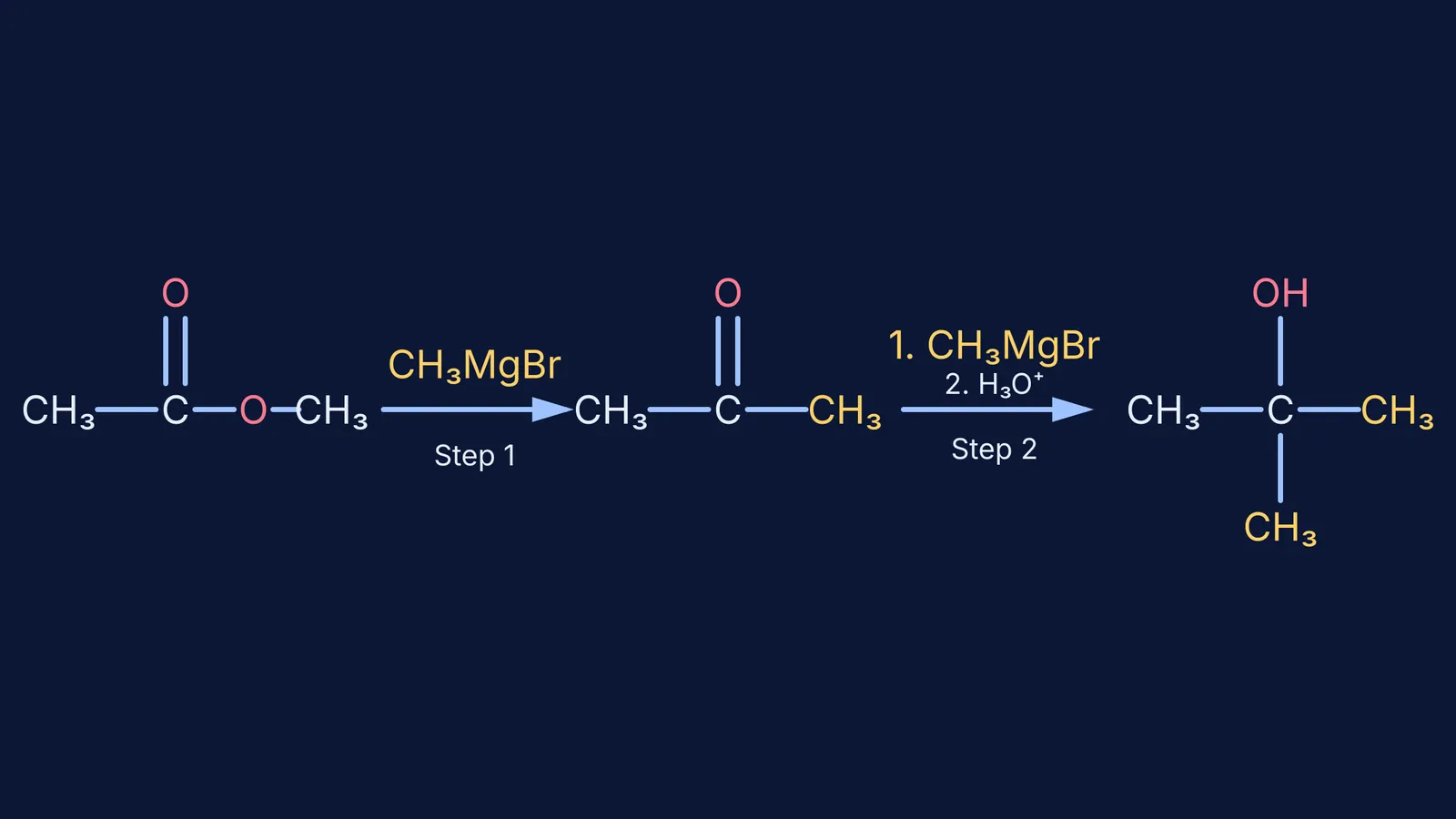
When you mix an ester with a Grignard reagent, the reaction consumes exactly two equivalents of the organometallic compound for every one molecule of the ester.
This happens because the reaction forms an intermediate that is more reactive than your starting material. You cannot easily isolate the halfway product. If you use only one equivalent of the Grignard reagent, you will not get a clean yield of the intermediate. Instead, you will get a messy mixture of the final tertiary alcohol, unreacted ester, and a small amount of the intermediate. To get a high yield of a single product, chemists intentionally add an excess of the Grignard reagent to drive the reaction to completion.
How does the mechanism work?
The transformation of an ester into a tertiary alcohol happens in two distinct stages before the final aqueous workup.
Step 1: Nucleophilic acyl substitution. The nucleophilic carbon of the Grignard reagent attacks the electrophilic carbonyl carbon of the ester. This forms an unstable tetrahedral intermediate. The negatively charged oxygen is not stable, so its lone pair immediately pushes back down to reform the carbon-oxygen double bond. This action kicks out the alkoxide group (the –OR portion of the ester) as a leaving group. This elimination step yields a ketone.
Step 2: Nucleophilic addition. Ketones are more electrophilic and less sterically hindered than esters. Because the newly formed ketone is more reactive than the original ester, the second equivalent of the Grignard reagent attacks the ketone instantly. This second nucleophilic addition forms a stable tertiary alkoxide ion.
Step 3: Acidic workup. The reaction is finished by adding a dilute acid to the flask. This protonates the negatively charged alkoxide oxygen, yielding the final tertiary alcohol.
Because the ketone intermediate never survives the reaction flask, the final tertiary alcohol will always have at least two identical alkyl groups. Both of these identical groups were delivered by the two equivalents of the Grignard reagent.
How do you plan the synthesis backwards?
Retrosynthetic analysis is the skill of looking at a target molecule and breaking it down into simpler starting materials. When a JEE or NEET problem asks you to synthesize a specific tertiary alcohol, your first step is to look at the alkyl groups attached to the central carbon.
To plan the synthesis of a tertiary alcohol from an ester:
Find two identical groups attached to the alcohol carbon.
These two identical groups must come from the Grignard reagent. For example, if the product has two methyl groups, your reagent must be methylmagnesium bromide.
The rest of the carbon skeleton (including the oxygen) comes from the ester.
Let us look at a worked example. Suppose you need to synthesize 2-phenylpropan-2-ol. The central carbon is attached to one phenyl group and two methyl groups. Since there are two identical methyl groups, they must come from the Grignard reagent (methylmagnesium bromide). The remaining piece is the phenyl group attached to a carbon with an oxygen. This tells you that the starting ester must be a benzoate, such as methyl benzoate.
If you need a tertiary alcohol where all three alkyl groups are different, an ester will not work. You would need to start with a ketone and add a single equivalent of a different Grignard reagent.
When you are trying to trace back a complex synthesis or distinguish isomers of an alcohol, it is easy to lose track of the carbon count or the mechanism. The Fermi Problem Library has a step-by-step solver that explains the reasoning for retrosynthesis, rather than just printing the final answer. If you have gaps in understanding why a ketone is more reactive than an ester, the Fermi Concept Library maps out nucleophilic addition and substitution so you can see exactly why the intermediate does not survive.
Mastering these reaction mechanisms is much more reliable than memorising outcomes, especially when compared to reactions like reducing carbonyls with Clemmensen or Wolff-Kishner, where the oxygen is removed entirely. By tracking the electrons, the requirement for two equivalents makes perfect logical sense.


