

On this page
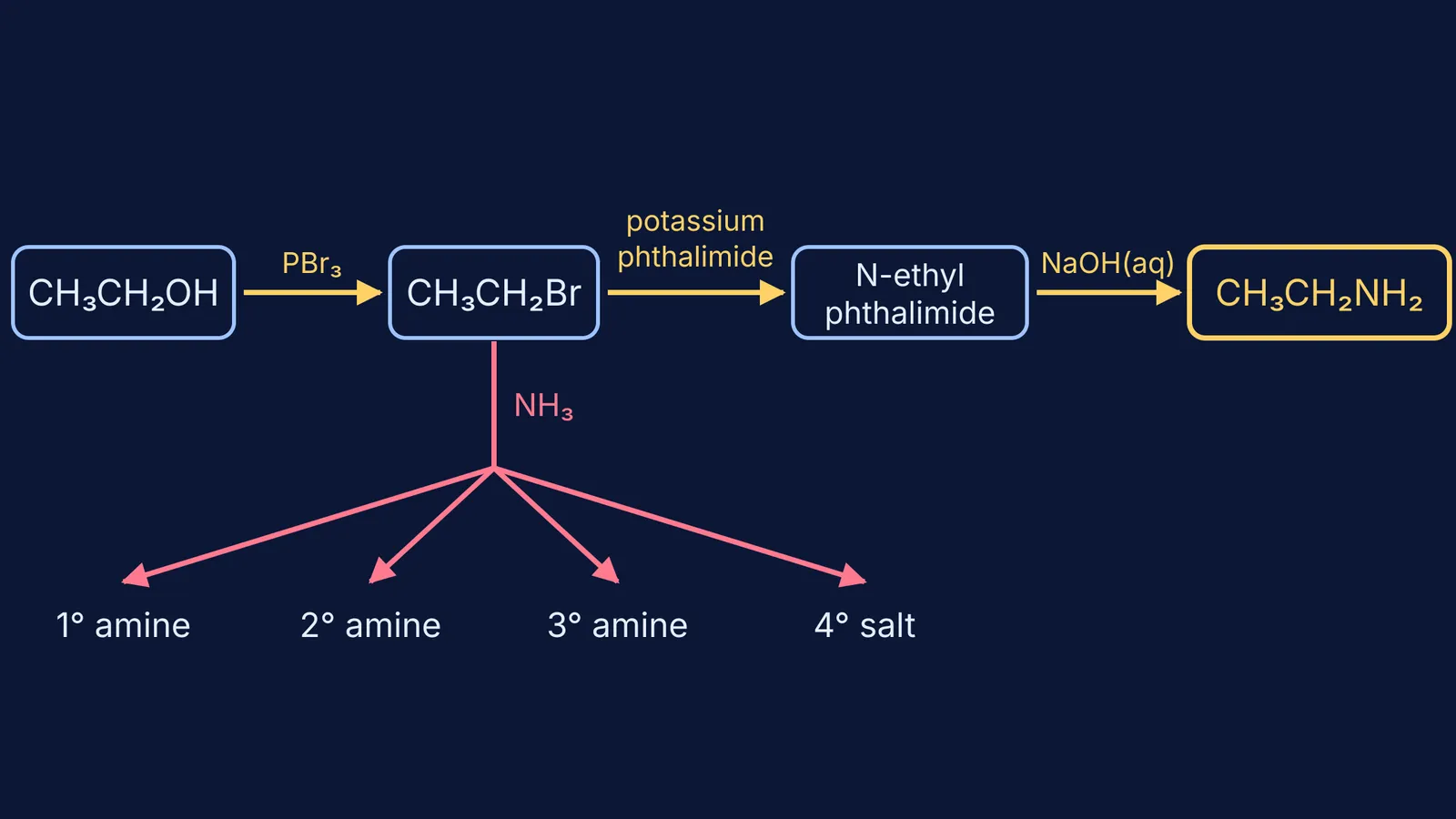
"Convert ethanol to ethanamine" looks like a two-line answer: make bromoethane, add ammonia. That route works on paper, but it does not stop at ethanamine. If the question asks for the primary amine alone, the standard answer is the Gabriel phthalimide synthesis. Here is the full route, why it works, and how to write it in an exam.
Why doesn't bromoethane plus ammonia give only ethanamine?
Ammonia attacks the carbon bonded to bromine and replaces the halogen with an –NH₂ group. NCERT calls this ammonolysis and notes it is carried out in a sealed tube at 373 K (NCERT Class 12 Chemistry, Unit 9: Amines).
The problem is what happens next. Ethanamine still has a lone pair on nitrogen, so it is a nucleophile too. It attacks another molecule of bromoethane to give N-ethylethanamine, which reacts again to give N,N-diethylethanamine, and finally a quaternary ammonium salt. NCERT's own worked example shows exactly this chain starting from chloroethane, and states that ammonolysis "has the disadvantage of yielding a mixture of primary, secondary and tertiary amines and also a quaternary ammonium salt" (NCERT, Unit 9).
A large excess of ammonia makes the primary amine the major product, the same chapter says, but "major" is not "only". We cover the mechanism step by step in why ammonolysis of alkyl halides yields a mixture of amines.
What is the three-step Gabriel route from ethanol?
Ethanol cannot go straight into the Gabriel synthesis, because the reaction needs an alkyl halide. So step 1 swaps –OH for –Br.
Ethanol to bromoethane. NCERT lists phosphorus tribromide (often made in situ from red phosphorus and bromine) and constant-boiling 48% HBr for making alkyl bromides from alcohols (NCERT Class 12 Chemistry, Unit 6: Haloalkanes and Haloarenes). Write: 3 CH₃CH₂OH + PBr₃ → 3 CH₃CH₂Br + H₃PO₃.
Make the phthalimide anion and alkylate it. Phthalimide with ethanolic KOH gives potassium phthalimide. Heating this with bromoethane gives N-ethylphthalimide (NCERT, Unit 9); the other product is KBr.
Hydrolyse to free the amine. Aqueous NaOH breaks N-ethylphthalimide into the sodium salt of phthalic acid and CH₃CH₂NH₂, ethanamine.
Why does this stop at the primary amine? In N-ethylphthalimide the nitrogen carries no hydrogen, and its lone pair is pulled into the two neighbouring C=O groups. It cannot attack a second bromoethane, so there is no route to the secondary amine. The ethyl group goes on once, and only once. The method is named after S. Gabriel, who described this way of making primary amines from halogen compounds in 1887 (Berichte der deutschen chemischen Gesellschaft, vol. 20).
Two physical facts make the route feel real. Bromoethane boils at about 38 °C (PubChem: ethyl bromide), and ethanamine boils at 16.6 °C (PubChem: ethylamine), so on a warm Indian afternoon your product is a gas. That fits NCERT's note that the lower aliphatic amines are gases with a fishy odour.
For more on why Gabriel fails for aniline (aryl halides do not undergo this substitution), see Gabriel phthalimide synthesis: why it gives only primary amines.
That trap is worth a second look in Hofmann bromamide degradation: losing one carbon to an amine.
Which route should you write in the exam?
Read the wording before you pick.
"Pure", "only" or "free from secondary and tertiary amines": write the Gabriel route, all three steps.
Just "convert" with no purity condition: you can write ammonolysis of bromoethane with a large excess of ammonia, but add one line saying a mixture forms and why.
A route through an amide: reducing ethanamide with LiAlH₄ gives ethanamine with the same carbon count, since NCERT shows R–CONH₂ going to R–CH₂–NH₂. It needs more steps from ethanol, so use it only if the question steers you there.
Here is a model answer you can copy into your notes:
CH₃CH₂OH + PBr₃ → CH₃CH₂Br (bromoethane)
Phthalimide + KOH (ethanolic) → potassium phthalimide; + CH₃CH₂Br, heat → N-ethylphthalimide + KBr
N-ethylphthalimide + NaOH (aq) → CH₃CH₂NH₂ + sodium phthalate
One-line reason: the nitrogen in N-ethylphthalimide has no N–H, so it cannot be alkylated twice; only the primary amine forms.
How do you check a conversion answer before moving on?
Run this four-point check on every conversion question, not just this one:
Count carbons at the start and the end.
Name the functional group after each arrow.
Ask whether the product of any step can react again with the same reagent. If yes, you may have a mixture.
Make sure the last step releases the free amine, not a salt.
If a conversion keeps going wrong at the same step, the Fermi Problem Library has worked problems with a step-by-step solver that explains the reasoning rather than printing an answer. If the gap is the idea underneath, such as why a lone pair makes something a nucleophile, the Fermi Concept Library gives each concept its own lesson.


