

On this page
When you study three-dimensional geometry for JEE or board exams, the symmetric equation of a line is one of the first tools you learn. It connects a point on the line with the line's direction, allowing you to find distances, intersections, and angles.
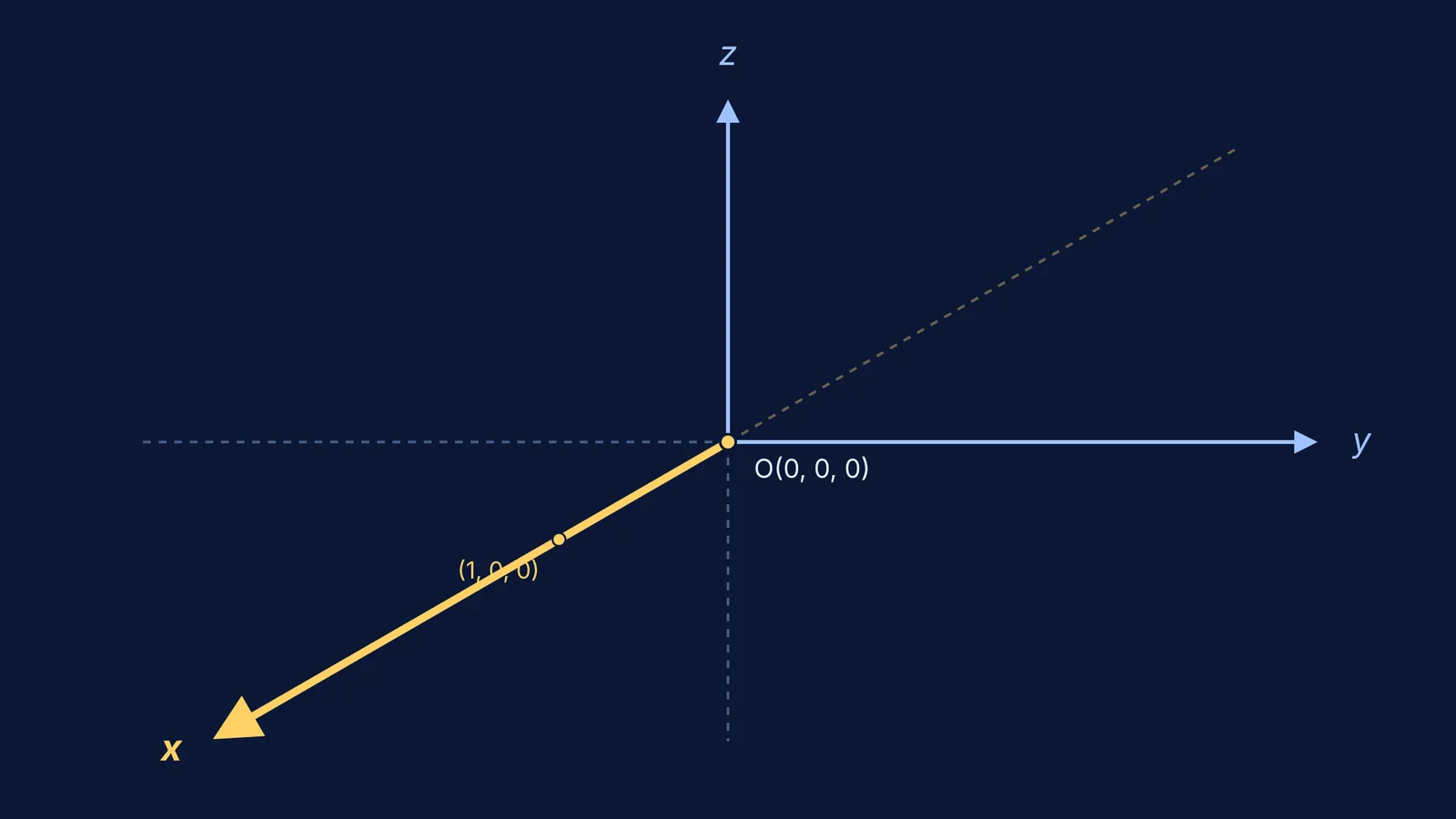
The symmetric equation of the x-axis is a special case: x/1 = y/0 = z/0. Because division by zero is usually a strict mathematical error, this notation often confuses students. The zero in the denominator does not mean you are dividing by zero; it is a shorthand convention that tells you exactly how the line behaves in 3D space.
What is the equation of the x-axis in 3D symmetric form?
To write the symmetric equation of any line in 3D, you need two things: a point the line passes through, (x₁, y₁, z₁), and its direction ratios, (a, b, c). According to OpenStax Calculus Volume 3, solving each parametric equation for the line's parameter yields the symmetric form (x - x₁)/a = (y - y₁)/b = (z - z₁)/c.
The x-axis passes through the origin, which gives us the point (0, 0, 0). Its direction is entirely along the x-direction, meaning it has no component in the y or z directions. Therefore, its direction ratios are (1, 0, 0).
Substituting these into the symmetric formula gives the equation of the x-axis in 3D symmetric form: x/1 = y/0 = z/0.
What does a zero denominator mean in a symmetric equation?
In arithmetic, writing a zero in the denominator is undefined. However, in the coordinate geometry of lines, a zero denominator is a formal notation that means the corresponding coordinate does not change.
When you see x/1 = y/0 = z/0, it is a way of packaging three facts into one expression. The parts with zero denominators imply that the numerators must also be zero to keep the ratio consistent. So, y/0 means that y = 0, and z/0 means that z = 0.
Geometrically, the equation y = 0 represents the xz-plane, and z = 0 represents the xy-plane. The x-axis is simply the straight line where these two planes intersect. If you are struggling to picture planes and intersections, the Fermi Concept Library holds every concept in mathematics, each with its own lesson and its place in the map.
How do you write equations for lines parallel to the axes?
Once you understand what the zeros mean, writing the symmetric equation for any line parallel to a coordinate axis becomes straightforward. A line parallel to an axis shares its direction ratios.
Parallel to the x-axis: Direction ratios are (1, 0, 0). A line passing through the point (2, 3, 4) has the equation (x - 2)/1 = (y - 3)/0 = (z - 4)/0. This line lies in the planes y = 3 and z = 4.
Parallel to the y-axis: Direction ratios are (0, 1, 0). A line through (2, 3, 4) is (x - 2)/0 = (y - 3)/1 = (z - 4)/0.
Parallel to the z-axis: Direction ratios are (0, 0, 1). A line through (2, 3, 4) is (x - 2)/0 = (y - 3)/0 = (z - 4)/1.
If you want to practice finding these equations, the Fermi Problem Library has worked problems with a step-by-step solver that explains the reasoning rather than printing an answer.
Why use this notation instead of parametric equations?
You might wonder why we use a confusing notation with zeros in the denominator instead of writing out the parametric equations. The parametric equations for the x-axis are x = λ, y = 0, z = 0.
The symmetric form is preferred in textbooks and exam papers because it allows every straight line, regardless of its direction, to be written in a single, standard format. It is a compact way to display the point and direction vector at a glance, which is essential when calculating the angle between two lines or finding the shortest distance between skew lines. When converting this form to parametric equations, you simply set the non-zero ratios equal to a parameter λ, and read off the constant coordinates directly from the zero denominators.
If you are preparing for competitive exams, you can review our guide to 3D geometry for JEE: lines, planes and distances with vectors. Vector algebra is closely tied to these concepts; for more on direction vectors, see our guide on Vector algebra for JEE maths: dot, cross and triple products. Understanding this notation ensures you do not waste time questioning the zeros when they appear in a paper.


