

On this page
Integral heat of solution and heat of dilution both measure an enthalpy change per mole of solute. The difference, which thermochemistry questions often test, is the starting point: pure solute, or a solution that already exists.
What is the difference between enthalpy of solution and enthalpy of dilution?
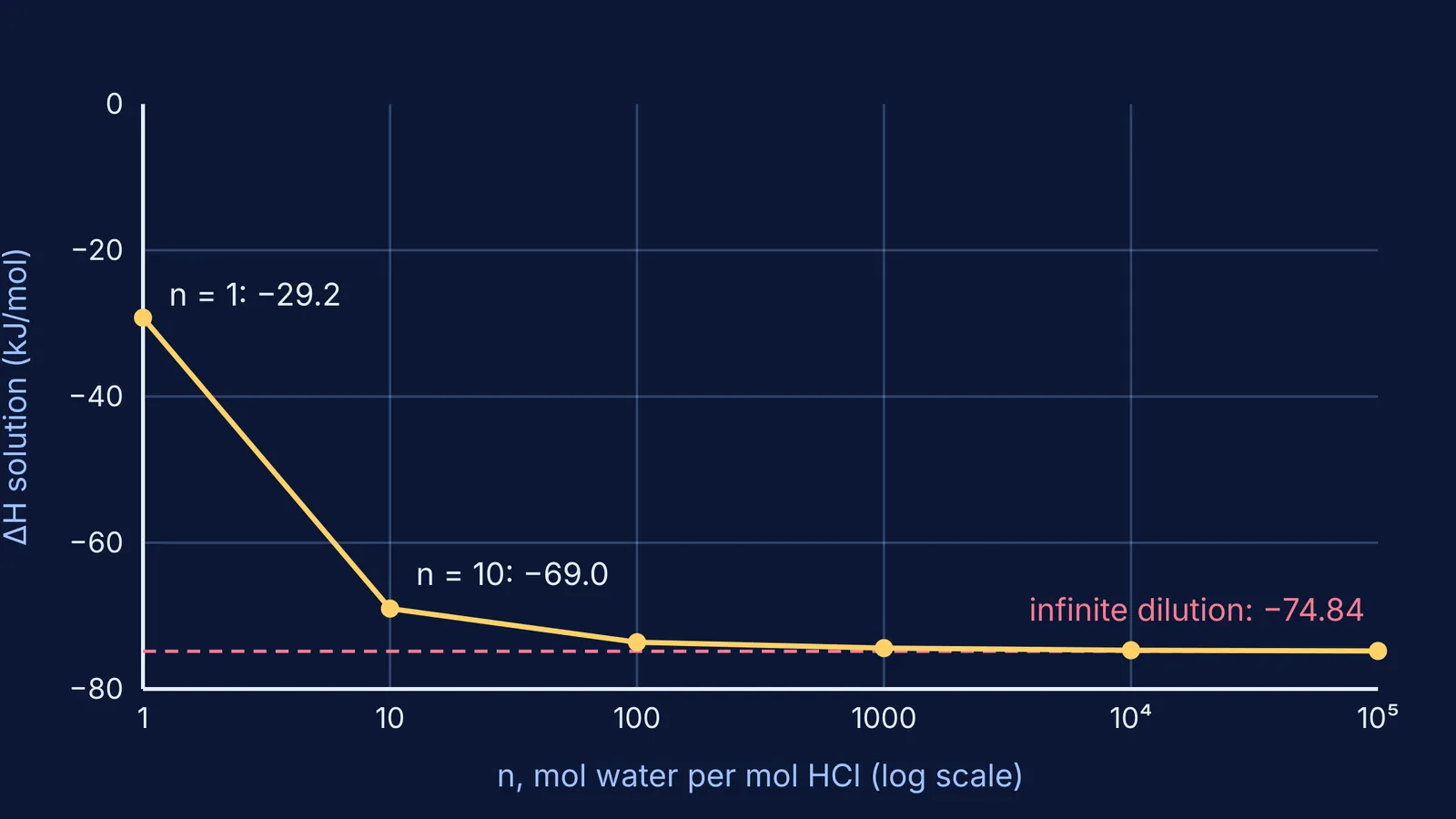
The integral heat of solution is the enthalpy change for dissolving 1 mole of solute in n moles of solvent, as defined in Duke University's physical chemistry lab manual on LibreTexts. As you add more water, it levels off at a limiting value (same manual). Data tables usually list that limit, the enthalpy of solution at infinite dilution (Wikipedia: Enthalpy change of solution).
The integral heat of dilution is the heat released or absorbed when a solution of known concentration is mixed with more solvent to give a more dilute solution of known concentration (same Duke manual). If the solute starts out as a pure liquid, dilution and dissolution are the same process (Wikipedia: Heat of dilution).
This is Hess's law: dissolving straight to n2 equals dissolving to n1, then diluting. Our guide to building Hess's law cycles that work covers the method.
Why does diluting concentrated acid release heat?
A concentrated acid has too few water molecules to surround every ion. Each added water can still bind to an ion, and forming that attraction releases energy. The first waters release the most; later ones find ions already surrounded, so the effect fades.
Hydrochloric acid shows this. V. B. Parker's 1965 compilation, Thermal Properties of Aqueous Uni-Univalent Electrolytes, as tabulated by Wikipedia: Heat of dilution, gives these figures at 25 °C:
Diluting HCl from 10 moles of water per mole of acid to infinite dilution releases 5.841 kJ per mole of HCl.
Diluting from 100 moles of water releases only 1.234 kJ per mole.
Dilution is not always exothermic: the same table shows perchloric acid absorbing 0.490 kJ per mole when diluted from 10 moles of water to infinite dilution.
Sulfuric acid is the one your lab teacher warns about. Adding water to concentrated (98%) sulfuric acid releases so much heat that the mixture can boil and spatter, which is why you add acid slowly to water and never water to acid (LibreTexts, Howard University general chemistry; Wikipedia: Sulfuric acid).
Worked example: diluting HCl from n = 10 to n = 100
The enthalpy of solution of HCl at infinite dilution, listed as hydrochloric acid, is −74.84 kJ/mol (Wikipedia: Enthalpy change of solution). Add Parker's dilution heats from above.
Integral heat of solution at n = 10: −74.84 + 5.841 = −69.00 kJ/mol.
Integral heat of solution at n = 100: −74.84 + 1.234 = −73.61 kJ/mol.
Heat of dilution = final − initial = −73.61 − (−69.00) = −4.61 kJ per mole of HCl.
For 0.50 mol of HCl, that comes to about −2.30 kJ, so the beaker warms up.
Shortcut: 5.841 − 1.234 = 4.607 kJ released per mole. The infinite-dilution value cancels out.
How do lattice and hydration enthalpy decide the sign?
For an ionic solid, the enthalpy of solution is the lattice enthalpy (positive, because you break the crystal apart) plus the hydration enthalpies of the ions (negative, because water binds to them), as set out in LibreTexts, Northern Michigan University. The same page gives these inputs:
Sodium chloride: lattice +788 kJ/mol, Na⁺ hydration −406 kJ/mol, Cl⁻ hydration −363 kJ/mol. The sum is +19 kJ/mol.
Calcium chloride: lattice +2258 kJ/mol, Ca²⁺ hydration −1650 kJ/mol, two Cl⁻ at −364 kJ/mol each. The sum is about −120 kJ/mol.
The tabulated values are +3.87 kJ/mol for NaCl (Wikipedia: Enthalpy change of solution) and −81.3 kJ/mol for CaCl₂ (LibreTexts, Howard University). For NaCl, two terms near 800 kJ almost cancel, so a small error in either flips the picture. For CaCl₂, the small, doubly charged Ca²⁺ holds water so strongly that hydration wins clearly.
Dilution has no lattice term: its heat comes only from changes in how solute and solvent interact. For why some salts dissolve and others don't, read our explainer on lattice versus hydration enthalpy.
How should you tackle these questions in an exam?
Write the n (moles of solvent per mole of solute) for every state in the question.
Decide whether each step starts from pure solute (solution) or from a solution (dilution).
Subtract the integral heats of solution, final minus initial.
Multiply by moles of solute, not moles of water.
Sanity-check the sign: adding water to concentrated HCl, HBr, HI or HNO₃ gives a negative value, but check the data rather than assume it.
If you keep losing marks on signs or on which n goes where, the Fermi Problem Library has worked problems with a step-by-step solver that explains the reasoning rather than printing an answer. If the gap is in lattice and hydration enthalpy themselves, each has its own lesson in the Fermi Concept Library.
To measure a heat of solution yourself, start with our walkthrough of constant-pressure calorimetry using q = mcΔT.


