

On this page
When you add water to bright white anhydrous copper(II) sulphate powder, it turns royal blue and releases heat, forming solid pentahydrate:
CuSO₄(s) + 5 H₂O(l) → CuSO₄·5H₂O(s)
In school practicals and exams like JEE Main and NEET-UG, finding the molar enthalpy change of this reaction (ΔH_hyd) is a standard problem. Yet measuring this heat directly in a calorimeter is practically impossible.
Why can you not measure the enthalpy of hydration directly?
Measuring hydration enthalpy directly presents physical obstacles documented in laboratory curricula like the NCERT Class 12 Chemistry Laboratory Manual. To form solid CuSO₄·5H₂O crystals without dissolving them, you must add exactly 5 moles of liquid water (90.1 g) per mole of anhydrous salt (159.6 g).
Mixing this stoichiometric water with the powder causes two problems:
Outer particles hydrate instantly into an impermeable crust, preventing water from reaching the interior.
The resulting thick paste cannot be stirred, causing localized hot spots and heat loss to the surroundings.
Adding excess water restores stirring, but it dissolves the salt into ions, turning hydration into dissolution.
How does Hess's law connect the two solution routes?
To find hydration enthalpy indirectly, chemists apply Hess's law of constant heat summation, referenced in the NIST Chemistry WebBook and our guide to Hess's law and thermochemical cycles. Because enthalpy is a state function, net heat change depends solely on initial and final states.
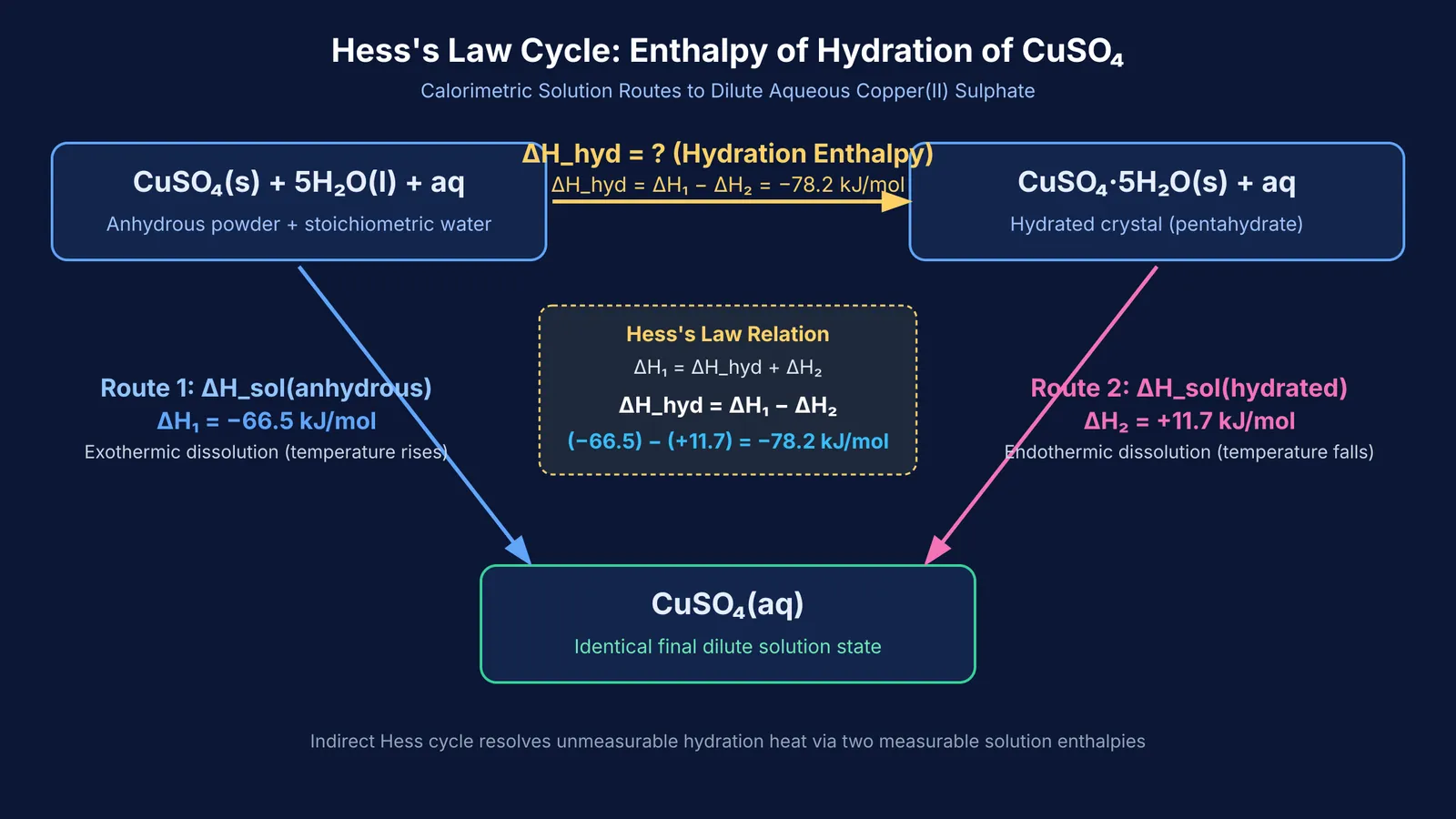
We reach the identical final state—dilute aqueous copper sulphate, CuSO₄(aq)—via two calorimetric routes:
Route 1 (Direct dissolution): Dissolving 1 mole of anhydrous CuSO₄(s) in excess water yields the enthalpy of solution of the anhydrous salt:
CuSO₄(s) + aq → CuSO₄(aq) [ΔH_sol(anhydrous)]
Route 2 (Indirect two-step dissolution): First hydrate 1 mole of anhydrous CuSO₄(s) to solid pentahydrate (ΔH_hyd), then dissolve the pentahydrate in excess water:
CuSO₄(s) + 5 H₂O(l) → CuSO₄·5H₂O(s) [ΔH_hyd] CuSO₄·5H₂O(s) + aq → CuSO₄(aq) [ΔH_sol(hydrated)]
Because both routes share identical initial reactants and final solutions, Hess's law requires:
ΔH_sol(anhydrous) = ΔH_hyd + ΔH_sol(hydrated)
Rearranging gives the hydration enthalpy:
ΔH_hyd = ΔH_sol(anhydrous) − ΔH_sol(hydrated)
When sign conventions in multi-step cycles get tangled, the Fermi Problem Library provides worked problems with a step-by-step solver that explains the reasoning rather than printing an answer.
Why is anhydrous copper sulphate exothermic while the hydrate is endothermic?
Dissolving an ionic solid balances two competing terms, explained in our guide to lattice enthalpy and Born-Haber cycles: endothermic lattice energy to break the crystal, and exothermic hydration energy when water surrounds the ions.
In anhydrous CuSO₄, bare Cu²⁺ and SO₄²⁻ ions bind water strongly. Thermodynamic data from Wagman et al. in the NBS Tables of Chemical Thermodynamic Properties show ion hydration releases more heat than the lattice consumes, making dissolution exothermic at −66.5 kJ/mol.
In copper sulphate pentahydrate (CuSO₄·5H₂O), four water molecules already coordinate to Cu²⁺ in the crystal, and the fifth hydrogen-bonds to sulphate oxygens. Because primary coordinate bonds already formed, dissolving the pentahydrate releases little extra solvation heat. Breaking the lattice consumes more energy than solvation returns, making dissolution endothermic at +11.7 kJ/mol in the NBS tables, matching calorimetry protocols in the NCERT Class 12 Chemistry Laboratory Manual.
To explore how ionic radii and coordination geometry govern energy balances, the Fermi Concept Library covers every concept in chemistry, each with its own lesson and its place in the map.
How do you calculate the enthalpy of hydration step by step?
Here is the standard calculation, validated against NIST thermochemical evaluations and our review of the calorimetry practical on enthalpies of solution:
Identify molar masses: anhydrous CuSO₄ is 159.6 g/mol, and CuSO₄·5H₂O is 249.7 g/mol (five water molecules add 90.1 g/mol).
Measure solution enthalpies in a calorimeter:
Anhydrous salt: ΔH_sol(anhydrous) = −66.5 kJ/mol (temperature rises).
Hydrated salt: ΔH_sol(hydrated) = +11.7 kJ/mol (temperature falls).
Apply Hess's cycle formula:
ΔH_hyd = ΔH_sol(anhydrous) − ΔH_sol(hydrated) ΔH_hyd = (−66.5 kJ/mol) − (+11.7 kJ/mol) = −78.2 kJ/mol.
The negative sign confirms that binding water of crystallization into anhydrous CuSO₄ releases 78.2 kJ per mole of pentahydrate formed.
How to avoid common sign and molar mass mistakes?
When calculating hydration enthalpy from calorimetry data, keep three checkpoints from the NCERT Class 12 Chemistry Laboratory Manual in mind:
Sign check: Subtracting an endothermic value from an exothermic one makes the result more negative: (−66.5) − (+11.7) = −78.2 kJ/mol. A positive answer (+78.2 kJ/mol) means you inverted the subtraction.
Molar mass conversion: Calorimeters measure heat using q = (m × c + W) × ΔT, where c is water's specific heat capacity (4.184 J/(g·K)) and W is the calorimeter constant. When converting q to molar enthalpy (ΔH = q / n), use 159.6 g/mol for anhydrous salt and 249.7 g/mol for pentahydrate.
Crystal hydration vs ion hydration: Do not confuse solid salt hydration (−78.2 kJ/mol) with gaseous ion hydration enthalpy (which exceeds −3000 kJ/mol for Cu²⁺ and SO₄²⁻ in NIST standard reference data). Salt hydration incorporates liquid water into the solid lattice.


