

On this page
The empty and universal relations are the two extremes of a relation on a set: one relates nothing, the other relates everything. They look too simple to matter, but checking them tests whether you really understand what "for all" and "if ... then" mean.
What is an empty relation and a universal relation?
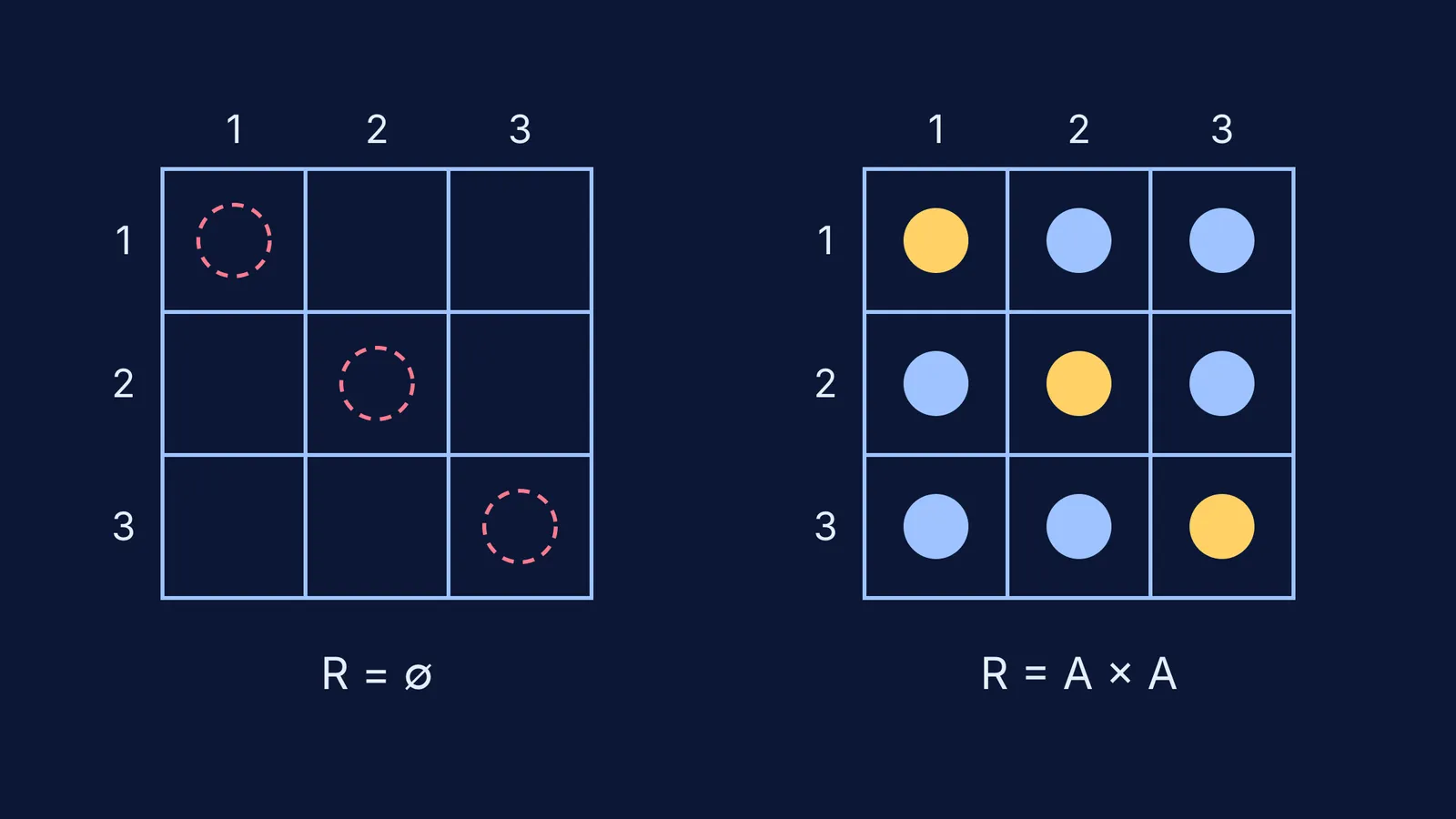
In the NCERT Class 12 chapter on relations and functions, a relation R in a set A is called the empty relation if no element of A is related to any element of A, that is, R = φ ⊂ A × A (NCERT Chapter 1, reproduced on SATHEE, Ministry of Education and IIT Kanpur).
The same chapter defines the universal relation as the one where each element of A is related to every element of A, that is, R = A × A, and calls both of them trivial relations.
A relation on A is just a subset of A × A, so these are the smallest and largest subsets you could pick. For a refresher on how the pairs are built, see the Cartesian product of two sets.
What are examples of empty and universal relations?
NCERT's own example takes A as the set of all students of a boys' school. The relation "a is sister of b" is empty, because no student in that school can be anyone's sister. The relation "the difference between heights of a and b is less than 3 meters" is universal, because every pair of students passes it (NCERT Example 1 on SATHEE).
The rule either never holds or never fails on the given set. Two more:
On A = {1, 2, 3}, R = {(a, b) : a + b = 10} is empty, since the largest sum is 6.
On the same A, R = {(a, b) : a + b ≤ 6} is universal, since every sum is at most 6.
Is the empty relation reflexive, symmetric and transitive?
NCERT calls R reflexive if (a, a) ∈ R for every a in A, symmetric if (a₁, a₂) ∈ R implies (a₂, a₁) ∈ R, and transitive if (a₁, a₂) ∈ R and (a₂, a₃) ∈ R imply (a₁, a₃) ∈ R (NCERT Chapter 1 on SATHEE).
Now test the empty relation on A = {1, 2, 3}:
Reflexive? No. It demands (a, a) for every a, and (1, 1) is missing. One missing pair is enough to fail.
Symmetric? Yes. It is an "if ... then" rule, and with no pairs in R the "if" never happens.
Transitive? Yes, for the same reason: there are no two pairs to chain.
Rules that pass because their condition never happens are called vacuously true; Wikipedia's article on homogeneous relations notes that the empty relation trivially satisfies the transitivity-type properties. So the empty relation on a non-empty set is symmetric and transitive but not reflexive, and therefore not an equivalence relation.
One edge case is worth knowing. If A itself is the empty set, there is no element a that needs (a, a), so reflexivity holds too, and the empty relation becomes an equivalence relation. It is also the universal relation then, because φ × φ = φ. If ∅ and {∅} still trip you up, our post on the empty set and the set containing the empty set untangles them.
Is the universal relation an equivalence relation?
Yes. On A = {1, 2, 3}, R = A × A has all 9 pairs.
Reflexive: (1, 1), (2, 2) and (3, 3) are all there.
Symmetric: whatever pair (a, b) you pick, (b, a) is also in A × A.
Transitive: (a, c) is in A × A for any a and c, so the conclusion is always true.
Since NCERT defines an equivalence relation as one that is reflexive, symmetric and transitive (NCERT Chapter 1 on SATHEE), the universal relation qualifies, and its single equivalence class is the whole of A. For the full method on less obvious relations, see equivalence relations in Class 12.
How do you check these properties quickly in an exam?
Run this list on any relation you are given:
Write the set first. Is it empty? Is it A × A? Decide with the given set, not the rule alone.
For reflexive, hunt for one element a with (a, a) missing.
For symmetric and transitive, hunt for one pair (or two chained pairs) that breaks the rule. No pairs means no counterexample, so it passes.
State the result in one line: "R is not reflexive since (1, 1) ∉ R."
If the "for all" versus "if ... then" difference still feels slippery, the Fermi Concept Library covers every concept in mathematics, each with its own lesson and its place in the map. To practise, the Fermi Problem Library has worked problems with a step-by-step solver that explains the reasoning rather than printing an answer.


