

On this page
When you compare an electron and a photon with identical kinetic energy, the result often surprises students. A photon carries pure electromagnetic energy, yet an electron with the exact same energy has a de Broglie wavelength that is dramatically shorter.
Why does an electron have a shorter wavelength than a photon of the same energy?
The physical answer comes down to momentum. In quantum theory, the de Broglie relation defines wavelength as λ = h / p, where h is Planck's constant (6.62607 × 10⁻³⁴ J s, established by NIST CODATA). Because Planck's constant is identical for all particles, a shorter wavelength requires larger momentum. Comparing wavelengths at the same energy E is therefore equivalent to asking which particle carries more momentum.
A photon has zero rest mass and travels at the vacuum speed of light (299,792,458 m s⁻¹, recorded by NIST CODATA). Because light moves at nature's maximum speed, it packages energy with the minimum possible momentum: p_ph = E / c.
An electron possesses a rest mass of 9.10938 × 10⁻³¹ kg (NIST CODATA electron mass), giving it a rest energy m_e c² of 0.510999 MeV (510,999 eV on the NIST electron rest energy record). At non-relativistic energies, its kinetic energy is E = (1/2) m_e v² = p_e v / 2, meaning momentum is p_e = 2E / v. Comparing the two momentums directly yields:
p_e / p_ph = (2E / v) / (E / c) = 2c / v
Because an electron travels much slower than light (v ≪ c), its velocity v sits in the denominator, forcing its momentum p_e to be vastly larger than p_ph. That large momentum compresses its de Broglie wavelength into a tiny fraction of the photon's wavelength.
How do you derive the wavelength ratio between a photon and an electron?
Deriving this ratio is a staple in CBSE Class 12 physics, JEE Main, and NEET-UG, following the CBSE Senior Secondary Curriculum:
Photon wavelength: For a photon of energy E, the wave equation gives λ_ph = hc / E. In numerical problems, students frequently use the quick photon-energy shortcut E = 1240 / λ, where λ is in nanometres and E in electronvolts.
Electron wavelength: For an electron of non-relativistic kinetic energy E, momentum is p_e = √(2 m_e E). Louis de Broglie introduced this matter-wave relation in his 1924 doctoral thesis, recognised by the 1929 Nobel Prize in Physics, giving λ_e = h / √(2 m_e E).
Take the ratio: Dividing λ_ph by λ_e gives:
λ_ph / λ_e = (hc / E) / (h / √(2 m_e E)) = c √(2 m_e E) / E = √(2 m_e c² / E)
Because an electron's rest energy m_e c² is approximately 511,000 eV (0.511 MeV, recorded by NIST CODATA), the quantity 2 m_e c² equals 1,022,000 eV (1.022 MeV). Whenever kinetic energy E is small compared to 1 MeV, this ratio is substantially greater than 1.
When special relativity is included, the exact formula becomes:
λ_ph / λ_e = √(1 + 2 m_e c² / E)
Because 2 m_e c² / E is positive for all real kinetic energies, this ratio is always greater than 1: a photon always has a longer wavelength than an electron of identical kinetic energy.
What happens to the wavelength ratio at 100 eV?
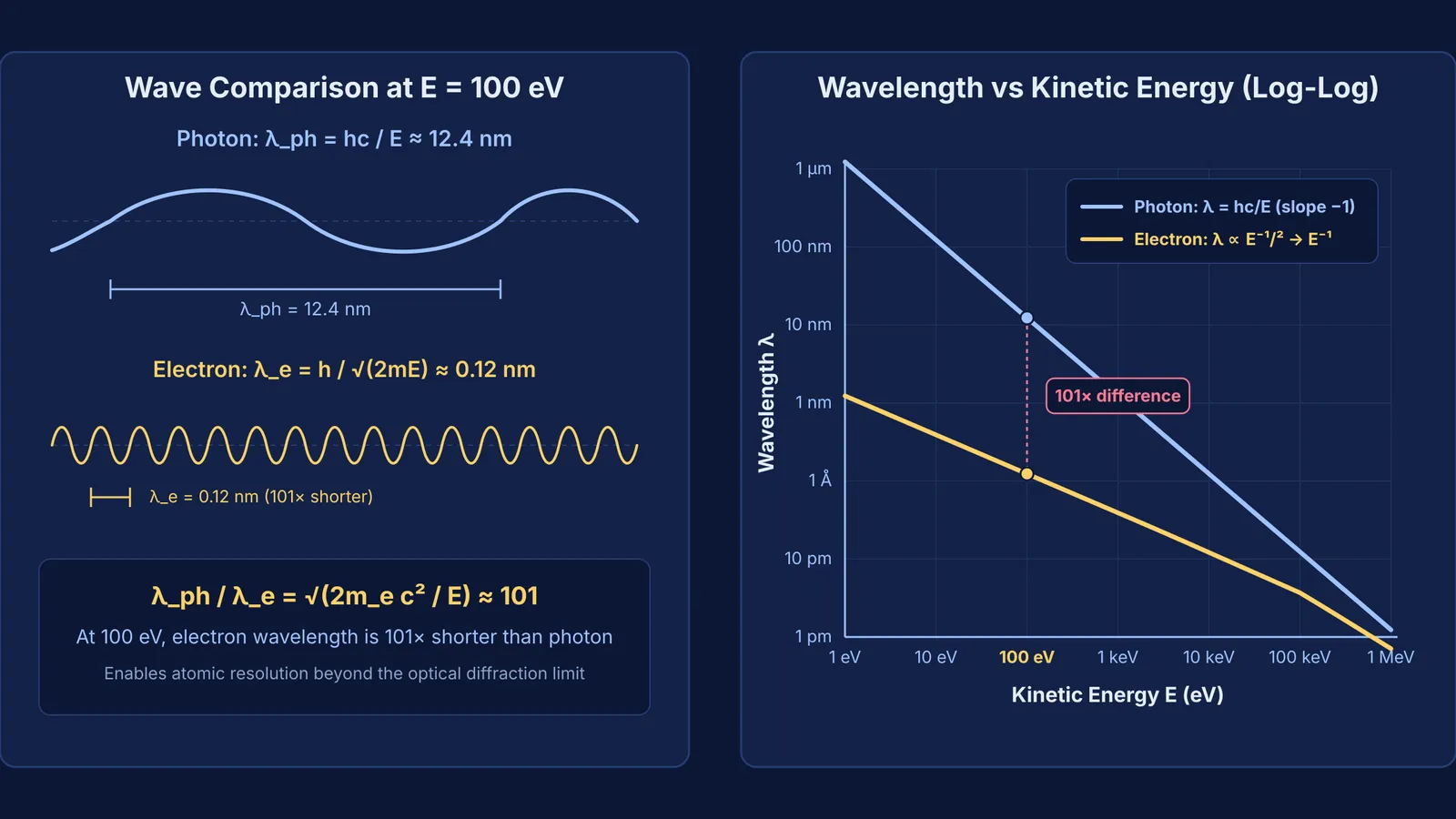
Evaluating both particles at a standard accelerating potential of 100 V (kinetic energy 100 eV, using recommended fundamental constants from NIST CODATA) shows the gap clearly:
Photon: λ_ph = hc / E ≈ (1240 eV nm) / (100 eV) = 12.4 nm (extreme ultraviolet).
Electron: λ_e = h / √(2 m_e E) ≈ 1.227 nm / √(100) = 0.1227 nm = 1.227 Å (crystal lattice spacing).
Ratio: λ_ph / λ_e = √(1,022,000 / 100) = √10,220 ≈ 101.1.
At 100 eV, the photon's wavelength is 101 times longer than the electron's wavelength.
At visible light energies (around 2.5 eV, or 500 nm green light), an electron's de Broglie wavelength is 1.227 nm / √2.5 ≈ 0.776 nm, making the photon over 640 times longer.
This physical disparity enabled electron microscopy. In 1931, Ernst Ruska built the first electron microscope, showing by 1933 that electron beams beat optical microscopes past the diffraction limit, as recounted in Ernst Ruska's Nobel biographical summary. Because electrons at tens of kiloelectronvolts possess picometre-scale wavelengths, they can resolve viruses and crystal planes that light waves cannot see.
Which exam traps should you watch out for?
Competitive physics questions frequently test this relationship with three common traps:
Inverting energy powers: A photon's wavelength scales as λ ∝ 1/E, whereas an electron's wavelength scales as λ ∝ 1/√E. Quadrupling kinetic energy quarters the photon's wavelength, but only halves the electron's wavelength.
Unit conversion errors: When using SI formulas, kinetic energy must be in joules. Convert electronvolts using 1 eV = 1.60218 × 10⁻¹⁹ J (NIST CODATA electron volt). Quick dimensional analysis checks catch mismatched units before you compute.
Kinetic versus total energy: "Same energy" in modern physics problems means kinetic energy. If a question specifies total energy, the electron's rest mass (511 keV) must be included, which increases momentum and makes the electron wavelength even shorter.
When practicing matter waves and photoelectric effect questions for JEE and NEET, start from momentum rather than isolated formulas. The Fermi Problem Library offers worked problems with a step-by-step solver that explains the reasoning rather than printing an answer. To explore how matter waves connect to atomic models across the syllabus, the Fermi Concept Library covers every concept in physics with its own lesson and its place in the map.


