

On this page
We often think of electric current as a river of electrons flowing continuously through a wire. But current is simply the flow of charge over time. This means that even a single electron revolving in a circular orbit around a nucleus creates a measurable current. This tiny current loop generates its own magnetic field at the centre of the atom.
What is the equivalent current of a revolving electron?
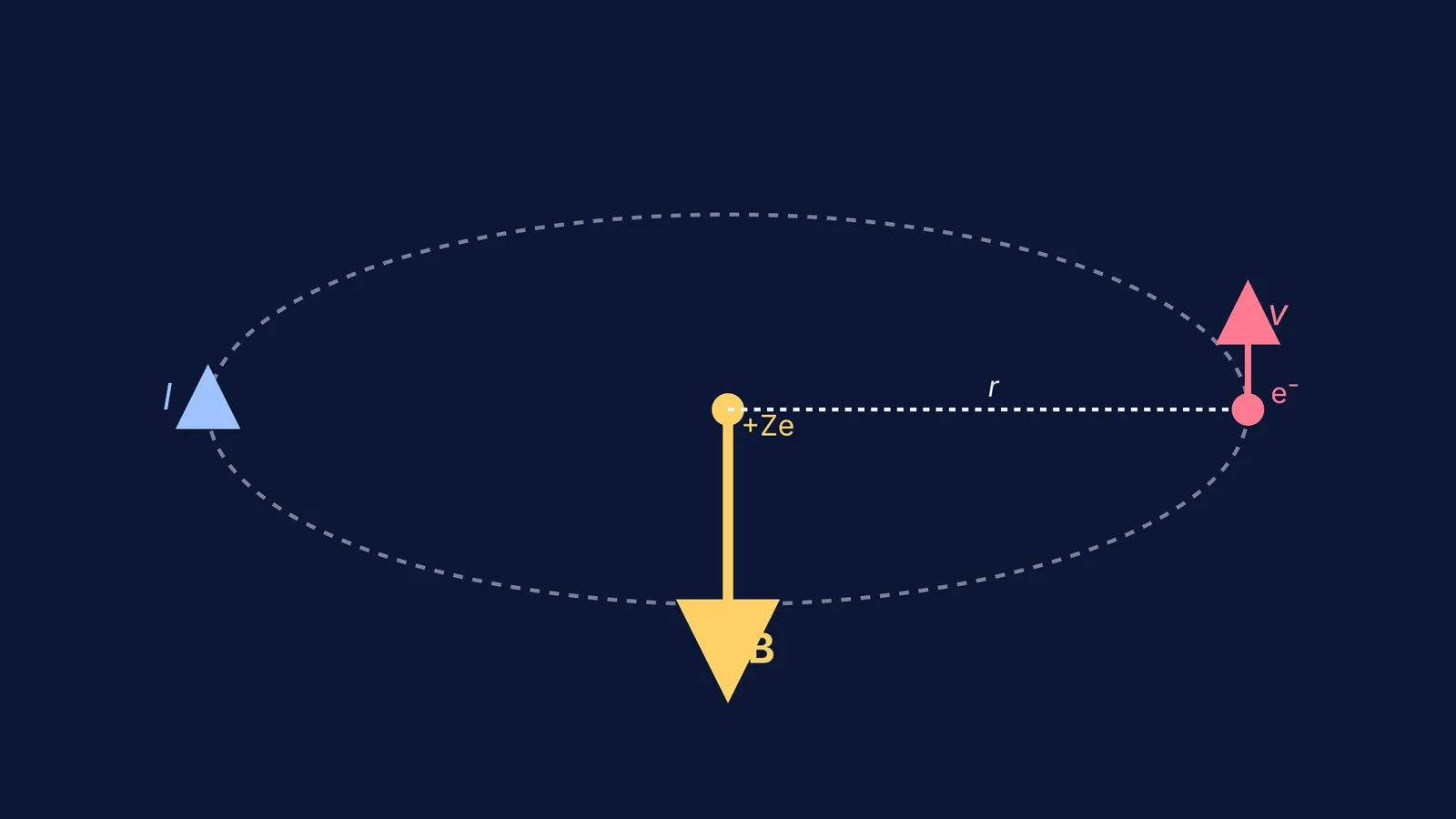
To find the equivalent current, we model an electron with charge e moving at a constant speed v in a circular orbit of radius r.
Current is defined as the total amount of charge passing a specific point per unit of time (Wikipedia). The time it takes for the electron to complete one full orbit is its time period, T.
The distance around the circular orbit is the circumference, 2πr. Because time is distance divided by speed, the time period is T = 2πr/v.
By substituting this into the definition of current (I = e/T), we get the formula for the equivalent current:
I = ev/(2πr)
Because the electron carries a negative charge, the direction of this conventional current is exactly opposite to the electron's physical velocity vector.
What magnetic field does this current produce at the nucleus?
Every current loop generates a magnetic field. According to the Biot–Savart law, the magnetic field B at the centre of a circular loop of radius r carrying current I is B = μ₀I/(2r) (Wikipedia).
To find the field at the nucleus, we substitute our equivalent current into this formula:
B = μ₀(ev/2πr) / 2r
B = μ₀ev/(4πr²)
The direction of this magnetic field is given by the right-hand rule. If you curl the fingers of your right hand in the direction of the conventional current (opposite to the electron's motion), your thumb points along the magnetic field vector at the centre.
How does the magnetic field change in different orbits?
In the hydrogen atom, an electron's speed and radius depend on its principal quantum number, n.
As the electron moves to higher, more energetic orbits, its speed drops (v ∝ 1/n) while its radius grows much larger (r ∝ n²).
Because the magnetic field formula depends on v/r², the magnetic field at the nucleus scales as (1/n) / (n²)² = 1/n⁵. This means the field weakens drastically in higher energy levels. For example, in the n = 2 orbit, the magnetic field drops to just 1/32 of its strength in the ground state.
A worked example: finding the field in a hydrogen atom
Let's see how strong this field is for the electron in the ground state of a hydrogen atom.
In the Bohr model of hydrogen, the speed of the electron in the ground state is about 2.19 × 10⁶ m/s (Wikipedia). The Bohr radius is 5.29 × 10⁻¹¹ m (Wikipedia).
The elementary charge is approximately 1.602 × 10⁻¹⁹ C (Wikipedia) and the magnetic constant μ₀ is approximately 4π × 10⁻⁷ T m/A (Wikipedia).
First, we calculate the equivalent current:
I = (1.602 × 10⁻¹⁹ C) × (2.19 × 10⁶ m/s) / (2π × 5.29 × 10⁻¹¹ m)
I ≈ 1.05 × 10⁻³ A (or 1.05 mA)
Next, we calculate the magnetic field at the nucleus:
B = (4π × 10⁻⁷ T m/A) × (1.05 × 10⁻³ A) / (2 × 5.29 × 10⁻¹¹ m)
B ≈ 12.5 T
A magnetic field of 12.5 Tesla is enormous, stronger than the superconducting magnets used in typical hospital MRI machines, all generated by a single moving electron.
How Fermi helps you master moving charges
Whether you are calculating the spinning charged ring or determining the helical path in a magnetic field, electromagnetism can be challenging.
If you are struggling to picture these 3D fields and forces, the Fermi Concept Library contains every concept in physics, chemistry, biology, mathematics and computing, each with its own lesson and its place in the map. When you need to set up these equations for a tough homework question, the Fermi Problem Library has worked problems with a step-by-step solver that explains the reasoning rather than printing an answer.


