

On this page
Hydrochloric acid turns blue litmus red. So it can be a surprise that hydrogen chloride gas, the substance that makes hydrochloric acid, does nothing to a dry strip of blue litmus. The short answer is one word: water. Here is the reasoning, the activity behind it, and a model answer for the exam.
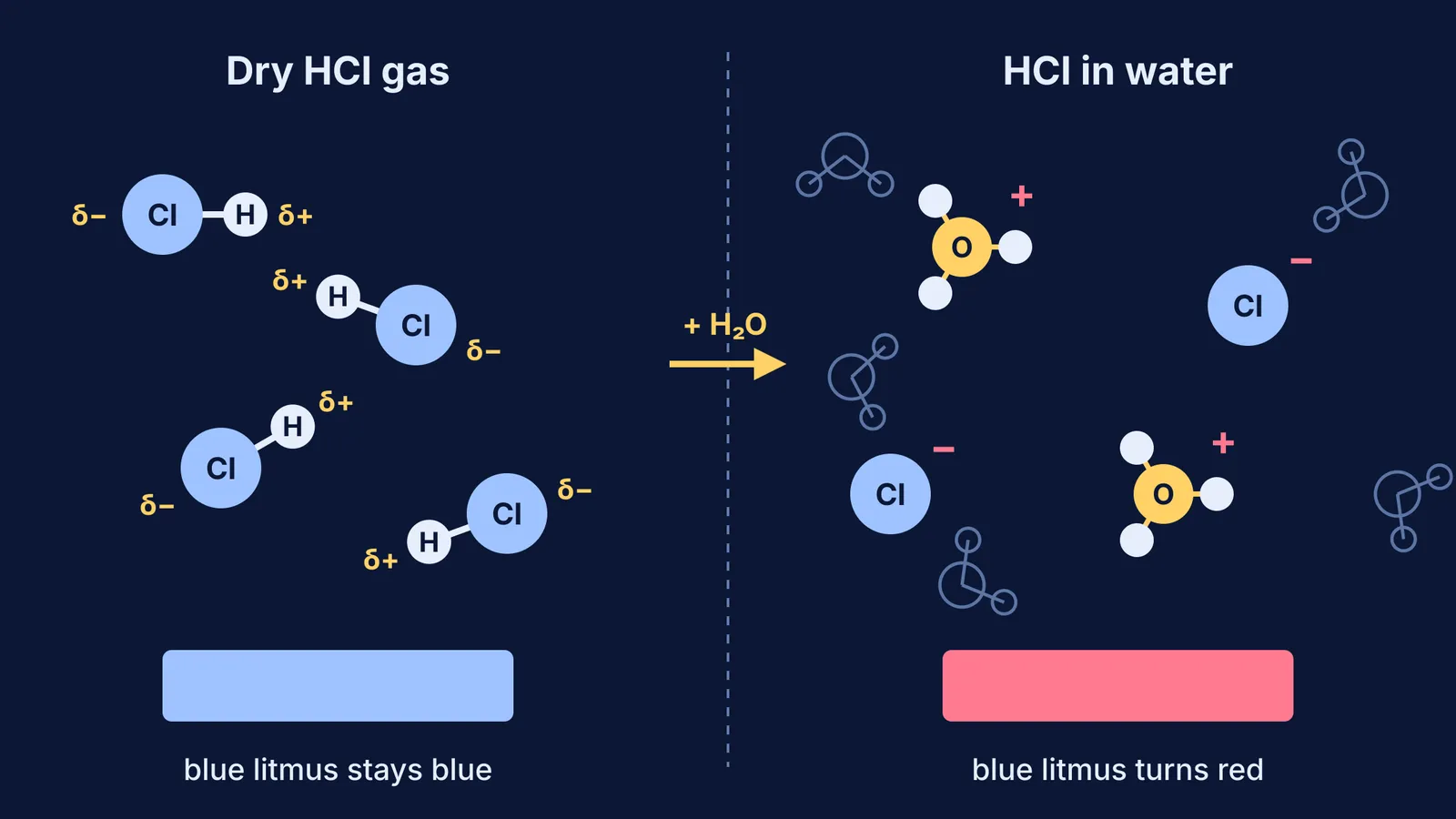
What happens in the NCERT dry and moist litmus activity?
In Activity 2.9 of the chapter "Acids, Bases and Salts" in the NCERT Class 10 science textbook, you add concentrated sulphuric acid to about 1 g of solid sodium chloride in a dry test tube. A gas comes out of the delivery tube. You then test it first with dry blue litmus paper and then with wet blue litmus paper.
Dry blue litmus: no colour change.
Wet (moist) blue litmus: turns red.
The gas is hydrogen chloride. The same NCERT page tells teachers that in a very humid climate the gas should be passed through a guard tube containing calcium chloride to dry it, a sign that moisture picked up from humid air can affect the result.
The International Chemical Safety Card for hydrogen chloride states that it is corrosive to the eyes, skin and respiratory tract.
Why is HCl gas covalent and not ionic?
In a molecule of hydrogen chloride, the hydrogen and chlorine atoms share a pair of electrons in a single covalent bond, as the LibreTexts chemistry page on hydrogen chloride/Descriptive_Chemistry/Elements_Organized_by_Block/1_s-Block_Elements/Group__1%3A_The_Alkali_Metals/Z001_Chemistry_of_Hydrogen_(Z1)/Hydrogen_Chloride) explains. Nobody has given an electron away, so there are no H⁺ or Cl⁻ ions in the dry gas.
The bond is shared unequally, though. On the Pauling scale, chlorine's electronegativity is 3.16 and hydrogen's is 2.2, according to PubChem's periodic table data. Chlorine pulls the shared electrons closer, so the molecule carries a partial negative charge (δ−) on chlorine and a partial positive charge (δ+) on hydrogen. The NIST Computational Chemistry Comparison and Benchmark Database lists the experimental dipole moment of HCl as 1.093 debye and the H–Cl bond length as 1.275 Å.
So HCl is a polar covalent molecule, and polar is not the same as ionic. A partial charge cannot turn litmus red; a hydrogen ion in water can. Our post on dipole moment and molecular polarity compares HCl with other molecules.
Why does acidity need H⁺ ions in water?
NCERT's Activity 2.8, just before this one, shows that dilute HCl conducts electricity while glucose and alcohol solutions do not. The textbook's conclusion is that acids produce hydrogen ions, H⁺(aq), in solution, and these ions are responsible for acidic properties (NCERT Class 10 science, chapter 2).
After the dry and wet litmus test, the same chapter states that the separation of H⁺ from HCl molecules cannot occur in the absence of water:
HCl + H₂O → H₃O⁺ + Cl⁻
NCERT adds that hydrogen ions cannot exist alone; they combine with water and must be shown as H⁺(aq) or as the hydronium ion, H₃O⁺. The water in moist litmus paper is enough to do this right on the strip, which is why the wet strip turns red and the dry one does not.
How do you write this answer for full marks?
Make each key point visible. Here is a model answer for NCERT's in-text question "Why does dry HCl gas not change the colour of the dry litmus paper?"
Name the cause of acidic behaviour: acids show acidic properties only when they produce H⁺(aq) or H₃O⁺ ions.
Describe dry HCl: it is a covalent molecule, so dry HCl gas contains no H⁺ ions.
Say what water does: H⁺ separates from HCl only in the presence of water.
Write the equation: HCl + H₂O → H₃O⁺ + Cl⁻.
Conclude: dry litmus has no water, so no H⁺ ions form and the colour does not change. Moist blue litmus turns red.
For a one-mark version, points 2, 3 and 5 are the core. For practice in this style, see our guide to give-reasons questions in CBSE Class 12 chemistry.
Which mistakes cost marks on this question?
Writing "dry HCl is a weak acid". It is not acting as an acid at all without water, and HCl in water is a strong acid.
Calling HCl gas ionic because it has a dipole. Partial charges are not ions.
Forgetting the equation, or writing H⁺ alone without (aq).
Mixing up which litmus changes. Acids turn blue litmus red; dry HCl leaves it blue.
Our overview of Class 10 acids, bases and salts ties this to the rest of the chapter.
If ions, polar bonds and hydronium still feel like separate facts, the Fermi Concept Library gives each concept in chemistry its own lesson and its place in the map, so you can see how bonding leads to acidity. When you want to check your reasoning on a written question, the Fermi Problem Library has worked problems with a step-by-step solver that explains the reasoning rather than printing an answer.


