

On this page
It is a scene familiar to any parent or teacher: a child eats a large slice of cake at a birthday party and, shortly after, is bouncing off the walls. It seems obvious that the sugar caused the hyperactivity. This belief is so widespread that "sugar rush" is a standard phrase in parenting and education.
However, when researchers actually test this in controlled conditions, the link between sugar and hyperactive behaviour completely vanishes.
Where did the sugar rush myth come from?
The idea that food directly alters a child's behaviour gained immense popularity in the 1970s. Dr Benjamin Feingold, a pediatric allergist, proposed the Feingold diet, which suggested that eliminating artificial food colourings and certain preservatives could treat hyperactivity (Source). While his original work focused on additives, public perception quickly expanded to include refined sugar.
Because we know that chemically, sugar provides quick energy to cells—you can read about the structure of these energy-rich molecules in our guide to reducing and non-reducing sugars: why sucrose fails Tollens' test—it felt scientifically plausible that eating it would make a child physically overactive.
What happens in a double-blind sugar study?
To see if sugar actually causes hyperactivity, scientists use double-blind, placebo-controlled trials. In these studies, some children are given real sugar, while others are given a sugar substitute like aspartame. Crucially, because it is "double-blind," neither the children nor the adults observing them know who received the real sugar.
A landmark 1995 meta-analysis published in *JAMA* by Mark Wolraich and his colleagues combined the results of 23 such studies (Source). The researchers found that sugar does not affect the behaviour or cognitive performance of children. Whether the children were considered "normal" or had been described by their parents as "sugar-sensitive," the results were the same: the sugar did not make them hyperactive.
How powerful is a parent's expectation?
If the sugar is not causing the behaviour, why do so many adults swear they see it happen? The answer lies in our own psychology.
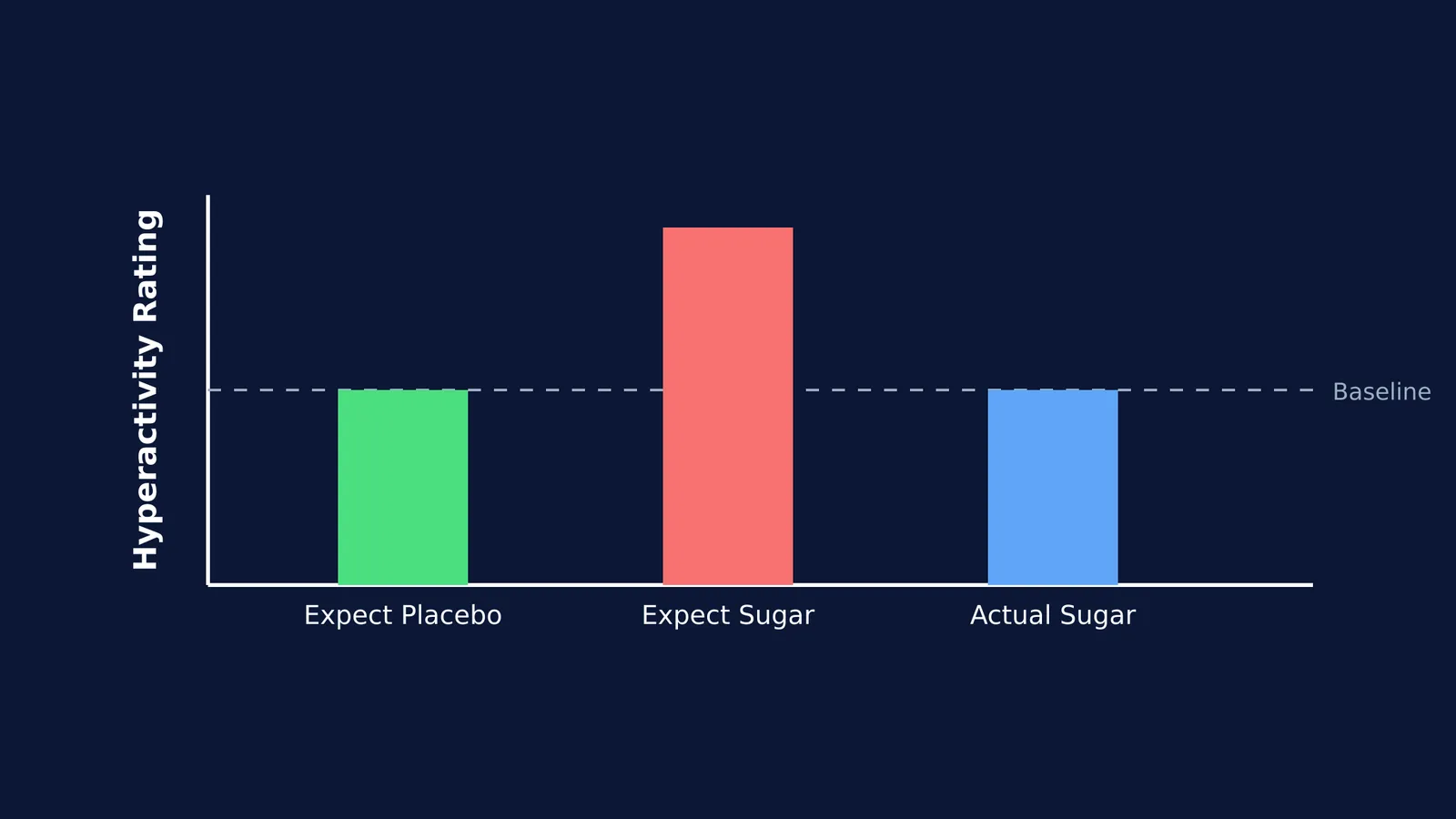
A fascinating 1994 study published in the *Journal of Abnormal Child Psychology* by Daniel Hoover and Richard Milich tested the effect of parents' expectations (Source). They took a group of boys who were considered "sugar reactive" and gave all of them a placebo (aspartame). However, they told half of the mothers that their sons had been given a large dose of sugar, while the other half were told their sons received the placebo.
The mothers who *thought* their children had eaten sugar rated them as significantly more hyperactive. Furthermore, when observing the interactions, researchers found that these mothers stayed physically closer to their sons and were more likely to criticize and direct them. The mothers' belief entirely shaped the reality they experienced and how they treated their children.
If it is not sugar, what is happening?
When a child seems hyperactive after eating sweets, it is almost always the environment causing the excitement, not the food. Sugar is usually served at birthday parties, holidays, or special events—situations that are highly stimulating.
A child's nervous system responds to this external excitement. This is a great real-world example of how the brain processes stimuli, a topic covered deeply in our overview of control and coordination in Class 10: reflexes, brain and hormones. The child is reacting to the party, the games, and their friends; the cake just happens to be there.
When helping your child study or prepare for exams, their environment is far more important than restricting an occasional sweet treat. For instance, when they are visualising hard-to-picture ideas in the Fermi Simulation Lab, a quiet room, a structured routine, and a good night's sleep will do far more to improve their focus than removing a biscuit from their lunchbox.


