

On this page
The peepal tree (*Ficus religiosa*) is a keystone species in India, revered in tradition and often planted for shade. A persistent claim suggests that unlike other plants, the peepal tree releases oxygen 24 hours a day, purifying the air even while you sleep.
It is a comforting idea, but biology paints a different picture. While the peepal tree does have a unique way of breathing at night, it does not manufacture new oxygen in the dark.
Does a peepal tree really give oxygen at night?
To answer this, researchers sequenced the entire 406-megabase genome of the peepal tree in a 2023 study published in *BMC Genomics*. They looked at which genes were active in the leaves on bright sunny days and which turned on at night.
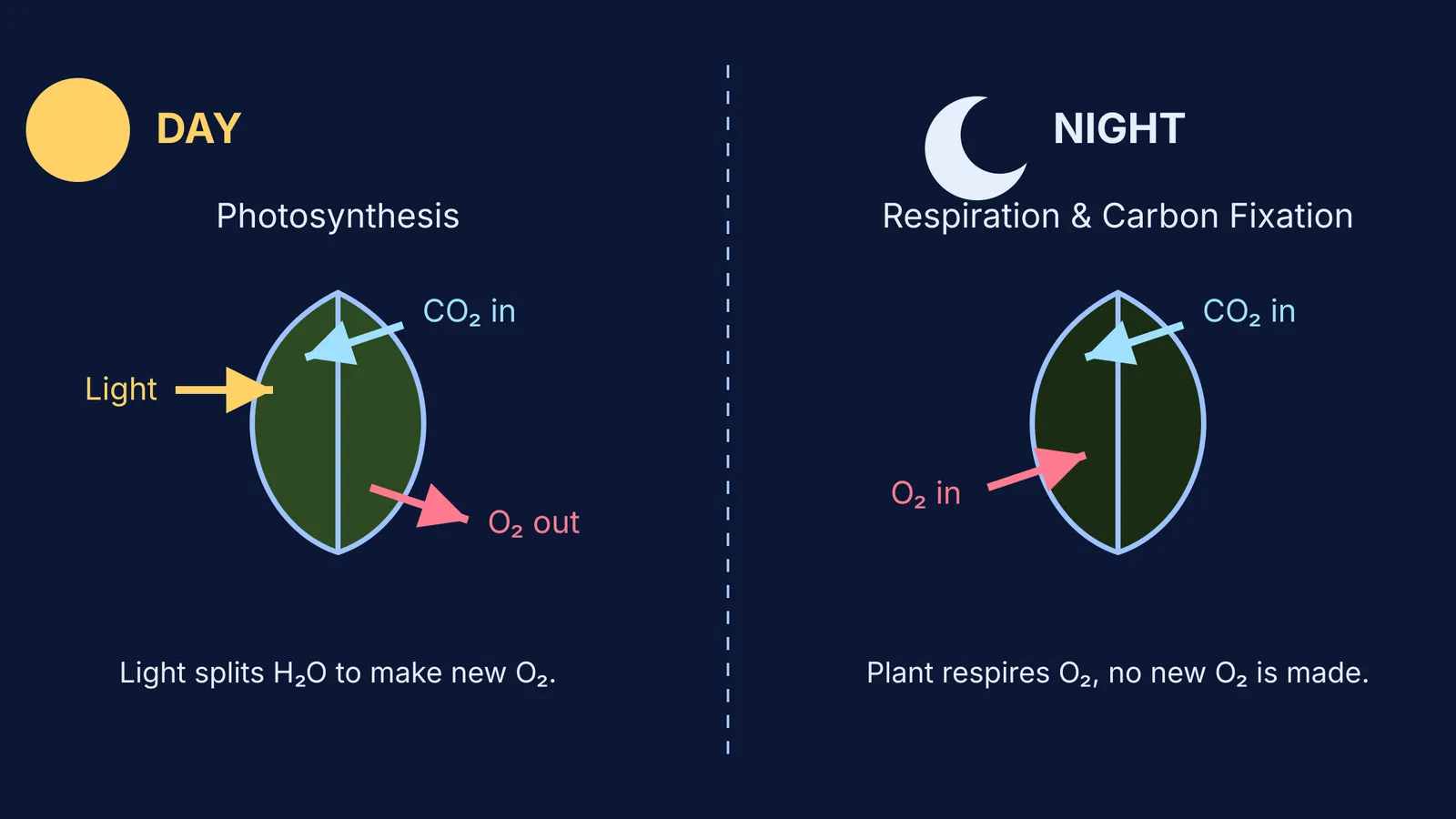
The study found that the tree has a flexible metabolism. While it usually follows the standard C3 photosynthesis pathway like most trees, it also expresses genes for a nocturnal carbon-fixation pathway. This survival strategy, often seen in desert plants, allows the plant to take in carbon dioxide (CO₂) at night.
Because it takes in carbon dioxide at night, the peepal tree does actively remove this gas from the night air. However, the researchers noted there is no scientific evidence that this nocturnal activity produces oxygen.
Why do plants need sunlight to make oxygen?
Oxygen is not a magical byproduct of a tree simply existing; it is the specific result of splitting a water molecule (H₂O). This process, known as photolysis, is a light-dependent reaction.
During the day, chlorophyll in the leaves captures photons from sunlight. This energy is used to tear water molecules apart, capturing the hydrogen to help build sugars and releasing the leftover oxygen into the air. When the sun goes down, the energy source disappears. The water-splitting stops, and oxygen production grinds to a halt.
Visualising how gases move in and out of a leaf can be difficult. The Fermi Simulation Lab has interactive models where you can change the sunlight and temperature to see photosynthesis and respiration happen in real time.
How does a peepal tree breathe at night?
If the tree is not making oxygen at night, what is it doing? Like you, it is respiring.
Plants need a constant supply of energy to survive. During the day, they make sugars through photosynthesis (which you can read more about in our guide to limiting factors in photosynthesis: Blackman's law and CO₂). At night, they break those sugars down to power their cells.
This process is cellular respiration. It consumes oxygen and releases carbon dioxide as waste (we explore the wider chemical routes of this in respiration as an amphibolic pathway: where fats and proteins enter).
Because plants that fix carbon at night often keep their stomata closed during the hot day to conserve water, they might trap some of the oxygen they produced in the afternoon. When they finally open their pores at night to take in carbon dioxide, a small amount of that leftover daytime oxygen might diffuse out. However, this is just trapped gas escaping, not active nocturnal production.
How can you explain the science to your friends?
If someone tells you a peepal tree gives oxygen at night, you can use this simple script to explain the real science without sounding dismissive:
Acknowledge the partial truth: "You are right that the peepal tree does something special at night. Unlike most trees, it actually absorbs carbon dioxide in the dark to save water."
Explain the light requirement: "But to make oxygen, a plant has to split water molecules. That chemical reaction requires energy from sunlight."
Finish with respiration: "So at night, the tree stops making oxygen. In fact, to keep its cells alive, it breathes in a little bit of oxygen, just like we do."


