

On this page
Cellular respiration is the fundamental process of breaking down glucose to fuel a living organism. If you have ever wondered whether a plant stops "breathing" when the sun goes down, the answer is a definitive no. Plants respire continuously, but their overall gas exchange profile changes dramatically between noon and midnight.
Understanding this shift—and the exact moment when the gas exchange balance tips—is a core part of plant physiology and a frequent target for biology exam questions.
Do plants respire at night?
Yes, respiration is a continuous process that runs in both the light and the dark.
To stay alive and maintain their tissues, plant cells must constantly metabolise glucose to produce ATP (energy). At night, because there is no sunlight available to drive the light-dependent reactions, photosynthesis comes to a complete halt. Without the massive oxygen production of daytime photosynthesis to mask it, the plant's true respiratory demand becomes obvious. As a result, during the night, the plant acts entirely as a net producer of carbon dioxide and a net consumer of oxygen (Wikipedia).
What is the difference between photosynthesis and respiration?
In biology exam problems, it helps to treat these as two separate metabolic tracks that simply happen to share the same gases.
Photosynthesis takes in CO₂ and water, using light energy to build glucose and release O₂. It happens in the chloroplasts and depends entirely on the availability and intensity of sunlight.
Respiration breaks down glucose with O₂ to release energy, producing CO₂ and water as waste. It happens in the mitochondria around the clock, regardless of external lighting.
During daylight hours, the rate of photosynthesis vastly outpaces the rate of respiration. The overall net gas exchange of a healthy leaf shows carbon dioxide rushing in and oxygen pouring out. If you want to understand how different substrates like fats and proteins feed into this constant energy cycle, see our guide to respiration as an amphibolic pathway.
What is the compensation point?
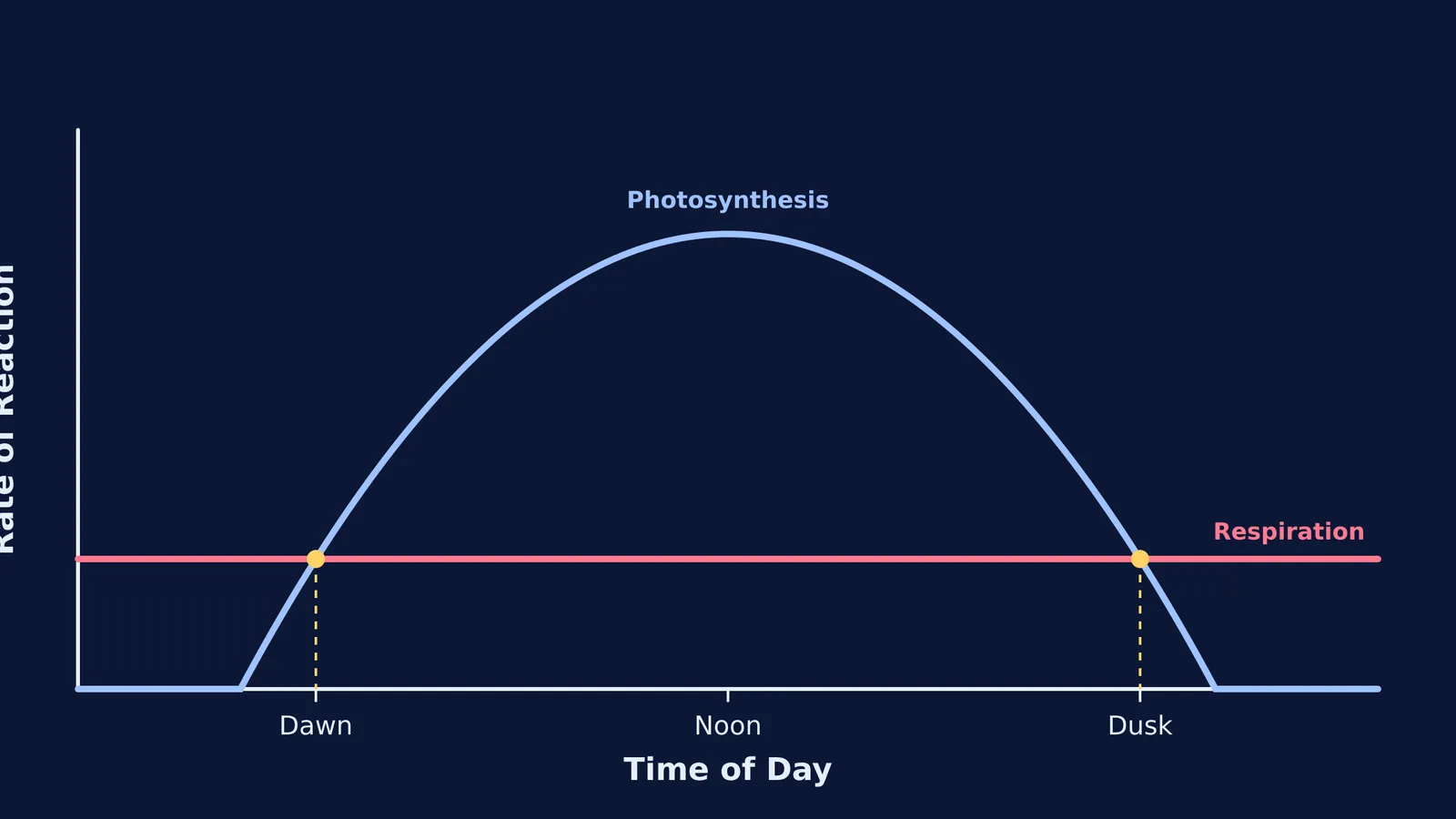
As the sun sets and light intensity fades, photosynthesis slows down until its rate drops to perfectly match the constant, steady rate of cellular respiration. This exact balance is known as the light compensation point.
At the compensation point, the net gaseous exchange between the plant and the atmosphere is exactly zero. All the CO₂ produced by cellular respiration is immediately reused by the chloroplasts for photosynthesis. Simultaneously, all the O₂ produced by photosynthesis is instantly consumed by the mitochondria for respiration. This equilibrium happens naturally twice a day for most plants: once at dawn and once at dusk (Wikipedia).
There is also a related concept called the CO₂ compensation point, which refers to the atmospheric carbon dioxide concentration where the two processes perfectly balance. Because they use different carbon-fixing mechanisms, C₃ plants have a CO₂ compensation point of 40–100 μmol/mol, while more efficient C₄ plants balance at a much lower 3–10 μmol/mol (Wikipedia). Aquatic plants face a similar physical boundary called the compensation depth, where sunlight penetration through the water is just enough to maintain this gas balance. You can explore more about how environmental constraints limit plant growth in our article on limiting factors in photosynthesis.
How to master net gas exchange questions?
When an exam problem asks about plant gas exchange, the trick is to immediately look for the time of day or the light intensity given in the question stem. If you confuse the net exchange of the whole leaf with the absolute rate of mitochondrial respiration, you will likely lose marks.
Here is a quick checklist for solving these questions:
Identify the light level: Is the problem set at high noon, the middle of the night, or twilight?
Check the balance: At high light intensity, the net exchange is CO₂ in, O₂ out. In total darkness, the net exchange flips to O₂ in, CO₂ out.
Spot the compensation point: If a question states that the net gas exchange is zero, it means the leaf is exactly at its compensation point.
Understanding how these rates compete also explains why certain plants evolved entirely different carbon-fixing pathways. For a deeper look at this evolutionary split, see our post on why RuBisCO wastes energy in C3 plants through the process of photorespiration.
If you struggle to picture how these two rates overlap across a full day, the Fermi Concept Library covers every concept in physics, chemistry and biology. When you are ready to apply this knowledge to exam questions, the Fermi Problem Library offers a step-by-step solver that explains the reasoning rather than just printing a final answer. If you get stuck interpreting a gas exchange graph, Fermi's AI tutor can work out what you already know, build a plan for the session, and draw the figure to help you find the compensation point yourself.


