

On this page
The test for 11 comes down to adding and subtracting the digits in turn. Here is the recipe, why it works, and five 6-digit numbers checked by hand.
How does the divisibility test for 11 work?
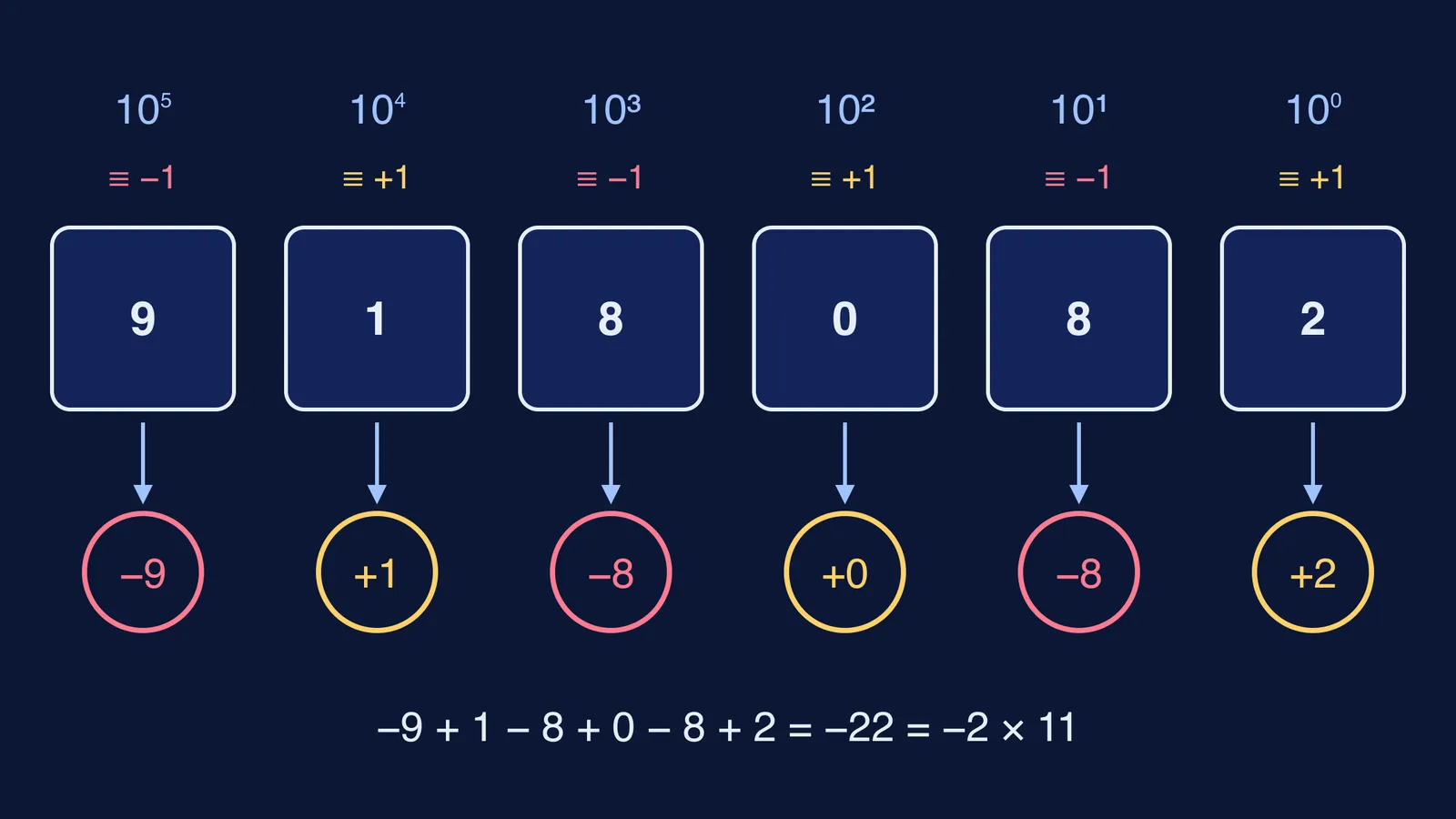
Start at the units digit and give it a plus sign.
Move left, alternating minus, plus, minus, and so on.
Add up the signed digits. Call the result the alternating sum.
If the alternating sum is 0 or a multiple of 11 (including negative ones such as −22), the number is divisible by 11.
Wikipedia's list of divisibility rules also writes it as the sum of digits in odd places minus the sum in even places: the same calculation, grouped differently.
A bonus: with a plus on the units digit, the alternating sum leaves the same remainder on division by 11 as the number itself. So the test gives you the remainder, not just yes or no.
Why does the alternating digit sum test for 11 work?
Everything comes from one fact: 10 is one less than 11. In remainder language, 10 ≡ −1 (mod 11), which is the first line of the proof in the Wikipedia article on divisibility rules. Wolfram MathWorld's page on divisibility tests lists the consequence: modulo 11, 10¹ ≡ −1, 10² ≡ 1, 10³ ≡ −1, 10⁴ ≡ 1, and so on.
Check each power against the multiple of 11 next to it:
10 = 11 − 1, so 10 leaves −1.
100 = 99 + 1, and 99 = 9 × 11, so 100 leaves +1.
1000 = 1001 − 1, and 1001 = 91 × 11, so 1000 leaves −1.
10000 = 9999 + 1, and 9999 = 909 × 11, so 10000 leaves +1.
Now write a 6-digit number with digits f, e, d, c, b, a, where a is the units digit:
N = 100000f + 10000e + 1000d + 100c + 10b + a
Replace each power of 10 by what it leaves on division by 11, and you get N ≡ −f + e − d + c − b + a (mod 11). The right-hand side is the alternating sum. N and its alternating sum differ by a multiple of 11, so both are divisible by 11 or neither is. The argument works for any number of digits, because the pattern +1, −1 keeps repeating.
Worked checks on five 6-digit numbers
Each line starts at the units digit, with a plus sign.
918082: 2 − 8 + 0 − 8 + 1 − 9 = −22. That is −2 × 11, so 918082 is divisible by 11. Check: 11 × 83462 = 918082.
142857: 7 − 5 + 8 − 2 + 4 − 1 = 11. Divisible. Check: 11 × 12987 = 142857.
123456: 6 − 5 + 4 − 3 + 2 − 1 = 3. Not divisible; the remainder is 3. Check: 11 × 11223 = 123453.
654321: 1 − 2 + 3 − 4 + 5 − 6 = −3. Not divisible. A remainder cannot be negative, so add 11: the remainder is 8. Check: 11 × 59483 = 654313.
375375: 5 − 7 + 3 − 5 + 7 − 3 = 0. Divisible. This holds for every number of the form abcabc, because abcabc = abc × 1001 and 1001 = 7 × 11 × 13.
If the fourth line feels shaky, our post on what the remainder is when you divide a negative number explains why a remainder must be non-negative.
What mistakes do students make with the 11 test?
Starting the signs from the left. For a 6-digit number this flips every sign. 123456 read from the left gives −3, which suggests a remainder of 8 instead of 3. The yes-or-no answer survives, but the remainder does not.
Stopping at "not zero". An alternating sum of 11, 22 or −22 still means divisible.
Mixing it up with the digit-sum test for 3 and 9. That test works because 10 leaves +1 on division by 3 or 9, so every digit counts with a plus sign. For 11, 10 leaves −1, so the signs alternate.
How can you practise the test for 11?
Write five 6-digit numbers and find each remainder with the alternating sum.
Check two of them by long division.
Write three digits twice (like 482482) and confirm the alternating sum is 0.
Prove the rule for 4-digit numbers.
The same move, replacing a power by its remainder, drives our guide to finding the remainder of large powers with modular arithmetic. It also shows up in two-digit numbers with reversed digits: (10a + b) + (10b + a) = 11(a + b).
For more remainder and digit problems, the Fermi Problem Library has worked problems with a step-by-step solver that explains the reasoning rather than printing an answer. For congruence itself, the Fermi Concept Library gives each mathematics concept its own lesson.


