

On this page
When you face an algebraic expression with multiple terms over a single denominator, it can look difficult to simplify. A polynomial (an expression with several terms added or subtracted) divided by a monomial (a single term) is a standard topic in Class 8 mathematics.
Understanding how to simplify these algebraic fractions early on is vital for high school mathematics. There are two reliable ways to approach these problems: splitting the expression term by term, or pulling out a common factor first. Both methods lead to the same answer, but knowing which one to use depends on the numbers in front of you.
How do you divide each term separately?
The most direct way to divide a polynomial by a monomial is to split the large fraction into several smaller ones.
As standard teaching methods show, you break the polynomial into its individual terms and divide each one separately (BYJU'S). You then simplify each small fraction by dividing the numbers and using the laws of exponents to subtract the powers of the variables. This works perfectly because division distributes across addition and subtraction in the numerator.
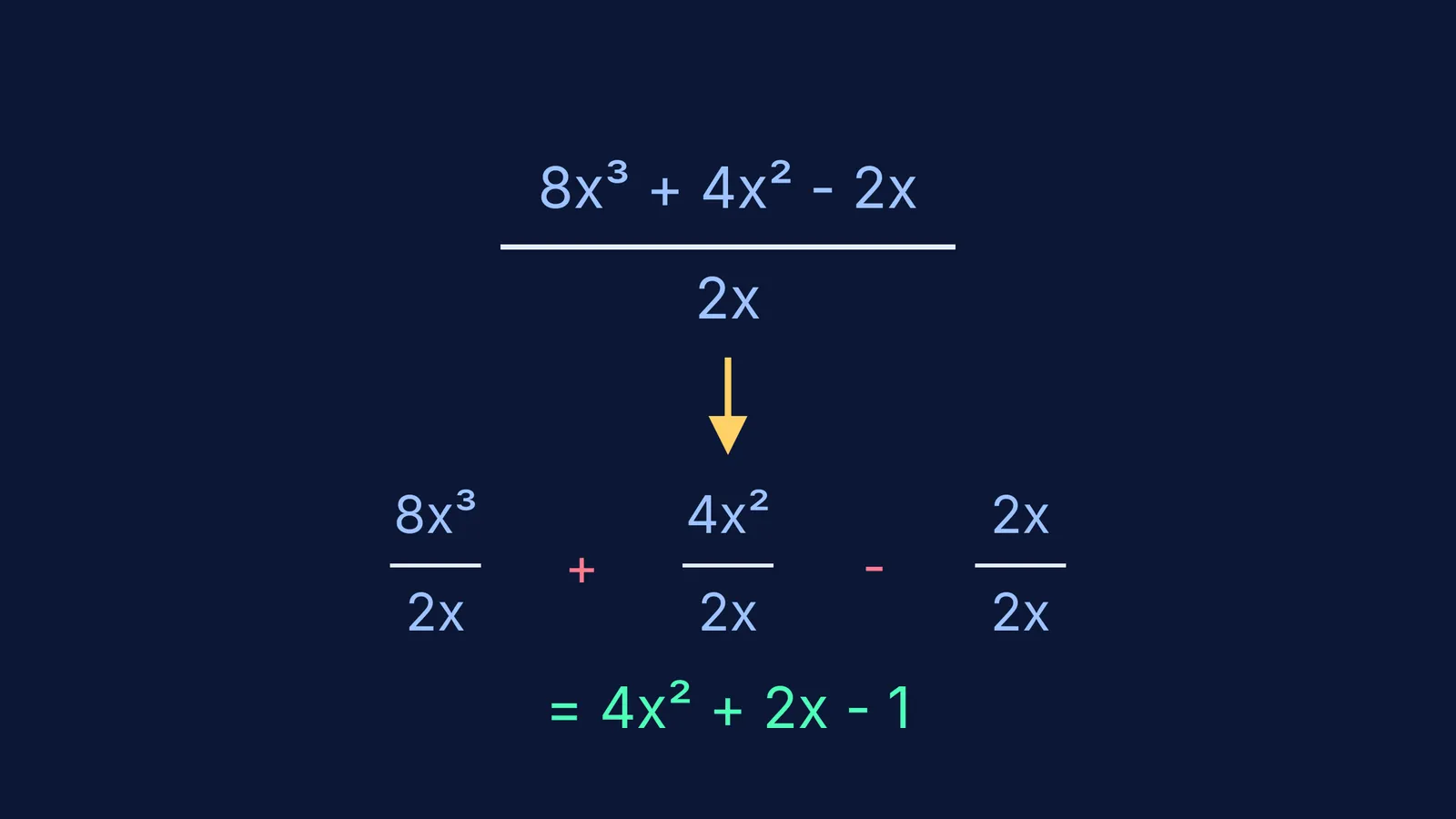
For example, to divide (8x³ + 4x² - 2x) by 2x, follow these steps:
Write the expression out as three separate fractions: (8x³ / 2x) + (4x² / 2x) - (2x / 2x).
Simplify the first term: 8 divided by 2 is 4, and x³ divided by x is x², giving 4x².
Simplify the second term: 4 divided by 2 is 2, and x² divided by x is x, giving 2x.
Simplify the third term: 2x divided by 2x is exactly 1.
When you put these pieces back together, the final answer is 4x² + 2x - 1.
Why can you not cancel across plus signs?
A common mistake in algebra is trying to "cancel" a number or variable straight out of the top of a fraction when it is added to something else.
In mathematics, you can only cancel factors (parts of a multiplication), never terms (parts of an addition or subtraction) (Paul's Online Notes). Division is the inverse of multiplication, so cancelling only works when everything is held together by multiplication.
If you have (4x + 6) / 2, you cannot simply cross out the 4 and the 2. The division by 2 applies to the 6 as well, meaning the correct simplification is 2x + 3. If you just crossed out the 4 and the 2, you would wrongly end up with 2x + 6. If you keep getting stuck on what is a factor and what is a term, the Fermi Concept Library breaks down the fundamentals of algebraic expressions so you can build from first principles.
How do you divide by factorising first?
If all the terms in your polynomial share a common factor, you can pull that factor outside a bracket first. This is called the common factor method, and it often saves time when the numbers are large.
Take the problem (15y⁴ - 10y³) / 5y²:
Look for the greatest common factor in the numerator. Both 15 and 10 divide by 5, and both terms contain at least y³.
Factor out 5y³ from the top: 5y³(3y - 2).
Your fraction is now 5y³(3y - 2) / 5y².
Because the top is now a multiplication, you can cancel safely. Divide the outside factor 5y³ by the denominator 5y² to get y.
Multiply that y back into the bracket, leaving y(3y - 2), which expands to 3y² - 2y.
If you understand Polynomials in Class 9, you will use this exact factorisation step constantly to find the roots of equations. Factoring first reduces the chances of making a sign error, because you handle the division in one single step outside the bracket.
A checklist for monomial division
When you sit down to solve Linear equations in one variable for Class 8 or tackle a long homework assignment on polynomials, keep this simple checklist in mind:
Check for common factors: Can you pull a number or variable out of every single term on the top?
Split if needed: If factorising does not clear the denominator completely, split the expression into separate fractions.
Watch the exponents: Remember that dividing x³ by x leaves x² (you subtract the powers, rather than dividing them).
Never cancel terms: Make sure you are only ever cancelling a factor that multiplies the entire numerator.
Practise splitting fractions and factorising tops until both feel completely natural. Once you master these two methods, you will stop making cancellation errors and find that simplifying complex algebra becomes a quick, routine process.


