

On this page
You see x on both sides of an equation, cross it out, and solve what is left. The working looks clean, but one root has gone missing. It is an easy way to lose marks in algebra and trigonometry, and the fix is a habit you can practise this week.
Why does dividing both sides by x lose a solution?
Dividing by x only works if x is not zero, because division by zero is not defined. So when you cancel x, you quietly assume x ≠ 0. If x = 0 is a solution, that step deletes it, and nothing later brings it back.
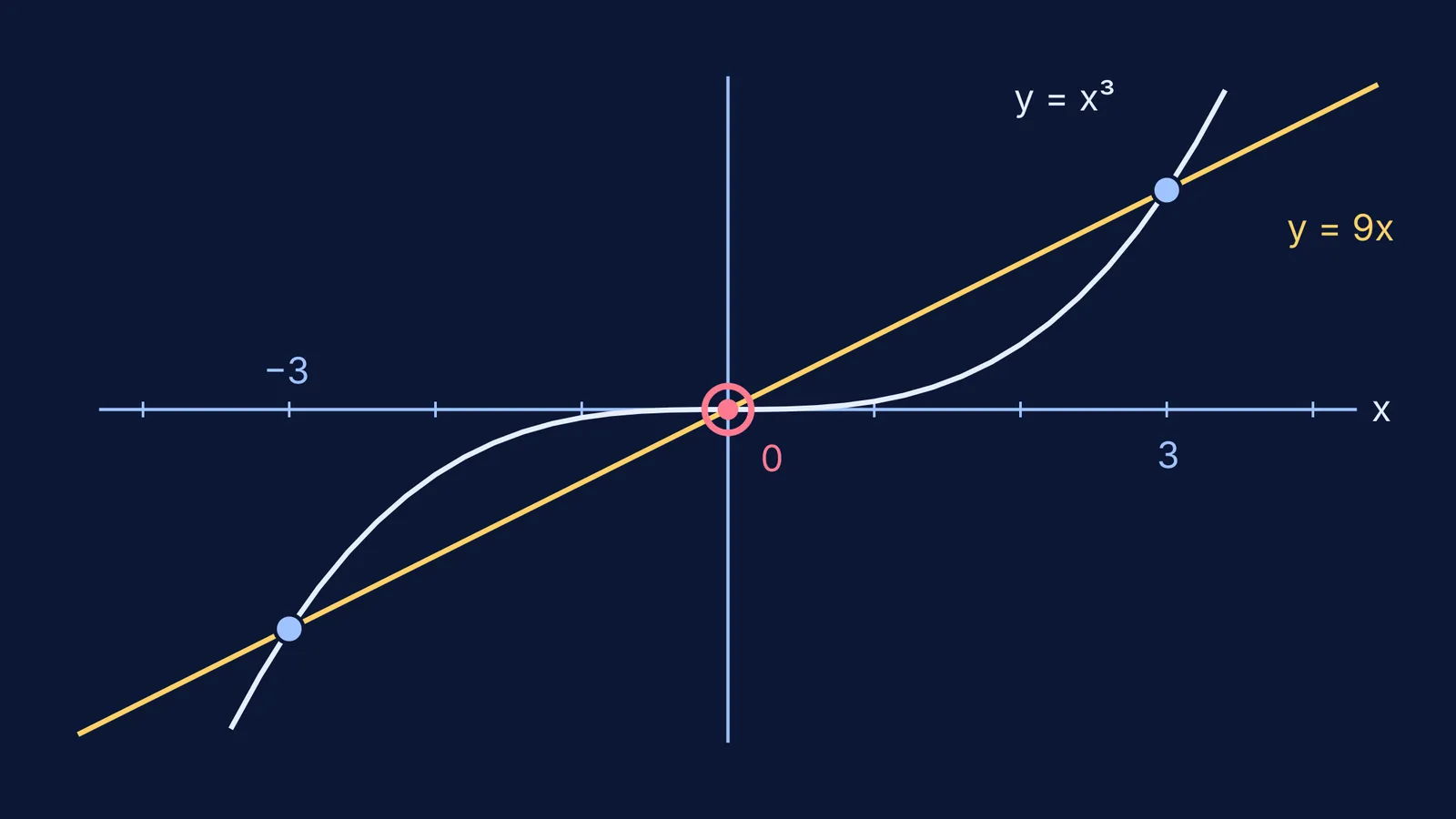
The Illustrative Mathematics task "Solving a Simple Cubic Equation" shows this with 9x = x³. Dividing by x gives x² = 9, so x = 3 or x = −3. The full solution set is 0, −3 and 3. In the task's own words, the person who divided "neglected the possibility that x could be zero". On a graph, the line y = 9x meets the curve y = x³ three times, and division throws away the meeting point at the origin.
The safe tool is the zero product property: if a·b = 0, then a = 0 or b = 0 or both (OpenStax Elementary Algebra 2e, section 7.6). It needs a product on one side and zero on the other. That is why "factorise first" works and "cancel first" does not.
How do you solve it without losing the root?
Take x(x − 3) = 5(x − 3). Cancelling (x − 3) gives x = 5, which is incomplete. Factorise first instead:
Bring everything to one side: x(x − 3) − 5(x − 3) = 0.
Take out the common factor: (x − 3)(x − 5) = 0.
Set each factor to zero: x = 3 or x = 5.
Check x = 3 in the original: 3 × 0 = 5 × 0. It is a real root.
The OpenStax chapter solves 5x² − 13x = 7x the same way: 5x² − 20x = 0, so 5x(x − 4) = 0, so x = 0 or x = 4. Dividing by x would have left only x = 4.
Does the same mistake happen in trigonometric equations?
Yes, and it is harder to spot, because sin x and cos x do not look like things you could lose. Take sin 2x = sin x.
Cancelling: write 2 sin x cos x = sin x, cancel sin x, get cos x = 1/2. From 0 to 2π inclusive, that gives only π/3 and 5π/3.
Factorising first:
Bring everything to one side: 2 sin x cos x − sin x = 0.
Factor: sin x (2 cos x − 1) = 0.
Solve each factor: sin x = 0 gives x = 0, π, 2π; cos x = 1/2 gives x = π/3, 5π/3.
Cancelling cost three of the five answers in that interval. The general solution is x = nπ or x = 2nπ ± π/3, for any integer n. OpenStax Precalculus 2e, section 7.5 treats 2sin²θ + sin θ = 0 the same way, factoring it as sin θ(2 sin θ + 1) = 0 and solving each factor.
When is dividing by a variable actually safe?
Dividing is fine once you have shown the divisor cannot be zero:
The question rules it out, for example "x > 0" or "0 < θ < π/2".
You test the zero case first. To turn sin x = √3 cos x into tan x = √3, check cos x = 0: then sin x = ±1, not 0, so dividing loses nothing.
Inequalities add a second trap: dividing by an expression of unknown sign can also flip the inequality. The wavy curve method for rational inequalities avoids this by keeping the factors and tracking their signs.
A factorise-first checklist for your next practice set
Move every term to one side so the other side is 0.
Take out every common factor, including x, (x − a), sin x and cos x.
Set each factor to zero and solve each one.
If you must divide, first test the case "this factor = 0".
Count roots against a quick sketch, as in counting roots from curve intersections.
Substitute each answer into the original equation, and reject any that make a denominator zero.
If you keep losing roots and cannot see where, the Fermi Problem Library has worked problems with a step-by-step solver that explains the reasoning, so you can compare each line with yours. If the gap is the idea itself, such as the zero product property or general solutions of trig equations, the Fermi Concept Library gives each concept its own lesson. And for why zero needed rules at all, read Brahmagupta's rules for zero, and the one he got wrong.


