

On this page
If ∫ dx/(1 + eˣ) has stopped you in a Class 12 exercise or a JEE Main paper, the fix is one line: multiply the top and bottom by e⁻ˣ. Here is the working, a quick check, and the related forms the same idea solves.
How do you integrate 1 divided by 1 plus e to the x?
Start with I = ∫ 1/(1 + eˣ) dx.
Multiply the numerator and denominator by e⁻ˣ: I = ∫ e⁻ˣ/(e⁻ˣ + 1) dx.
Put t = e⁻ˣ + 1, so dt = −e⁻ˣ dx.
Then I = −∫ dt/t = −ln|t| + C.
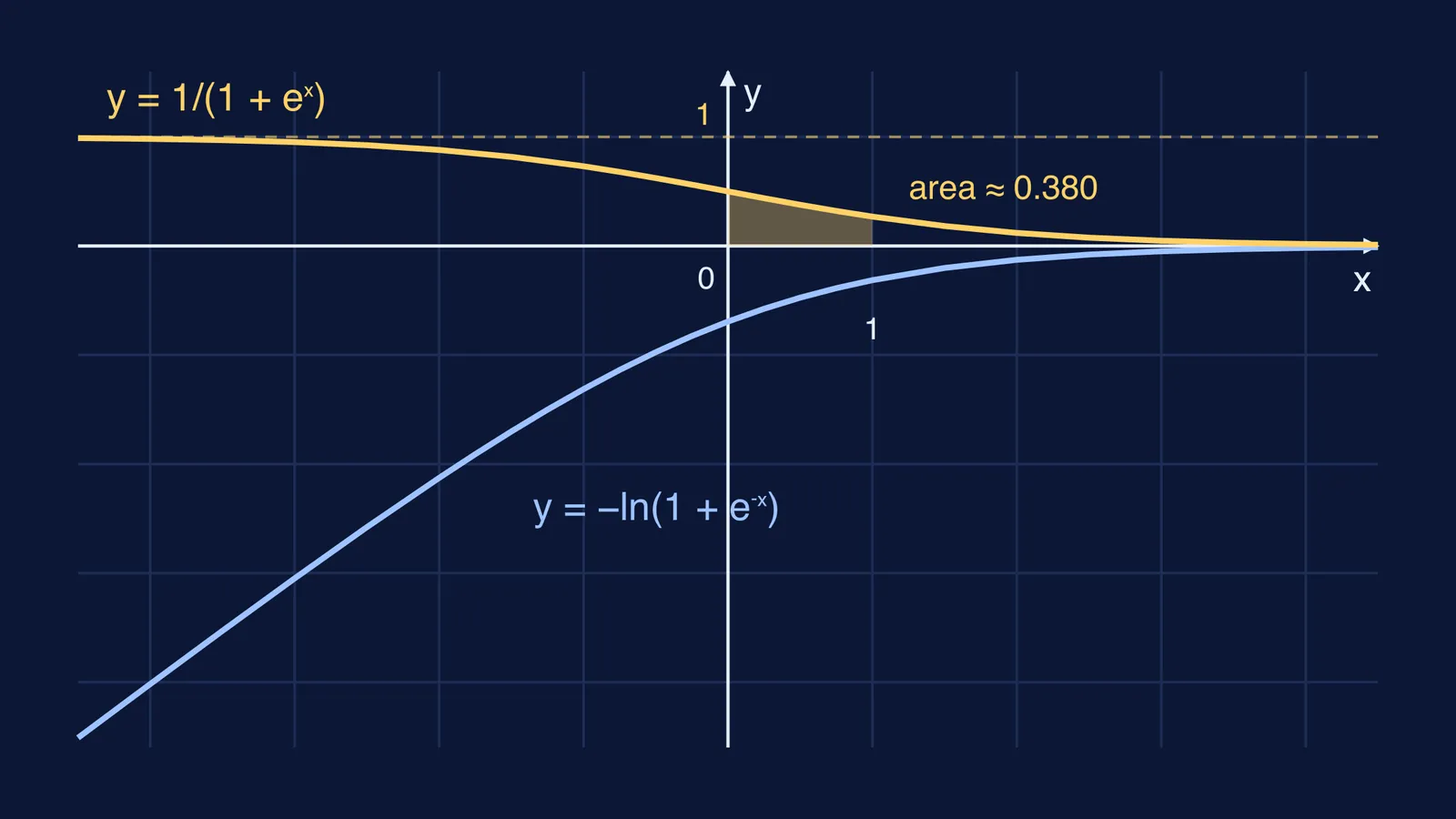
So I = −ln(1 + e⁻ˣ) + C. You can drop the modulus because 1 + e⁻ˣ is always positive.
Since 1 + e⁻ˣ = (eˣ + 1)/eˣ, the same answer can be written as x − ln(1 + eˣ) + C. MCQ options may use either form.
A second route agrees: write 1/(1 + eˣ) = 1 − eˣ/(1 + eˣ). The first term gives x; the second gives ln(1 + eˣ), because its numerator is already the derivative of its denominator.
Why does multiplying by e⁻ˣ work?
The target is the pattern ∫ f′(x)/f(x) dx = ln|f(x)| + C. It comes straight from the rule ∫ (1/u) du = ln|u| + C, which OpenStax Calculus Volume 1, Section 5.6 lists among its integration formulas for logarithmic functions.
NCERT's Class 12 integrals chapter states the habit behind it in Section 7.3.1: "Usually, we make a substitution for a function whose derivative also occurs in the integrand" (NCERT Mathematics Part II, Chapter 7). The same chapter finds ∫ sec x dx by multiplying the top and bottom by (sec x + tan x), the same kind of move you make here.
In 1/(1 + eˣ), the numerator is 1, but the derivative of 1 + eˣ is eˣ. After multiplying by e⁻ˣ, the denominator is e⁻ˣ + 1, whose derivative −e⁻ˣ matches the new numerator apart from a minus sign.
Which other exponential integrals use the same trick?
The first four become ∫ f′/f after at most one rewrite. The second and third are Questions 19 and 20 in Exercise 7.2 of the NCERT integrals chapter.
∫ eˣ/(1 + eˣ) dx = ln(1 + eˣ) + C. No rewrite needed.
∫ (e²ˣ − 1)/(e²ˣ + 1) dx: divide the top and bottom by eˣ to get (eˣ − e⁻ˣ)/(eˣ + e⁻ˣ). The numerator is now the derivative of the denominator, so the answer is ln(eˣ + e⁻ˣ) + C.
∫ (e²ˣ − e⁻²ˣ)/(e²ˣ + e⁻²ˣ) dx: the derivative of the denominator is 2(e²ˣ − e⁻²ˣ), so the answer is ½ ln(e²ˣ + e⁻²ˣ) + C.
∫ 1/(a + b eˣ) dx, with a and b positive: multiply by e⁻ˣ to get e⁻ˣ/(a e⁻ˣ + b). The derivative of the denominator is −a e⁻ˣ, so the answer is −(1/a) ln(a e⁻ˣ + b) + C.
∫ 1/(eˣ + e⁻ˣ) dx is the odd one out. Multiply by eˣ instead and you get an inverse tangent, not a log; see how to integrate 1/(eˣ + e⁻ˣ) with the eˣ multiplication trick.
There is no fixed rule for choosing eˣ or e⁻ˣ: keep the one that gives f′/f or a standard form such as 1/(1 + t²).
How can you check the answer quickly?
Differentiate it: d/dx [x − ln(1 + eˣ)] = 1 − eˣ/(1 + eˣ) = 1/(1 + eˣ). This catches a lost minus sign, an easy slip with this integral. For why eˣ survives differentiation, see our post on why the derivative of eˣ is eˣ.
For a numerical check, take the definite integral from 0 to 1: it is 1 − ln(1 + e) + ln 2, about 0.380. The integrand falls from 0.5 to about 0.269 over that interval, so an area a little under 0.4 makes sense. A negative result, or one above 0.5, means a sign has gone wrong.
A checklist for any fraction with eˣ in it
Differentiate the denominator. If it is a multiple of the numerator, the answer is a log.
If not, multiply the top and bottom by e⁻ˣ, then try eˣ. Keep whichever one makes step 1 work.
If neither works, add and subtract in the numerator, for example 1 = (1 + eˣ) − eˣ.
Put t equal to the denominator, write dt with its sign, and integrate.
Differentiate your answer to check it, and rewrite it if the options use a different form.
If step 2 does not come to you on a new integrand, the Fermi Problem Library has worked problems with a step-by-step solver that explains the reasoning rather than printing an answer. If the f′/f idea itself feels shaky, the Fermi Concept Library gives every concept in mathematics its own lesson, so you can go back over substitution first.
Next step: cover the answers above and work Questions 19 and 20 of NCERT Exercise 7.2 on your own.


