

On this page
For a point P(x, y, z), the distance from the x-axis keeps y and z and drops x. Here is why, and what changes for the other axes and the coordinate planes.
Why is the distance from the x-axis √(y² + z²)?
The distance from a point to a line is the length of the perpendicular dropped from the point to the line. Call the foot of that perpendicular F. Every point on the x-axis has the form (t, 0, 0), so F = (t, 0, 0) for some number t.
The vector from F to P is (x − t, y, z). For it to be perpendicular to the x-axis, whose direction is (1, 0, 0), their dot product must be zero: (x − t) × 1 + y × 0 + z × 0 = 0, so t = x. The foot is F(x, 0, 0), the point on the x-axis with the same x-coordinate as P.
Now use the 3D distance formula, d = √[(x₂ − x₁)² + (y₂ − y₁)² + (z₂ − z₁)²], as given in this reference on the Cartesian coordinate system. Between P(x, y, z) and F(x, 0, 0) the x-term is zero, which leaves PF = √(y² + z²).
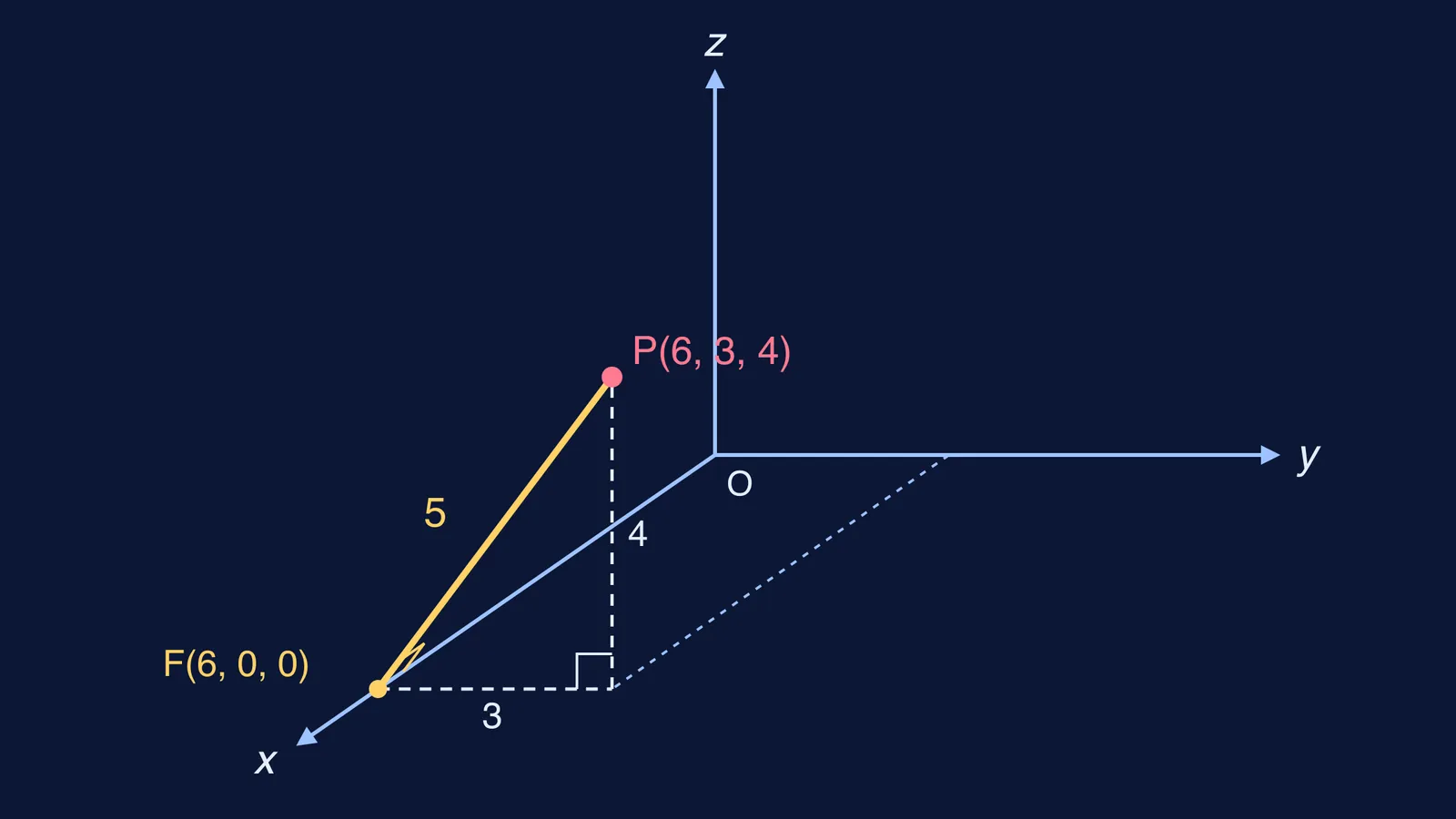
In a picture: PF is the hypotenuse of a right triangle with legs |y| and |z|.
What are the distances from the y-axis, z-axis and coordinate planes?
The same reasoning, axis by axis, gives six results for P(x, y, z):
From the x-axis: √(y² + z²), foot (x, 0, 0)
From the y-axis: √(x² + z²), foot (0, y, 0)
From the z-axis: √(x² + y²), foot (0, 0, z)
From the yz-plane (x = 0): |x|, foot (0, y, z)
From the zx-plane (y = 0): |y|, foot (x, 0, z)
From the xy-plane (z = 0): |z|, foot (x, y, 0)
The plane results are simpler still, because each coordinate of a point is its signed distance from the plane formed by the other two axes, as the same coordinate-system reference explains. Take the absolute value and you have the distance. Notice the swap: the distance from the yz-plane is |x|, not |y| or |z|.
Worked example: how far is P(6, 3, 4) from each axis?
From the x-axis: foot F(6, 0, 0), distance √(3² + 4²) = √25 = 5.
From the y-axis: foot (0, 3, 0), distance √(6² + 4²) = √52 = 2√13.
From the z-axis: foot (0, 0, 4), distance √(6² + 3²) = √45 = 3√5.
From the origin: √(36 + 9 + 16) = √61.
From the planes: 6 from the yz-plane, 3 from the zx-plane, 4 from the xy-plane.
Two quick sanity checks. First, no axis distance can exceed the distance from the origin, because the origin lies on every axis: 5, about 7.2 and about 6.7 are all below √61, which is about 7.8. Second, the squares of the three axis distances add up to twice the square of the origin distance: 25 + 52 + 45 = 122 = 2 × 61. That check works for every point, since each squared coordinate appears in exactly two of the three axis formulas.
You can also cross-check with vectors. The distance from P to a line through A with direction u is |AP × u| / |u|, a formula listed in this reference on distance from a point to a line. Take A as the origin and u = (1, 0, 0): (6, 3, 4) × (1, 0, 0) = (0, 4, −3), whose length is 5. Same answer, and this method keeps working when the line is not an axis.
Which mistakes cost marks on this question?
Using √(x² + y² + z²): that is the distance from the origin, not from an axis.
Keeping the wrong pair: for the y-axis you drop y, not x.
Writing |x| as the distance from the x-axis: |x| is the distance from the yz-plane.
Forgetting the absolute value: a point with z = −4 is still 4 units from the xy-plane.
Giving the foot as (0, y, z): that is the foot on the yz-plane, not on the x-axis.
Where does this idea show up next?
The foot-of-the-perpendicular step is the same one you use to find the image of a point in a plane, and the perpendicular-distance logic extends to the shortest distance between two parallel lines in 3D. Writing the x-axis direction as (1, 0, 0) is a direction-ratio idea, covered in angle between two lines in 3D from direction ratios.
If you can recite the formula but freeze when the line is not an axis, the Fermi Problem Library has worked problems with a step-by-step solver that explains the reasoning rather than printing an answer. For a refresher on 3D coordinates themselves, the Fermi Concept Library gives each concept in mathematics its own lesson and its place in the map.


