

On this page
When you learn dimensional analysis for physics exams like JEE and NEET, one rule is drilled into you: you can only add and subtract quantities with the same dimensions. But dimensional analysis also throws up a surprising question.
Can a quantity have a unit but no dimensions?
Yes, a physical quantity can have a unit but no dimensions. The classic examples in physics are the plane angle and the solid angle.
According to the International System of Units (SI), these quantities are classified as dimensionless derived units. They are assigned specific units—the radian (rad) for plane angles and the steradian (sr) for solid angles—to keep equations clear and track what is being measured. However, their physical dimensions cancel out entirely because they are defined as ratios of identical quantities.
If you struggle to remember the difference between base units, derived units and dimensionless quantities, the Fermi Concept Library has a lesson for every concept in physics and its place in the map.
Why is the radian considered dimensionless?
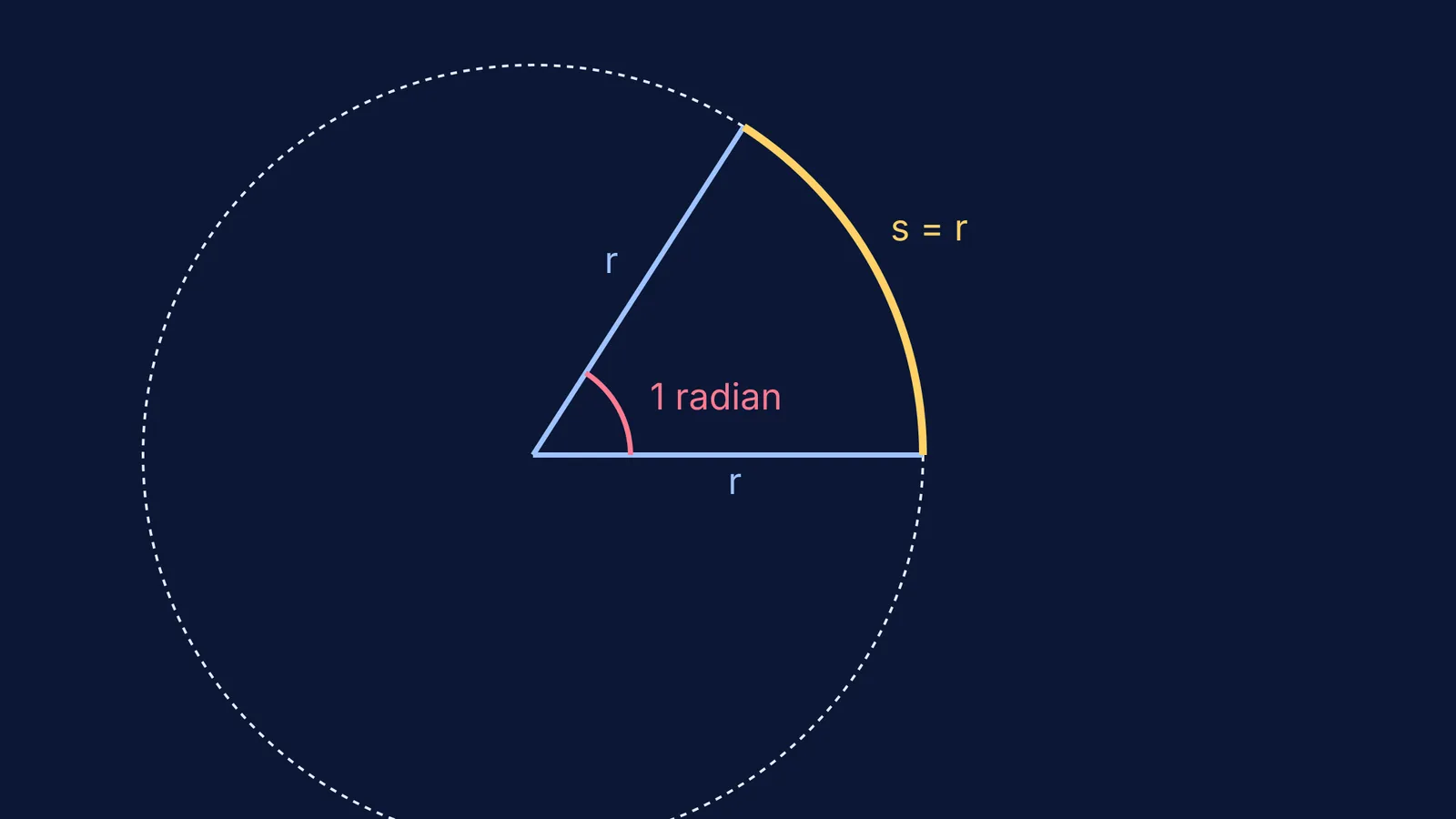
A plane angle is defined as the ratio of an arc length to the radius of the circle (s/r). Because it divides a length (measured in metres) by another length (also in metres), the dimensions cancel out, giving a dimension of 1, or [M⁰ L⁰ T⁰].
The radian is defined such that one radian is the angle subtended when the arc length exactly equals the radius. The SI formally recognised the radian as a dimensionless derived unit in 1995 to ensure consistency across physical equations.
You cannot have it the other way around. A quantity cannot have dimensions but lack a unit; if it has a physical dimension like mass or time, it must be measurable in some unit system.
The solid angle is the three-dimensional equivalent of the plane angle. It is defined as the ratio of the spherical surface area subtended by the angle to the square of the radius (A/r²). Because it divides an area (square metres) by a squared length (square metres), its dimensions cancel out to 1. The steradian (sr) is the SI unit for solid angles.
Are strain and refractive index dimensionless?
Yes, both strain and the refractive index are dimensionless quantities. Unlike the radian, they are entirely unitless in practice.
Strain is the measure of physical deformation, defined as the change in length divided by the initial length (ΔL/L). Since it divides metres by metres, it has no units. If you are calculating the stress and strain of materials, such as finding the rod elongation under its own weight, the resulting strain is a pure number.
The refractive index is the ratio of the speed of light in a vacuum to the speed of light in a medium (c/v). This is a ratio of two velocities, so the units of metres per second cancel out. When studying optics, such as the dispersion of white light by a glass prism, the refractive index tells you how much the light bends without attaching any unit to the value.
When does a dimensionless quantity need a unit?
If the dimensions cancel out anyway, why do we bother writing "radians" instead of just leaving it as a pure number? The answer comes down to clarity in physical equations.
Some physical quantities share the exact same dimensions but describe completely different physical phenomena. A classic example is angular velocity (ω) and frequency (f). Both have the dimensional formula of [T⁻¹], because the radian itself has no dimension.
However, frequency measures how many full cycles occur per second and is measured in hertz (Hz). Angular velocity measures the rate of angular rotation. By attaching the unit "radians per second" (rad/s) to angular velocity, physicists explicitly show that the quantity involves rotational motion rather than full cycles.
A similar conflict occurs with energy and torque. Both are calculated by multiplying a force by a distance, giving them the same dimensions ([ML²T⁻²]). Energy is a scalar quantity measured in joules, while torque is a vector quantity that describes a twisting force. While you could technically write torque in joules, doing so would be misleading.
How to test for units and dimensions
When studying for exams, you can use a simple checklist to categorise any physical quantity:
Write down the defining formula. For example, kinetic energy is 1/2 mv².
Substitute the base units. Mass is kilograms (kg), and velocity is metres per second (m/s).
Cancel where possible. If everything cancels out, the quantity is dimensionless.
Check for a supplementary unit. Does the SI assign a specific name to this ratio, like the radian or steradian? If so, you must use it to avoid confusion in your calculations.
If you get stuck trying to prove whether a complex formula is dimensionally correct, Fermi's AI tutor can help. Instead of just printing an answer, it holds a line of reasoning across a session, notices where a student is stuck, and decides whether to explain, ask, or show.


