

On this page
Most tangent questions run one way: here is a curve, find its tangent. This post is about the reverse: you are told what the tangent, normal or an intercept does at every point, and you must find the curve.
The Complete Dictionary of Scientific Biography describes the “inverse of tangents” as “the determination of a curve from a property of its tangent” and calls the version Florimond Debeaune posed in a letter of 16 October 1638 “the first integration problem of a first-order differential equation” (Dictionary of Scientific Biography entry, hosted by MacTutor).
Today it sits in NCERT Class 12 Mathematics, Chapter 9, Differential Equations. The CBSE Class XII Mathematics curriculum for 2026-27 lists the three methods you need (separation of variables, homogeneous equations and linear equations) and gives the Calculus unit 35 of the paper's 80 marks.
How do you find a curve whose tangent has a given property?
Use four steps every time:
Name a general point (x, y) and write the tangent's slope as dy/dx.
Translate the words into one equation in x, y and dy/dx, using the list below.
Spot the type (separable, homogeneous or linear) and solve it to get a family of curves with a constant C.
Put in the given point to fix C and pick one curve from the family.
A common slip is putting in the given point too early, so the equation collapses into a single number.
What do tangent, normal and intercept conditions turn into?
Take a point (x, y) with slope m = dy/dx. Each line comes from the point-slope form; derive it once yourself:
Tangent: Y − y = m(X − x). Normal: Y − y = −(1/m)(X − x).
Where the tangent cuts the y-axis: y − x·dy/dx.
Where the tangent cuts the x-axis: x − y ÷ (dy/dx).
Where the normal cuts the x-axis: x + y·dy/dx.
Subtangent: y ÷ (dy/dx). Subnormal: y·dy/dx. If a question says length, take the size and ignore the sign.
Slope of the line from (x, y) to a fixed point (a, b): (y − b)/(x − a).
“The normal passes through the origin”: put X = 0, Y = 0 in the normal's equation to get x + y·dy/dx = 0.
Worked example: NCERT Exercise 9.3, Question 18
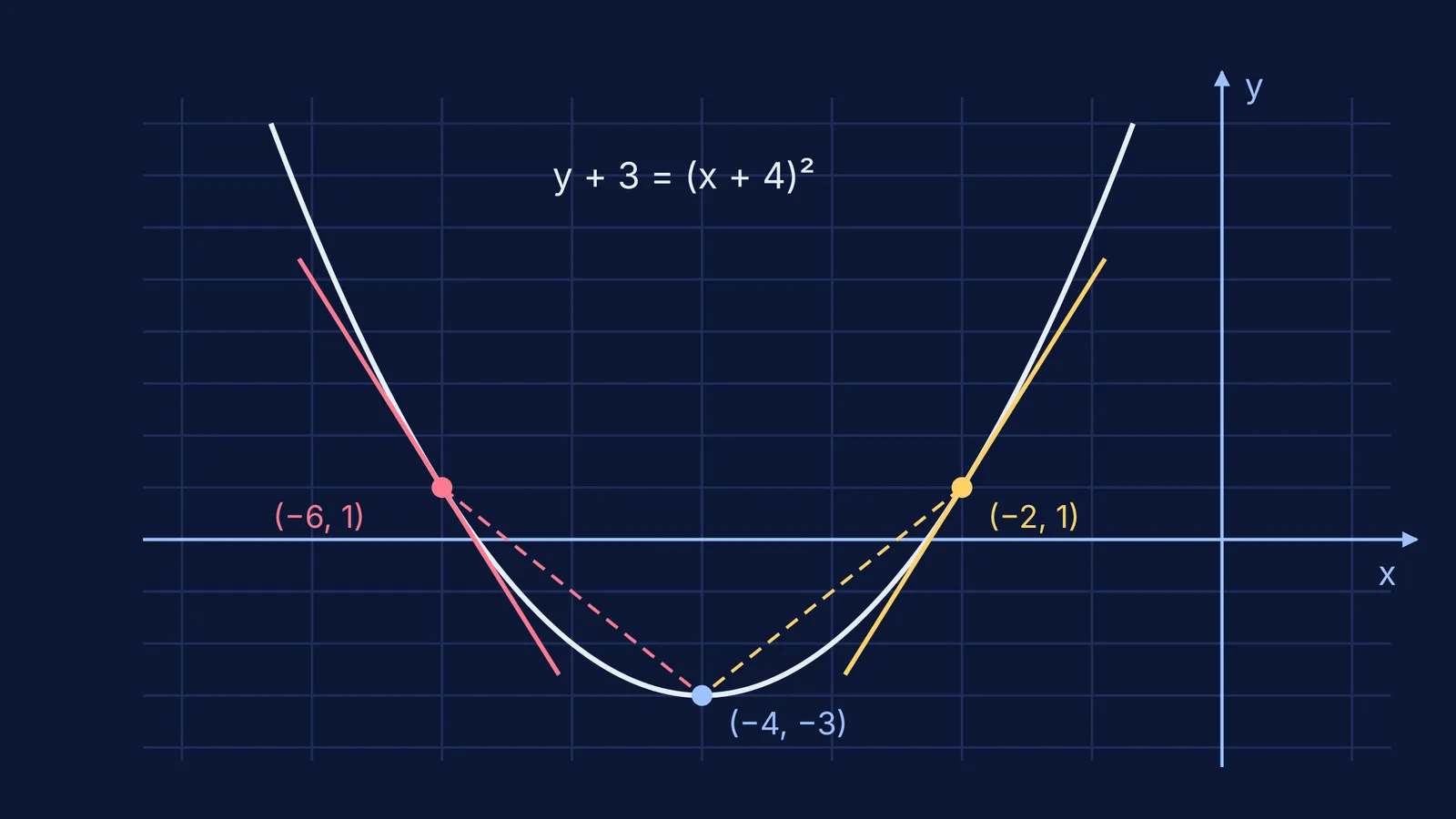
From the NCERT chapter: at any point (x, y) of a curve, the slope of the tangent is twice the slope of the line segment joining the point of contact to (−4, −3). Find the curve, given that it passes through (−2, 1).
Translate: dy/dx = 2(y + 3)/(x + 4).
The variables separate: dy/(y + 3) = 2 dx/(x + 4).
Integrate: log(y + 3) = 2 log(x + 4) + log C (both brackets are positive near the given point), so y + 3 = C(x + 4)².
At (−2, 1): 4 = C × 4, so C = 1. The curve is y + 3 = (x + 4)², a parabola with its vertex at (−4, −3).
Check it: at (−2, 1) the tangent slope is 2(x + 4) = 4, and the segment to (−4, −3) has slope 4 ÷ 2 = 2. The diagram at the top also shows (−6, 1), where the slopes are −4 and −2.
Which method do you use after translating?
The variables separate: integrate both sides.
The right side depends only on y/x (common with intercept conditions): substitute y = vx, as in our guide to solving homogeneous differential equations.
The equation looks like dy/dx + Py = Q: use an integrating factor, as in our post on linear differential equations and the integrating factor.
Try an intercept version. “The tangent at every point cuts the y-axis at a height equal to the x-coordinate” gives y − x·dy/dx = x, or dy/dx − y/x = −1. That is linear with integrating factor 1/x, so d(y/x)/dx = −1/x and, for x > 0, y = Cx − x log x.
Three quick drills:
Subnormal constant, y·dy/dx = k: you get y² = 2kx + C, a family of parabolas.
Normal through the origin, x + y·dy/dx = 0: you get x² + y² = C, circles centred at the origin.
Subtangent constant, y ÷ (dy/dx) = k: you get y = Ae^(x/k), exponential curves.
If translating feels shaky, revise how derivatives give tangents and normals, or look them up in the Fermi Concept Library, which gives every concept in mathematics its own lesson.
How should you practise these for boards and JEE?
Do five translations a day without solving them.
Check every final curve by differentiating it and putting it back.
Write log C, not C, when the other terms are logs.
Parents can help without knowing the method: ask your child to read one condition aloud and say what each phrase means in symbols.
When an answer does not match, the Fermi Problem Library has worked problems with a step-by-step solver that explains the reasoning rather than printing an answer. Pick one condition from the list above and try it tonight.


