

On this page
When a straight conductor moves through a magnetic field, an electrical potential difference develops between its ends. This voltage is motional electromotive force (EMF), given by E = Blv when the magnetic field B, conductor length l, and velocity v are mutually perpendicular.
Most students encounter this result in Chapter 6 of the NCERT Class 12 Physics syllabus. Motional EMF can be derived through two distinct routes: the microscopic Lorentz force on conduction electrons, and the macroscopic rate of change of magnetic flux through a circuit. Mastering both derivations makes moving-rod and sliding-rail problems transparent. If you are revising induction from fundamentals, the Fermi Concept Library covers every concept in physics, chemistry, biology, mathematics and computing, each with its own lesson and its place in the map.
How do you derive E = Blv from the magnetic Lorentz force?
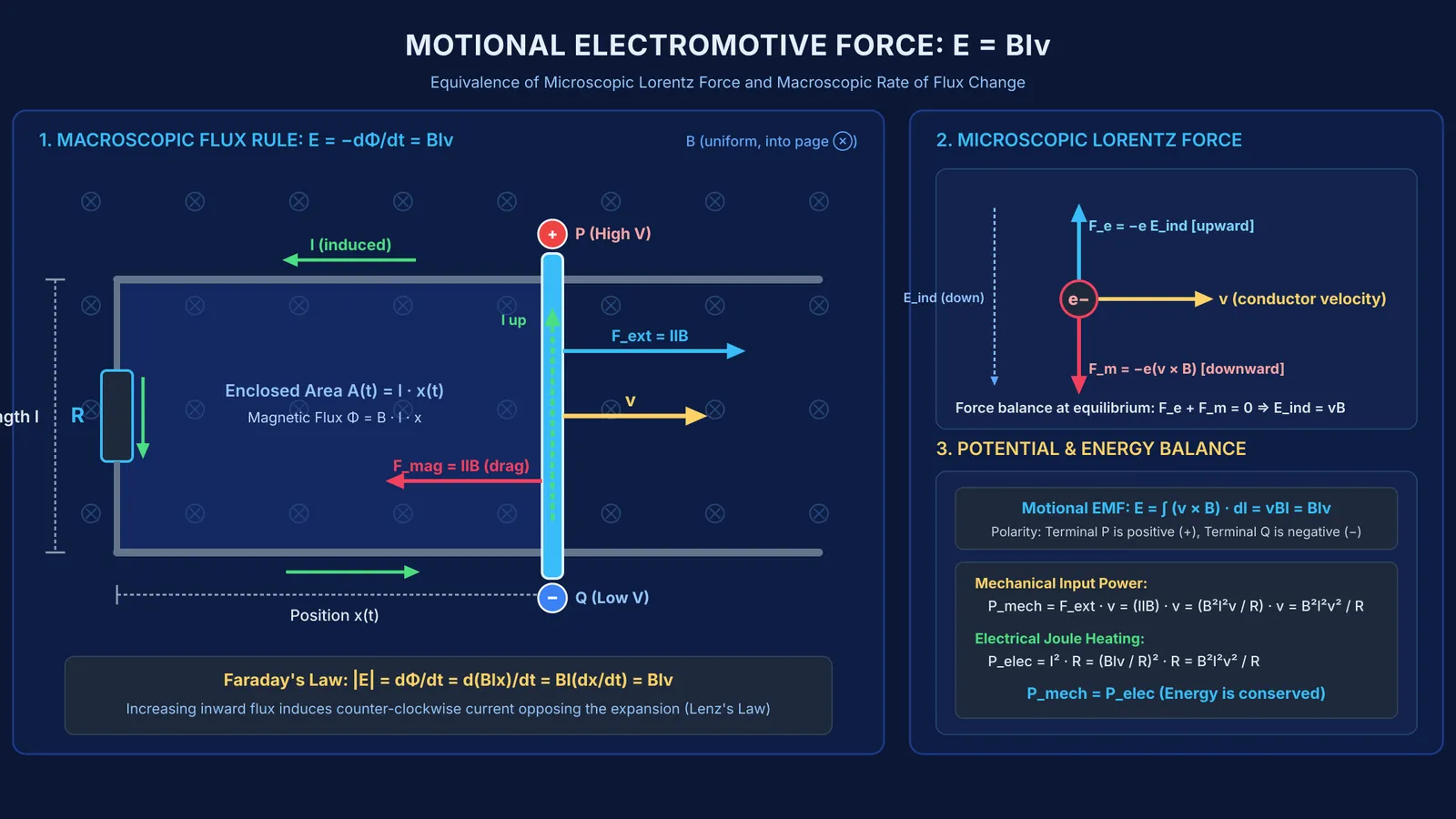
The microscopic derivation examines free charges inside the moving metal. Consider a straight rod of length l along the y-axis, moving with velocity v = v î through a uniform field B = -B k̂ pointing into the page.
Conduction electrons share the rod's velocity v. Each charge q experiences a magnetic Lorentz force F_m = q(v × B). For an electron with charge q = -e:
F_m = -e[(v î) × (-B k̂)] = -e (v B ĵ)
This downward force drives electrons toward bottom end Q, leaving positive charge at top end P. This charge separation sets up a downward electrostatic field E_ind, exerting an upward force F_e = -e E_ind on remaining electrons. Equilibrium occurs when forces balance:
q E_ind + q(v × B) = 0, giving E_ind = v B
The potential difference across length l is the line integral of force per unit charge:
E = ∫ (v × B) · dl = v B l
To avoid cross-product sign mistakes, see our guide on avoiding magnetic force right-hand-rule mistakes.
How does Faraday's flux rule give the exact same E = Blv formula?
The macroscopic derivation treats the moving rod as part of a complete circuit. Suppose the rod slides at speed v on two parallel rails separated by distance l, connected across a stationary resistor R.
At any instant, the rectangular loop encloses area A(t) = l x(t). In uniform perpendicular field B, enclosed flux is Φ = B · A = B l x. By Faraday's law, induced EMF magnitude is:
|E| = dΦ/dt = d(B l x)/dt = B l (dx/dt) = B l v
Lenz's law gives the direction. As the rod moves rightward, expanding area increases inward flux. The induced current creates an opposing outward field, circulating counterclockwise and driving current upward through the rod. You can trace related current responses in how a coil entering a magnetic field develops step-like voltage and calculating charge flow from a change in flux.
Why did Feynman call the flux rule a remarkable coincidence?
In Chapter 17 of The Feynman Lectures on Physics, Richard Feynman noted that physics uses a single flux rule, E = -dΦ/dt, to describe two distinct mechanisms:
A moving circuit in a constant field B, where EMF comes from the magnetic force F = q(v × B) on charges.
A stationary circuit in a changing field B, where EMF comes from an induced electric field given by ∇ × E = -∂B/∂t.
In the *American Journal of Physics*, Frank Munley (2004) and Igal Galili and colleagues (2006) showed that students often struggle with this distinction in sliding circuits.
Special relativity resolves the puzzle. As Albert Einstein noted in his 1905 relativity paper, whether an observer detects an electric field or a magnetic force depends on their frame of reference. In the moving rod's rest frame, the magnet moves, creating an electric field. Both views predict the same current.
How do you solve motional EMF numericals step by step?
To solve motional EMF numericals, follow this four-step checklist:
Check orientations: Confirm v, B, and l are perpendicular; otherwise evaluate E = (v × B) · l.
Identify polarity: Use the right-hand rule for v × B to locate the positive terminal.
Calculate current and drag: In a circuit of resistance R, induced current is I = E / R = B l v / R, causing magnetic drag F_mag = I l B.
Check energy balance: Verify that mechanical power P_mech = F_ext v = (I l B) v matches Joule heating P_elec = I² R.
How do you calculate motional EMF and power balance in a worked example?
According to the quantitative framework in OpenStax University Physics Volume 2, motional EMF problems require demonstrating exact mechanical-to-electrical power conservation. Consider a conducting rod of length l = 0.50 m moving at v = 4.0 m/s along rails connected to resistor R = 2.0 Ω in a perpendicular field B = 0.80 T.
Motional EMF: E = B l v = (0.80 T)(0.50 m)(4.0 m/s) = 1.6 V.
Induced current: I = E / R = 1.6 V / 2.0 Ω = 0.80 A.
Magnetic drag force: F_mag = I l B = (0.80 A)(0.50 m)(0.80 T) = 0.32 N.
Mechanical power: P_mech = F_ext v = 0.32 N × 4.0 m/s = 1.28 W.
Electrical heating: P_elec = I² R = (0.80 A)² × 2.0 Ω = 1.28 W.
Mechanical pulling power converts entirely into thermal power in the resistor.
If you struggle with circuit sign conventions, the Fermi Problem Library provides worked problems with a step-by-step solver that explains the reasoning rather than printing an answer. For guided practice, Fermi's AI tutor works out what you already know and builds a plan for the session, guiding you through each derivation step so you sit down to a clear next step.


