

On this page
A solid cylinder rolling on a plank that is itself being pulled is a classic mechanics problem. It tests whether you can connect translation, rotation, and relative motion. The trick isn't the force equations—it is writing the constraint that connects the two objects.
Here is how to set up the friction, the torques, and the no-slip condition to get the accelerations of both the plank and the cylinder.
What is the no-slip condition on a moving surface?
When an object rolls without slipping on the ground, the point touching the ground is momentarily stationary. According to OpenStax University Physics, rolling without slipping means the contact point has an instantaneous velocity of zero relative to the surface.
If the surface is a moving plank, the contact point is not stationary relative to the ground. Instead, it must match the plank's velocity exactly.
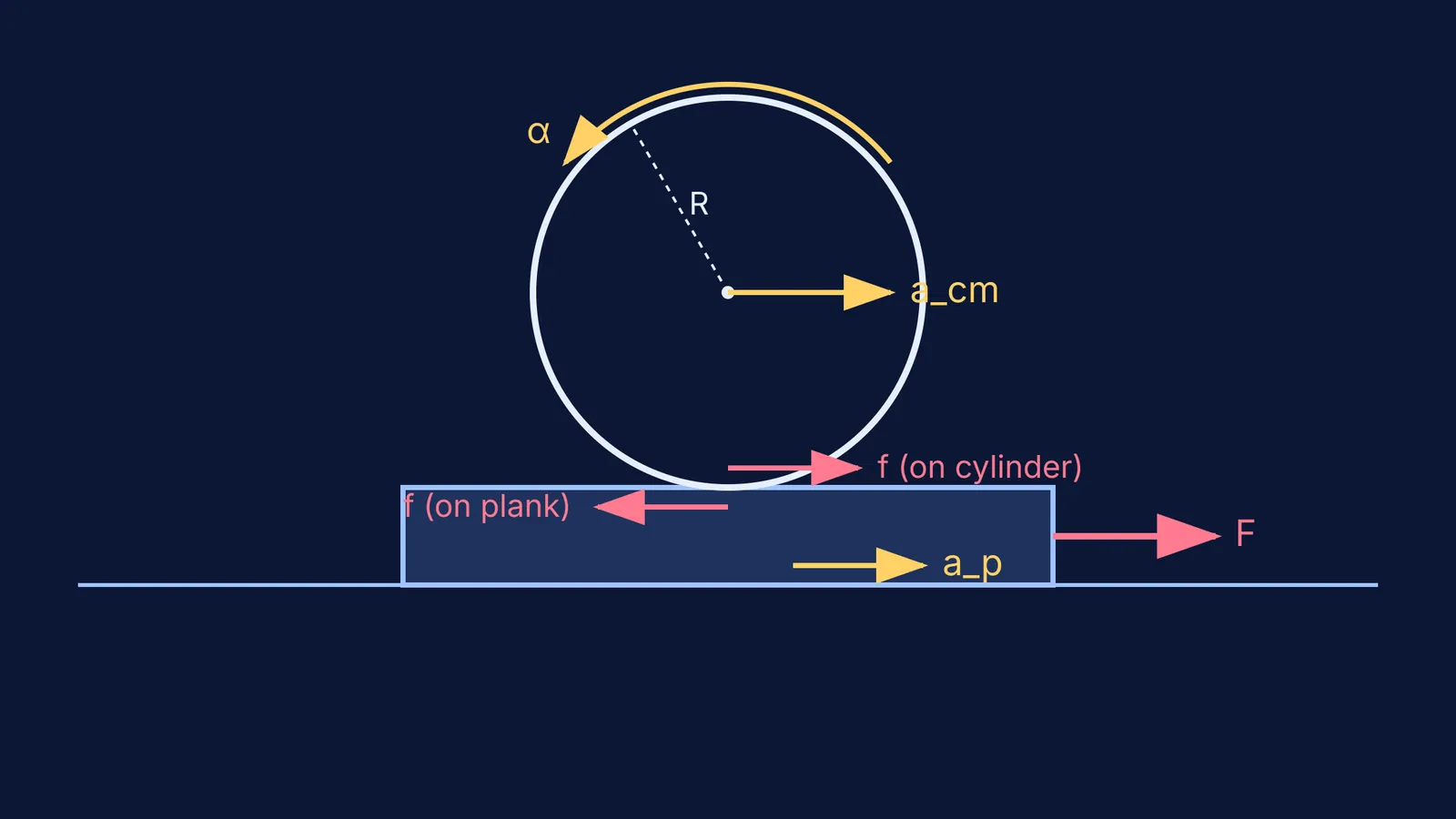
If the plank moves to the right with velocity v_p, and the cylinder (radius R) moves to the right with velocity v_cm and rotates counter-clockwise with angular velocity ω:
The cylinder's center moves forward at v_cm.
The rotation drives the bottom point forward relative to the center at ωR.
The net velocity of the contact point is v_cm + ωR.
Since this point must keep up with the plank, the constraint is: v_cm + ωR = v_p
Differentiating this with respect to time gives the acceleration constraint: a_cm + αR = a_p
This is the mathematical link you need to solve the dynamics. If you struggle to picture the relative motion of rolling objects (similar to when you test whether two projectiles collide midair), the Fermi Simulation Lab lets you watch the velocity vectors change in real time.
How do you set up Newton's laws?
Let a force F pull to the right on a plank of mass m. A solid cylinder of mass M and radius R rests on top. As the plank slides forward, it drags the cylinder with it via static friction f.
We need three equations of motion.
The plank (translation):
The forward force is F. The cylinder exerts a backward friction force f on the plank. F − f = m a_p
The cylinder (translation):
The only horizontal force on the cylinder is the forward friction f from the plank. f = M a_cm
The cylinder (rotation):
This same friction f applies a torque about the cylinder's center of mass, causing it to roll. For a solid cylinder, the moment of inertia is I = (1/2) M R². Torque τ = f R = I α f R = (1/2) M R² α
Dividing by R, we get: f = (1/2) M α R
If setting up the torque equation is where you usually get stuck, the step-by-step solver in the Fermi Problem Library will prompt you to draw the free-body diagram first and check your signs.
How do you solve for the accelerations?
Now we combine the physics with the kinematic constraint.
From the cylinder's two equations: M a_cm = (1/2) M α R
This simplifies to αR = 2 a_cm.
Notice that the angular acceleration is twice what it would be if the cylinder were rolling on a fixed ground (where αR = a_cm).
Substitute this into the moving-plank constraint (a_p = a_cm + αR): a_p = a_cm + 2 a_cm = 3 a_cm
The plank's acceleration is exactly thrice that of the cylinder's center of mass. We can now find the friction force entirely in terms of the plank's acceleration: f = M a_cm = M (a_p / 3)
Finally, plug this friction back into the plank's equation: F − (M a_p / 3) = m a_p F = (m + M/3) a_p
Solving for a_p gives the final acceleration of the plank: a_p = 3F / (3m + M)
And the cylinder's acceleration is one-third of this: a_cm = F / (3m + M)
What is the framework for any rolling problem?
You can adapt this method for spheres, hollow cylinders, or even a spool pulled by a string.
Draw the forces: Identify where static friction acts.
Write the motion equations: One for the surface, two for the rolling object (linear and rotational).
Write the constraint: Match the contact point's acceleration to the surface's acceleration.
Substitute and solve: Eliminate the angular acceleration α first, then friction f.
Whenever you are unsure if a shape will roll or slip, start with the no-slip constraint and let the algebra tell you the required friction.


