

On this page
Plants need both ATP (which provides energy) and NADPH (which provides reducing power) to turn carbon dioxide into sugar. They gather these resources during the light-dependent reactions of photosynthesis. However, the Calvin cycle—the series of reactions that actually builds the sugar—uses more ATP than NADPH. Specifically, according to the NCERT Class 11 Biology textbook, fixing one molecule of carbon dioxide requires 3 ATP and 2 NADPH.
If a chloroplast only ran a single, standard light reaction, it would quickly run out of ATP while having too much NADPH. To make up the difference and balance the energy budget, chloroplasts run two distinct versions of the light reaction: non-cyclic and cyclic photophosphorylation.
What is non-cyclic photophosphorylation?
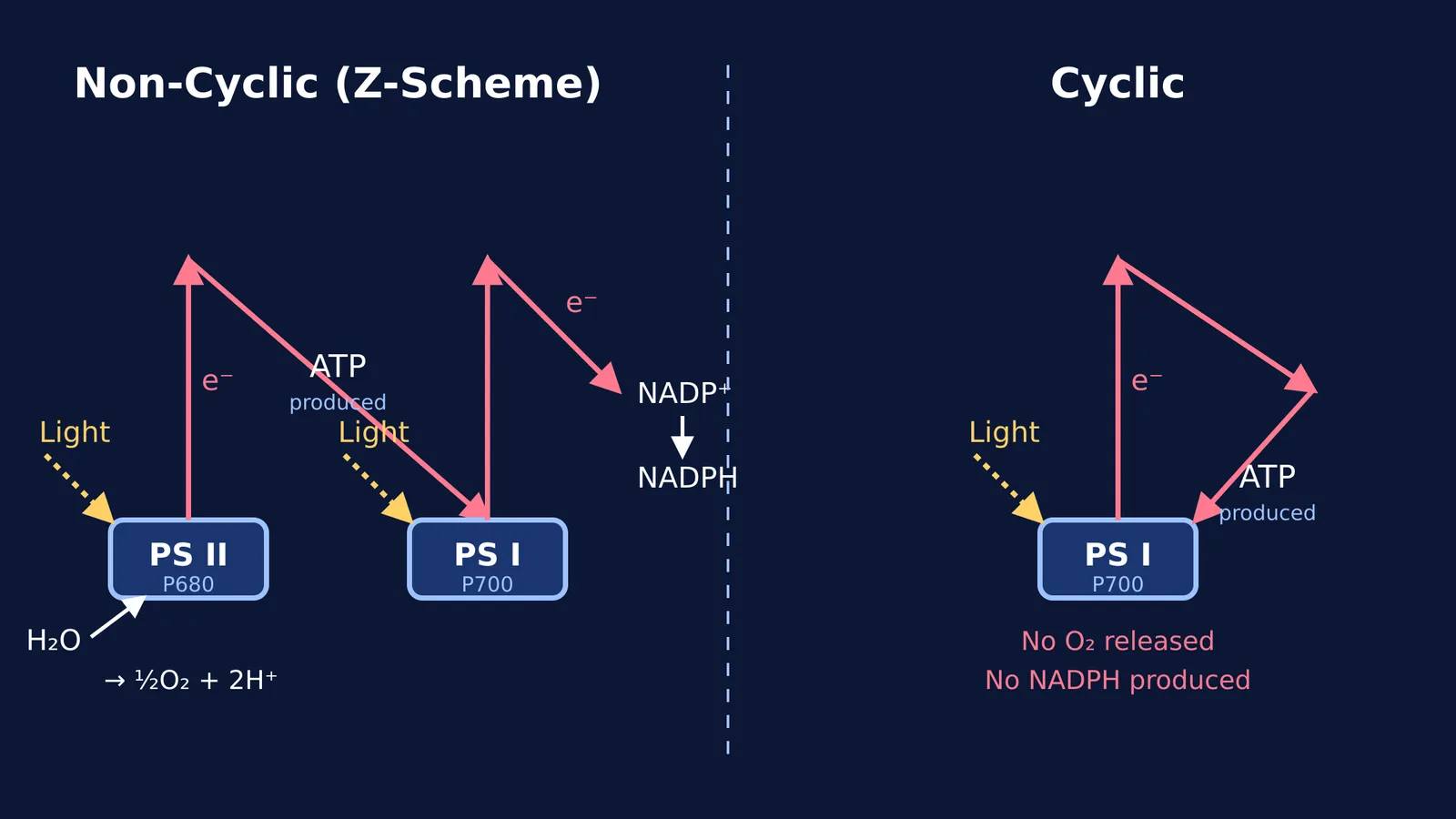
This is the standard "Z-scheme" that powers the bulk of photosynthesis. According to the NCERT Class 11 Biology textbook, non-cyclic photophosphorylation is a linear pathway that involves both Photosystem II (PS II) and Photosystem I (PS I).
It takes place in the grana lamellae, which are the stacked, coin-like thylakoid membranes within the chloroplast. The process begins when light hits PS II (specifically its reaction centre, P680). This light energy excites electrons, causing them to jump out of the photosystem. These electrons travel down a series of electron carriers—the electron transport chain—until they reach PS I (P700). After being excited again by more light at PS I, the electrons are finally handed off to NADP⁺.
This linear flow accomplishes three crucial things for the plant:
It makes ATP: As electrons move down the chain, they pump protons into the thylakoid lumen. This builds a proton gradient that drives ATP synthase to produce ATP.
It makes NADPH: The final transfer of electrons reduces NADP⁺ to NADPH.
It splits water: To replace the electrons initially lost by PS II, the plant splits water molecules in a process called photolysis. This releases protons into the lumen and gives off oxygen gas as a byproduct.
What is cyclic photophosphorylation?
Sometimes, a plant just needs to make more ATP, without generating any extra NADPH. In cyclic photophosphorylation, the excited electron from Photosystem I does not continue on to reduce NADP⁺. Instead, it circles back into the electron transport chain before returning to Photosystem I.
Because the electron runs in a continuous loop, this pathway has very different outcomes from the non-cyclic route. The cycling electrons still pump protons across the membrane to drive ATP synthesis, so it successfully makes ATP. However, because the electron never leaves the cycle, the plant does not need to split water to replace it. As a result, cyclic photophosphorylation does not release oxygen, and it does not produce NADPH.
According to the NCERT Class 11 Biology textbook, this process typically kicks in when the plant receives only light at wavelengths beyond 680 nm (which PS II cannot absorb well), or when the cell's metabolic sensors detect that the ratio of ATP to NADPH is too low.
Why does cyclic flow happen in the stroma lamellae?
The interior of a chloroplast is divided into two main membrane structures: the stacked grana thylakoids and the long, unstacked stroma lamellae that connect the different grana. The NCERT Class 11 Biology textbook highlights a key structural difference that dictates what happens where: the stroma lamellae membranes entirely lack Photosystem II and the NADP reductase enzyme.
Without PS II, the stroma lamellae cannot perform the photolysis of water, nor can they initiate the standard non-cyclic chain. Without the NADP reductase enzyme, they have no way to hand the final electron off to create NADPH.
Therefore, the only option left for an excited electron in the stroma lamellae's Photosystem I is to loop back into the electron transport chain. This structural limitation means the stroma lamellae are exclusively dedicated to cyclic photophosphorylation, serving as specialized ATP-generating zones that do not get bogged down making NADPH.
How to test your understanding of the differences?
Questions on this topic in board exams and competitive tests like NEET often ask you to match the location with the products, or to explain the biochemical reason why the stroma lamellae cannot release oxygen.
When you are reviewing, focus on the structural presence or absence of PS II and NADP reductase. If you are struggling to picture how the electrons flow between the photosystems, try the Fermi Concept Library. It maps out both the Z-scheme and the cyclic pathway step by step, and the AI tutor can explain exactly where the protons build up to drive the ATP synthase motor.
For more deep dives into plant energy, carbon fixation, and respiration pathways, you can explore:


